
Renata Birkenbuel
Special for ICT
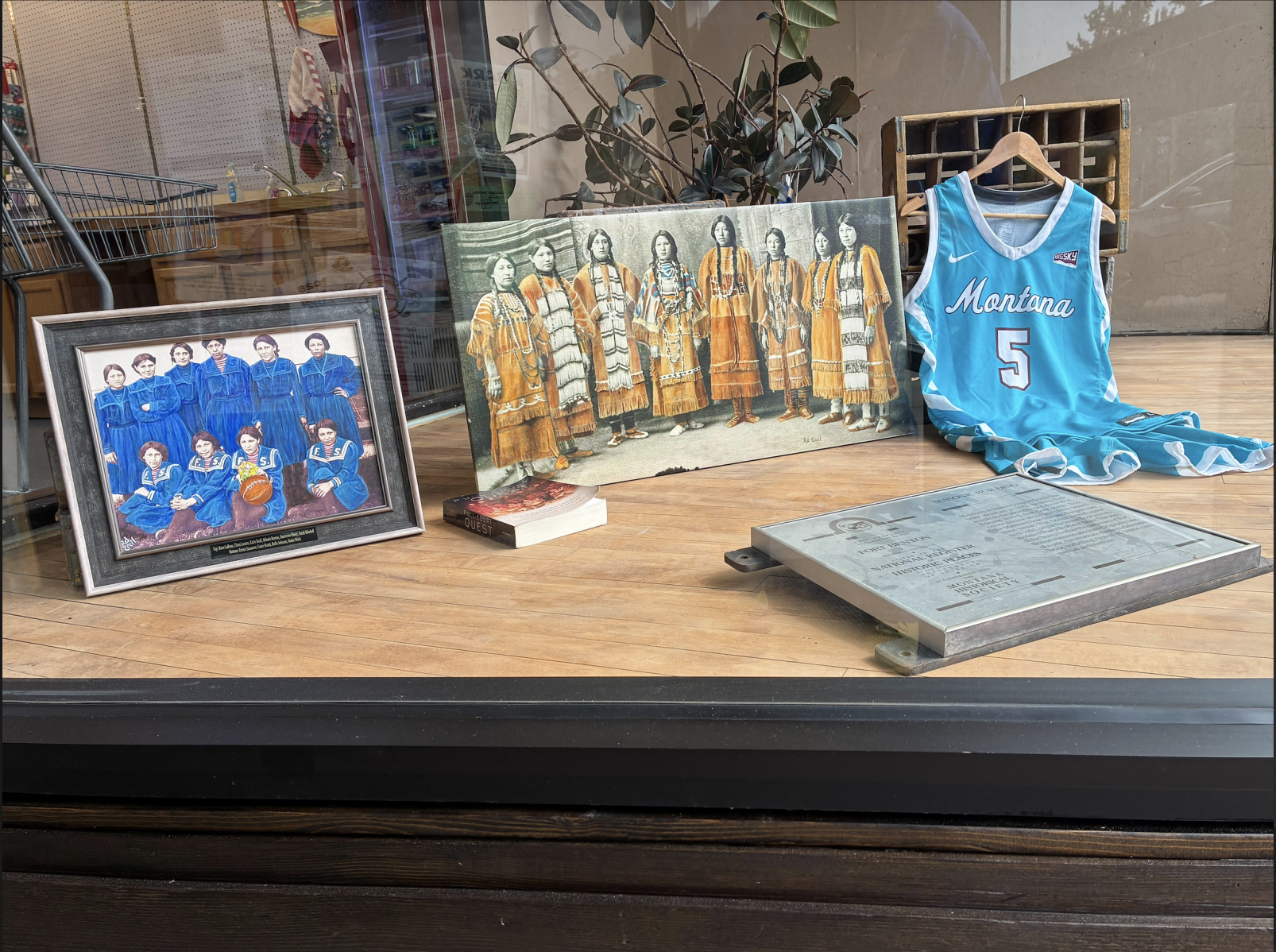
Relatives descended upon historic Fort Benton, Montana, on June 9 to celebrate their exceptional basketball-playing ancestors, a bunch of talented teenagers, champions of the 1904 World’s Fair in St. Louis, Missouri.
It was exactly 123 years to the day when the team played during a pre-World’s Fair tour of Hi-Line towns. The Hi-Line is a vast, windswept agricultural region in Northern Montana that runs primarily along U.S. Highway 2.
Among those present were descendants of the Fort Shaw Indian Girls basketball players Emma Sansaver, Metis; Genevieve Healy, Gros Ventre; Belle Johnson, Fort Belknap Indian Community; Nettie Wirth, Genie Butch, Fort Peck Assiniboine; Minnie Burton, Lemhi Shoshone; Katie Snell, Assiniboine; Flora Lucero, Chippewa; Rose LaRose, Shoshone and Cree; and Sarah Mitchell, Assiniboine; and Josephine Langley, Blackfeet.
Descendents of Fred Campbell also made the trip to Fort Benton to honor their ancestor, a former Poplar, Montana, school superintendent who successfully promoted and guided the team as the head coach. Campbell’s vision proved a remarkable achievement for a game that started in Montana in 1897 at Fort Shaw, according to prolific Montana historian Ken Robison.
Michele Dann Hernandez of Fort Hall, Idaho, and great-granddaughter of shooting phenom Minnie Burton, attended with her son Derick Hernandez and grandson Kiren. She blessed all with sage, which burned strong as it whisked along the constant Montana breeze during greetings in green, magnificent cottonwood tree-studded Levee Park.
“I’m burning the sage today in honor of the ladies of Fort Shaw,” said Michele Hernandez. “We want to send a message … they set a precedence for basketball. It’s a great honor to be here to burn this sage to send good blessings to everyone in Fort Benton.”
Minnie Burton was known as a hot shooter during the half-court playing days of old. Fans at games often shouted, “Shoot, Minnie, shoot!”
The girls, ranging in age from 15 to 19, hailed from their homes around Montana and the region. They became much-adored title holders of the eye-opening World’s Fair 122 years ago far from the wind-blown confines of the Central Montana boarding school, which housed boys, too, in Fort Shaw.
Michele Hernandez grew up in Fort Hall, Idaho with ICT’s own editor emeritus, Mark Trahant, who traveled to Fort Benton to honor his great aunt, player Genie Butch.
The year 1904 is a far cry from 2026, but the Fort Benton gathering was one of at least three reunions in the past 22 years for families of the athletic girls who represented not only Fort Shaw, but also Montana, the region and eventually, the nation.
Overall, about 100 visitors took in the speaking, sharing and museum events throughout the day in Fort Benton.
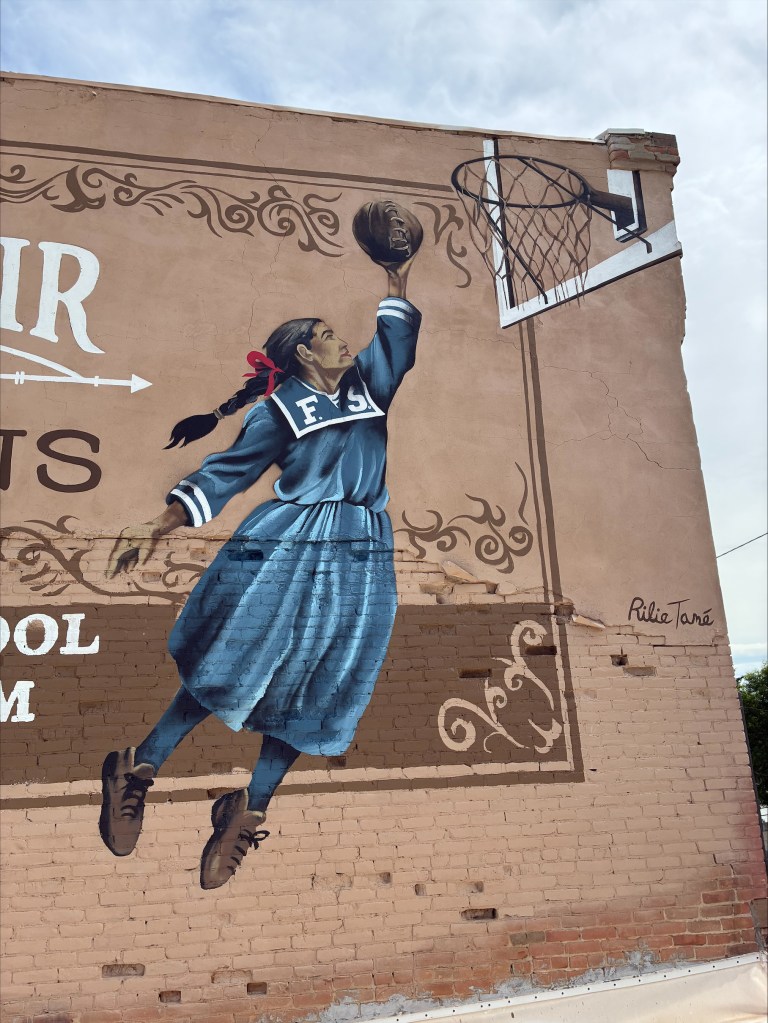
The highlight was the official unveiling of a gigantic original mural painted on the side of the still-standing, second-floor, ballroom-type space where the girls played. The original 1882 wooden floor, housed in a long, narrow, tall former opera hall, still holds true above the modern-day Benton Pharmacy.
Muralist Rilie Tane, Chippewa Cree/Metis, designed the stunning mural with Destination Fort Benton committee member Joellyn Clark. Over five days, Tane used a boom lift and a mixture of acrylic and spray paint to fashion the mural, representative of a Native player in the early 1900s rather than a true individual likeness.
“I was honored to be trusted with a mural that honors the Indigenous culture, with my family being Indigenous,” said Tane, who lives in Billings. “And the Facebook page with all the families being so happy about it.”
As part of an $1.25 million Pilot Community Tourism Grant Program for rural communities that the Montana Department of Commerce awarded to bolster overall tourism, the celebratory day cost a mere drop in the bucket. A seven-member volunteer committee spent $8,500 on the mural and about $2,000 to host guest speakers, according to Destination Fort Benton President Shannon Walden.
“It was a huge success for a very small amount of money,” said Walden.
Destination Fort Benton organized the event with help from lay researcher Ardis Cecil and renowned Montana historian Ken Robison.
Cecil, Assiniboine of the Red Bottom Band and enrolled member of the Fort Peck Tribes, attended school in Poplar. She is a promoter of the team as the pocket of descendants continues to grow. She is a descendant of Nettie Wirth and grandmother/team chaperone Lizzie Wirth.
The afternoon session at the Ag Museum elicited many tears among descendants.
“We can feel it in our bones today,” said Linda Peavy, co-author of the 480-page encyclopedic tome, “Full-Court Quest: The Girls from Fort Shaw Indian School Basketball Champions of the World.”
“It is your responsibility to carry on the story,” Peavy told those gathered. Her co-author, Ursula Smith — both Vermont residents researching in Montana — died in 2021. Peavy now lives in Bozeman.
Descendant Margo Schinadle, enrolled in the Fort Belknap Indian Community, is the great-great-great niece of player Gen Healey and the great-great granddaughter of player Katie Snell. Her eyes welled with tears as descendants in the crowd were introduced.
Mary Lynn Lukin, Blackfeet, spoke about her ancestor Belle Johnson, and the three replicas of the original 1904 World’s Fair Championship trophy.
Lukin said the original trophy “is with a family member, but we don’t know where,” adding that Belle Johnson’s great-granddaughters displayed it at an initial gathering in 2009. “Then it disappeared.”
The original trophy and the documentary, Playing For The World: 1904 Fort Shaw Indian Girls’ Basketball Team, debuted to great acclaim at The History Museum in Great Falls, where descendants, Peavy, Smith and history buffs filled the room on Feb. 19, 2009.
Robison bought a replica of the original 1904 St. Louis Fair championship trophy on display for $1,000. Larry McDowell, husband to Janice Swingley McDowell, a Belle Johnson descendant who grew up on the Blackfeet Reservation, took it upon himself to commission two other nearly similar trophies for the descendants’ organizing group.
Lukin, led the creation of a 2004 commemorative event in Bozeman and a 2024 gathering of descendants in Fort Shaw, where a granite displays players’ names below an arch near the old school.
The players hailed from their homes in the West region: Fort Belknap, Fort Peck and the Blackfeet Reservation in Montana, Eastern Washington, Northern Wyoming and Idaho.
If Cecil, collaborator, historian, organizer and former Poplar resident, had her way, fans and descendants would recreate the 1903 exhibition Hi-lineHighline Tour that preceded the 1904 World’s Fair in St. Louis, Missouri.
On June 10, the day after the Fort Benton celebration, Cecil, Peavy and the local committee spoke at the Rocky Boy Youth Center, where they shared their historical knowledge of the team, tour and descendants. Rocky Boy had been on the original exhibition tour of 1903.
“The real question for our two non-Native white women who stand for everything the Natives lost, as well as what they gained, was to know if the story was ours to tell,” said Peavy. “That was the biggest thing. How could we not tell it?”
She and Smith originally stumbled upon a photo of the team while researching frontier women for another project in Helena, prompting them to jump on the historic basketball project that continues to attract more descendants.

