
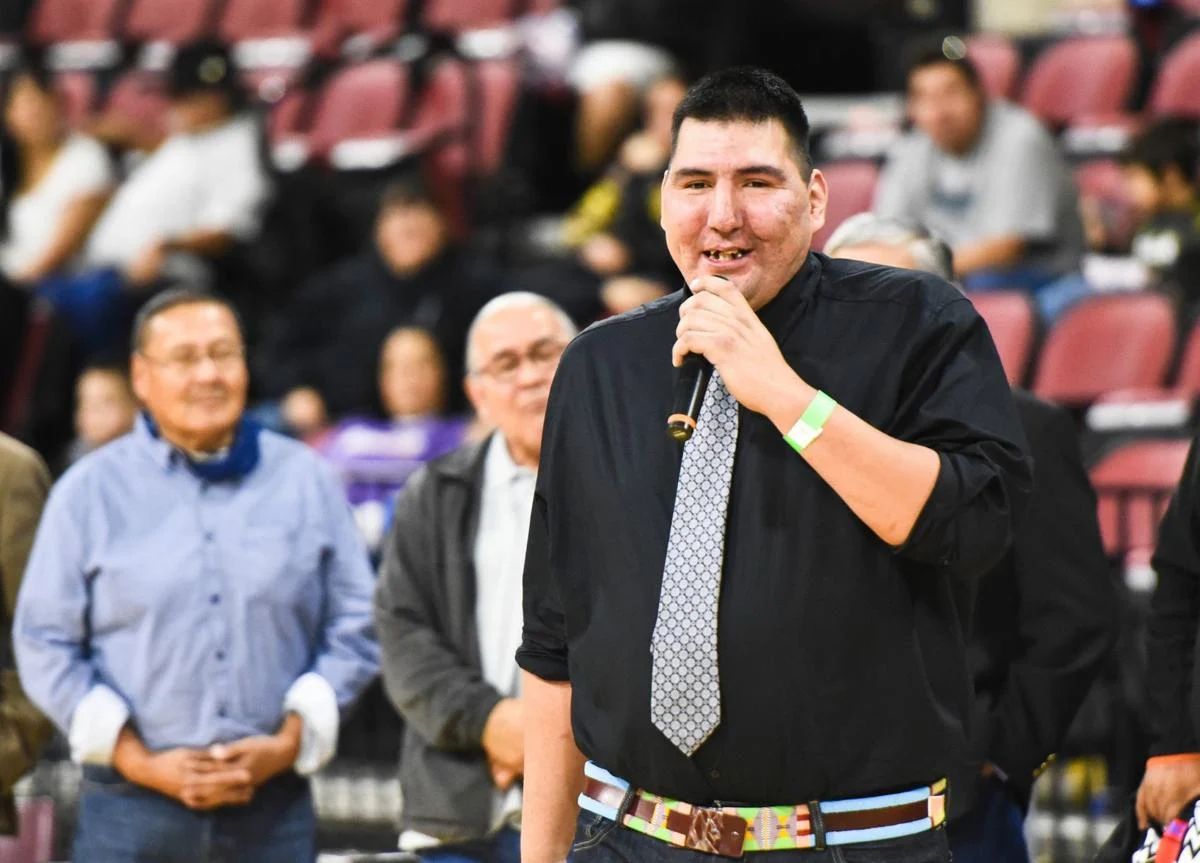
Editor’s note: This story is part of three-part series by Lee Newspapers on perceived anti-Native bias in high school basketball in Montana.
Jeff Welsch and Nora Mabie
Lee Newspapers
BOZEMAN, Montana — With the scoreboard clock reading 4:32, in the final quarter of a game that still reverberates around Montana high school basketball two years later, a disconsolate boys team from Rocky Boy had finally heard one too many antagonistic whistles.
After a fifth technical foul, including a second on junior guard Benji Crebs for “flopping” and a second on Stars coach Adam Demontiney for arguing, the entire team walked off the Malta High School court. For Rocky Boy, a team comprised of Native American players, it was a breaking point — emotions that boiled over on a Hi-Line winter night but in truth have simmered in Indian Country for more than a century.
To the Stars, the outcome was another painful reminder of a conviction held by Natives across Montana and, indeed, all of America: Historical racism permeating a bastion of passion and self-esteem, the basketball arena, in the form of biased officiating.
Crebs received his first technical — a foul related to sportsmanship, more egregious than common or personal fouls for routine physical play — moments into the game for slapping a backboard while trying to block a shot, a legal move that can be whistled if deemed overly emphatic.
“So that’s how we already knew, like, ‘Oh, it’s gonna be one of those games’,” Crebs tells Lee Newspapers and 406mtsports.com two years later. “Then it got really out of hand going down the line.”
Later, teammate Joe Demontiney received a “T” for “flopping” as well. Then came Nos. 4 and 5, after Crebs released a 3-point shot and fell to the floor as an onrushing defender initiated contact. Adam Demontiney protested and was hit with his second technical, an automatic ejection that sent him to the showers with Crebs and the team in defiant lockstep.
After the game, a 62-47 Malta victory, Crebs spoke for Indigenous people from Alaska to Florida when he posted on his Facebook page, “It was not acceptable tonight. Being a Native kid, we should already have the mindset that we ain’t gonna get the benefit of the doubt ever.”
When word of the debacle reached veteran Blackfeet official Alvin Yellow Owl in Browning, he cringed.
Yellow Owl, a former state-champion player for the Runnin’ Indians, examined the game’s dynamics — Native squad visiting a non-Native team, an increasingly chippy rivalry atmosphere, both head coaches in the ears of three inexperienced referees, Native players growing inconsolable in an environment that represents a refuge from reservation burdens while preserving a vestige of their historic warrior spirit — and saw inevitable combustion.
“Almost like a bottle ready to blow,” Yellow Owl says now.
Upon further review with other referees, both Native and non-Native, Yellow Owl concluded the drama was fueled partly by the grouping of two second-year referees and one rookie official. The lack of experience was, he lamented, the unfortunate result of a shrinking referee pool.
Regardless, Yellow Owl knew, the damage was done. Yet another cultural wound reopened despite ongoing Montana High School Association diversity-training efforts in response to similar tensions a decade earlier.
Malta-Rocky Boy was the latest flashpoint for a perception that has festered since Natives were introduced to the modern-day version of basketball at Indian boarding schools more than a century ago.
“My relatives talk about it all the time,” said Darin Williams (Crow), a Fresno, California, referee whose family is from Wyola. “The top-rated games, where they do championships at the Metra (Billings), those are very well-officiated. It’s those outlier games I’ve noticed that, for lack of a better term, are one-sided, especially when Indian schools go into non-Indian areas.”
Adds Cameron McCormick, Crow, who coached the girls team at Lame Deer this past season but also has had stints guiding Native teams at Rocky Boy and Northern Cheyenne and a non-Native boys team at Absarokee: “I would say if you were to do a survey on the reservations, 90 to 95 percent of the results would say there is at least to an extent some racial prejudice in Montana high school basketball games.”
Some Natives have even scoured old scorebooks and newspaper scoreboard sections to prove it.
In the mid-1980s, Crow coaching legend Gordon Real Bird Sr. tallied up 10 years of fouls for Lodge Grass games. He discovered his Runnin’ Indians were whistled for more than opponents in nine of those seasons. His findings were subsequently published in The Billings Gazette.
“You might say the s**t hit the fan,” Real Bird recalls now with a laugh. “When we played in White communities, we accumulated an ungodly number of fouls and they shot an ungodly number of free throws. It was a pattern. Boy, were they (officials) up in arms, but my statistics … they couldn’t argue that when it was the truth. I got myself in hot water, but I didn’t care.”
Eleanor YellowRobe, who is Fort Belknap Aaniih and now a Rocky Boy resident, did similar research for a University of Montana journalism class paper in 2005. After her 11-year-old son glanced at the scoreboard during a Stars road game against a non-Native team and marveled, “Look mom, we have more fouls than they have points!” she decided to scan a year of Great Falls Tribune box scores to see if they’d validate her instincts.
They did.
“There was a big gap in the foul spread,” remembers YellowRobe, adding her initial submission was rejected as “too emotional”. “It was a real rare statistical anomaly when it was very close. Numbers and stats don’t lie. They can be misinterpreted, but they don’t lie if you’re being truthful.”
Therein lies the rub. Numbers don’t lie, but they beg closer inspection of a multi-layered issue.
Does overt racism exist? Natives and non-Natives alike interviewed for these stories agree that barely a generation removed from an era of “No Dogs, No Indians” signs tarnishing storefronts in reservation border towns, it’s folly to suggest high school gyms are immune.
Such convictions are reinforced when a public-address announcer calls the Browning Lady Indians the “Lazy Indians”, or multiple signs in the same arena read “FTI!”, or entire Native teams are shut out of convenience stores, or Native fans believe they were barred from a gym, or a student section makes monkey gestures when a Native player dribbles, or a radio talk-show host suggests separate state tournaments for Native teams because their supporters are inherently unruly.
All these episodes have occurred in recent years, one in the last month.
“Sports reflects and intensifies all the good and the bad,” said Wade Davies, University of Montana professor of history and Native American Studies and author of “Native Hoops: The Rise of American Indian Basketball, 1895-1970”. “If there’s racism and tension within the community, it’s going to show up on the court, and it’s bound to show up in officiating because they’re humans.”
Says Rocky Boy superintendent Voyd St. Pierre: “This is a well-known topic in our community. I’ve heard it many times in community meetings, in tribal council meetings. The sentiment is still strong, and I would relate it to the ongoing discrimination that continues to happen across our area and how our community is treated in general.”
More systemic is what many say is a bias against Natives’ style of play, popularly called “rez ball”, and what it symbolizes.
Predominantly non-Native rural schools tend to prefer a more structured, half-court, methodical, inside-out game. Natives favor an unfettered, full-court, aggressive, perimeter-shooting approach — a stark contrast initially embraced in part, Davies said, as a rejection of the old “Kill The Indian, Save The Man” assimilation ethos at boarding schools.
Complicating the perception: rez ball’s relentlessness naturally lends itself to more fouls.
Further, when two Native teams play and the referees are from a Native pool in, say, Browning or Crow Agency, Native officials say they’ll tend to call a looser game matching their style but not always by the book. When Native teams travel to play non-Native teams with non-Native officials, tighter whistles can be construed as bias.
“It doesn’t help that we play totally different styles,” said former Heart Butte and Browning star Mike Chavez, Crow, who played for the Griz and now is an assistant coach at Hardin. “You’ve got officials who’ve never officiated Native games. Some might come in with an agenda, but that’s a very small sample — the bad apples. And if you press the whole game, the fouls are going to come.”
Many Native coaches and players also, while lamenting those “bad apples,” simply say Native teams must hone facets of their game.
“The environment we grew up in made us believe and think (bias), but as I got older I believed as Natives we need to play better defense,” said White Shield (N.D.) coach Shaun Knife, whose team played in the All-American Indian Shootout in Billings.
“Push all that aside and play the way it’s supposed to be played. We’re really aggressive and go for the ball. We play rez ball all the time. But you’ve just got to be able to adjust to personnel and refs the way the game sees fit.”
Even so, perceptions of anti-Native bias are so deeply engrained and can be so charged that the MHSA candidly acknowledges the challenge.
“For us it’s a huge, huge issue,” says new MHSA executive director Brian Michelotti, who can rattle off a list of efforts to combat perceptions while conceding much work remains.
How to solve the issue is the million-dollar question.
Or, as Jay Lemelin, who is non-Native and supervisor of officials for the Billings pool, put it with a chuckle:
“I’d say it’s a two-million-dollar question.”
Refuge for Native students
In 1904, 13 years after Dr. James Naismith nailed the first peach basket to a gymnasium pillar, his methodical “basket ball” looked scarcely like the varieties of “ball game” Indigenous cultures had fancied for time immemorial.
A group of high school-aged girls at Montana’s Fort Shaw boarding school was among the first Native teams to showcase the contrast, starting in 1897. The barnstorming squad free-wheeled “here and there with the rapidity of lightning”, as one writer marveled, ultimately winning an unofficial championship at the St. Louis World’s Fair.
“They did it so differently and the whole idea of Minnie Burton just shooting whenever she had the ball blew people away,” said Mark Trahant, Shoshone-Bannock, an editor at large for ICT whose great aunt, Genie Butch, played for Fort Shaw.
At boarding schools, basketball transcended recreation. Within the 94×50-foot confines of a court, the sole setting where authoritarian oversight was lax due to understaffing, Davies notes, Natives recaptured a semblance of historic freedoms.
“It was something that was kind of a refuge for a lot of students within the school — a positive force for them in an otherwise traumatic environment,” he said.
When students returned to reservations, the re-invented game came with them. Rims appeared seemingly overnight on every telephone pole, backyard post and playground in Indian Country.
Natives played with breathtaking zeal.
“What is the king sport in Indian Country? It’s basketball. Basketball, basketball, basketball,” Rocky Boy’s St. Pierre said. “It’s a vital part of every Native community in Montana.”
Davies submits that rez ball’s contrasting style was not only a rejection of assimilation, but an adaptation to early basketball bias as well.
“If officiating was biased, relying more on speed and agility and shooting from the outside might also have been a way to compensate for the fact that fouls were going to be called on you more often,” he said.
Many Naismith purists dismiss “rez ball” as undisciplined.
Natives chafe at the narrative.
“They call it run-and-gun Indian basketball, but I put a lot of structure into my programs,” Real Bird counters. “It’s not just running up and down with no plan or discipline. We know what we’re doing out there.”
Author Shann Ray Ferch, the younger half of the frenetic “Flying Ferch Brothers” when he and Kral thrived playing rez ball at Livingston’s Park High in the early 1980s under their father, Tom, also disabuses the notion. Ferch, who is non-Native and a professor of leadership and forgiveness studies at Gonzaga, played with some of Indian Country’s mystical greats when his father coached on the Crow and Northern Cheyenne reservations.
“I think (Native basketball) means grace and dignity and beauty, power, love of family — like anything else of great value in life, especially artistic value,” he said.
Natives say bias against them, through rez ball, has taken myriad forms.
Real Bird recalled a road game where two of his Crow players were called for a technical foul while quietly talking strategy at midcourt. Their transgression? Speaking in their Native tongue.
Real Bird wasn’t alone in his experiences.
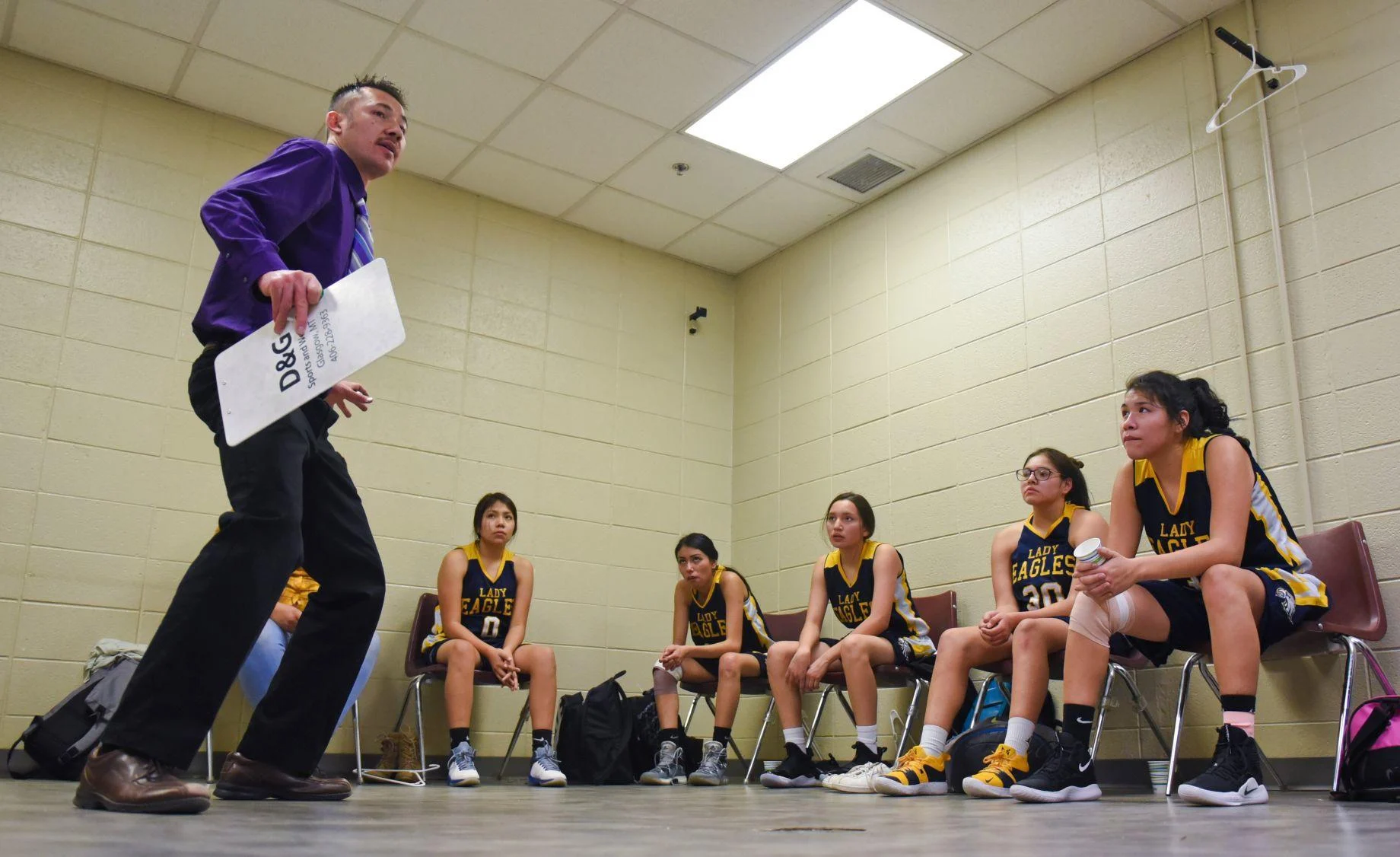
“When I first started (coaching), there was a few that were really just terrible,” Rocky Boy’s Demontiney said. “They wouldn’t talk to you at all and be pretty ignorant. After my first game, my first conference game, I was about ready to quit. That’s how bad it was. I was so mad — furious. I wanted to fight them.”
Another touchpoint preserved in perpetuity also involves Rocky Boy and is highlighted in the 2008 Montana documentary “Class C: The Only Game In Town.” As a Northern C divisional tournament game deteriorates and the Stars unravel emotionally, the coach of a mostly non-Native team seizes the moment at halftime to reinforce a pregame pep talk in which he distinguishes for his players disciplined vs. non-disciplined basketball — in essence, between right and wrong.
In the film, YellowRobe consoles her tearful daughter in the gym, saying, “Don’t cry, my baby, this is just how it is.” Rocky Boy’s coach bites her lip during an interview as she laments, “When they shoot 44 times from the free-throw line and we only shoot 13, it makes a huge amount of difference.”
While many viewers, Native and non-Native alike, saw thinly veiled systemic prejudice, others were struck by the message a female tribal elder delivered afterward in the Stars’ locker room.
“Now you know what it costs us to be an Indian!” she says to tearful, angry players. “We get cheated everywhere we go. But you’re still winners in my book. You hear?”
Said Lemelin: “I was shocked. Her whole point was you need to learn to be leery of non-Natives, and I was like, ‘My goodness, that’s a strong belief’. She’s going in that locker room and she’s very well respected, and she was adamant. What I recognized was just how real that is.”
The sentiment isn’t just real to Montana Natives.
Brent Cahwee, Pawnee and Euchee, of Lawrence, Kansas, who founded the NDNSports.com website two decades ago to champion Native athletes, recalls a non-Native friend from Boston who came to coach the Haskell Indian Nations University men’s team. His duties included submitting statistics to the NAIA office, which required copious film review.
The coach already suspected Haskell was among the nation’s leaders in fouls. What stunned him was the number of “phantom” fouls against his team, Cahwee said.
“That’s what we grew up with on the reservations,” Cahwee explained to the coach. “If it’s new to you you’re not Native. The 50-50 call — I guarantee you a lot of reservations know which way that’s going to go. What causes that?”
The frustration runs so deep in Indian Country that tribal leaders, already burdened by non-sports issues, are often asked to prioritize basketball grievances.
Blackfeet Tribal Councilman Everett Armstrong, former athletic director for the Browning School District, said the council met with Native legislators about bias just last week.
“We want our questions answered,” Armstrong said. “We need to take a stance because we’re so tired of it. We want help.”
Said St. Pierre: “Community members go to tribal leadership hoping the leadership can send a letter or a statement from the highest authority on the reservation might bring the attention of the officials.”
And it isn’t just Natives who see a difference.
Colton Young, who is non-Native and thrived under McCormick during the Crow coach’s lone season at Absarokee three winters ago, said he noticed a change in foul calls when the Huskies switched to rez ball.
“I feel like a lot of bias comes from that run-and-gun style of play that all reservations have played, and they have perfected,” said Young, emphasizing he doesn’t believe McCormick’s ethnicity was a factor. “I think growing up what style of basketball you played really does affect the decisions made. If I grew up in that environment I wouldn’t call a foul any time contact is made. I think that’s where some of the frustration, and bias toward those Native American teams, can come from.”
Combating bias perceptions
About a decade ago, after several incidents in eastern Montana, Native complaints reached a crescendo. Technical fouls had spiked. Charges of cheating and racism flew.
At the time, there were even rumblings about Native schools forming their own leagues.
The Native American Legislative Caucus called MHSA executive director Mark Beckman for answers. It was then Beckman suggested cultural-diversity training.
“There was really some concerns from a school that their players were being targeted in situations,” recalls Michelotti, who was an MHSA associate director until succeeding the retiring Beckman last year. “After that investigation we realized a big challenge, and our biggest goal in the challenge was to provide education.”
The MHSA traveled the state to train referees, coaches and administrators. Attendance was mandatory. Michelotti estimates more than 5,000 participated.
Basic information about tribes and reservations in Montana was presented. Officials learned the importance of star blankets, headdresses, and other Native observances and traditions.
An example: Referees expect eye contact when addressing players but many Natives avoid it for cultural reasons. Officials are reminded not to feel insulted when players instinctively look away.
Stereotypes permeating the games also were challenged. Among them is lax academic standards allowing ineligible players to compete. Also, because school transfers are more common, Native teams are often accused of recruiting.
“A lot of people don’t realize the situation on reservations,” Chavez, who grew up in Crow Country but lived with his mother in a halfway house in Heart Butte on the Blackfeet reservation, said of a pandemic of drugs, alcohol, teen pregnancy and broken families. “A lot of time kids have to live with grandparents. That’s why we have a hardship process. We all do it and abide by it.”
Referees now are required to participate in six study clubs per year where cultural education is topical. Ethnic diversity is a pillar of MHSA’s mission statement.
“I think some really good things came of this,” Michelotti said. “I think the biggest opportunity we have is to understand better the cultural diversity out there — to really understand and appreciate the culture of Native American basketball.
“The opposite of that is the realization that the officials are trying to do the best they can and be the best officials they can be. We need to get over pre-conceived ideas, educate ourselves on it, and we’ve got to be reasonable about these things.”
A major obstacle: The acute referee shortage, due largely to increasing belligerence from spectators for what many describe as “a thankless job”.
Yellow Owl said he and other Native officials have been called derogatory names from the bleachers. Lemelin avoids social media after games between Native and non-Native teams.
“It bothers me that there is this animosity,” he said. “I’ve had good friends get their picture taken and posted on Facebook saying, ‘This person is racist!’ It just hurts my heart because I know those people just want to referee.”
Agrees NDNSports’ Cahwee: “Certainly we need better treatment of referees whether Black, White, red, brown or yellow.”
One solution to combat perceived bias is to recruit more Native referees. In South Dakota, state law requires games between Native and non-Native teams have at least one Native official.
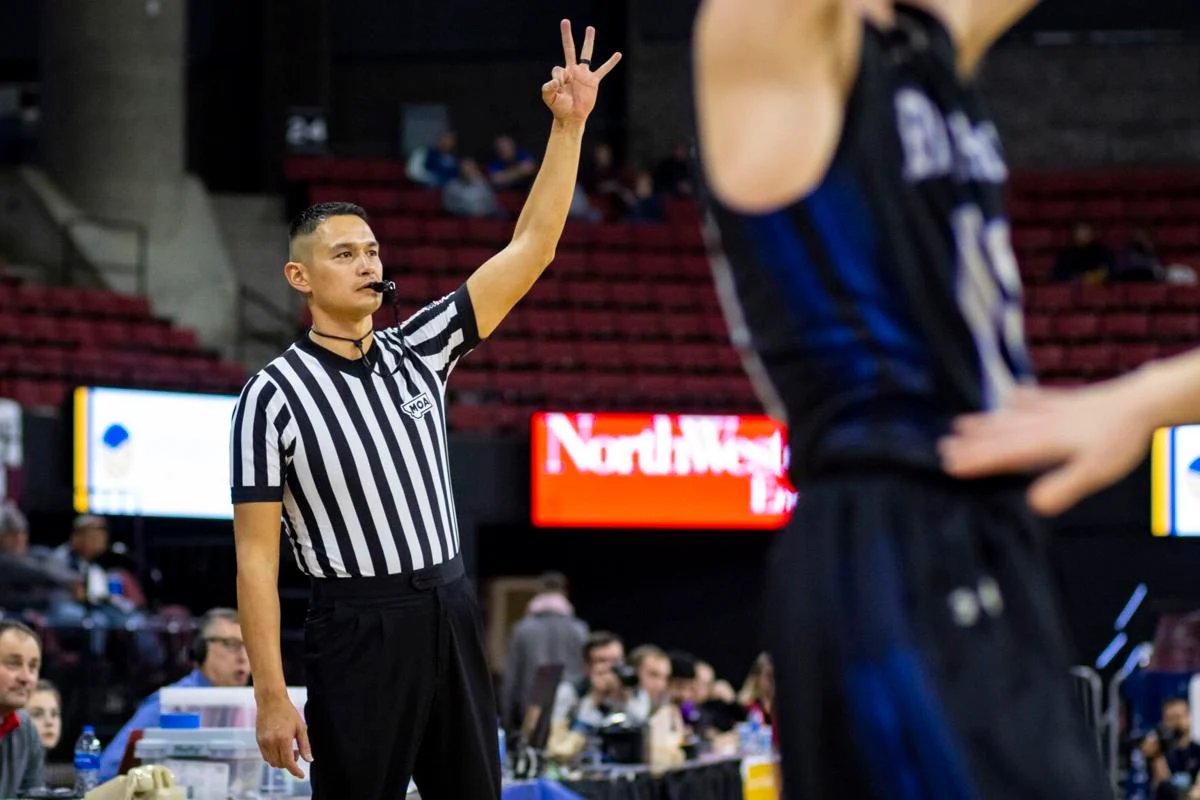
The Montana Officials Association is striving to rebuild its base, including seeking more Natives for a stable that roughly approximates the state’s overall population ratio. But reservations are remote. Refereeing means windshield time — and cost, even with mileage reimbursement, per diems and game pay ($70).
“It all comes down to economics,” St. Pierre said. “A lot of people locally may not have transport to get up and do study clubs and travel to get to games and things that are part of it.”
Despite the hurdles, diversity training has made headway against perceptions some say are reinforced by older generations still salving historic wounds. Social media is helping to create awareness.
“It’s gotten a lot better,” Chavez said. “I think with media and social media, and our youth becoming better at intermingling, even small-town people in Montana from non-Native communities, their eyes have been opened. The world has gotten a lot smaller so I think we’ve gotten more mature about that stuff.”
Said Yellow Owl: “I remember when I played, it seemed like we were always being told you were cheated of this, cheated of that. The more I’ve gotten into officiating, the longer I’ve been doing it, especially the bigger games, I don’t see it. I know some people like to hear 90 percent of officials out there want to get to Indians, but I feel a majority of guys out there just want to help the kids.”
Helping this dynamic, Rocky Boy’s Demontiney said, is referees and coaches striving to foster stronger relationships. Real Bird, who still attends games, said he’s noticed an improvement, too. What Native coaches and players discover is how much many non-Native officials enjoy calling games with Native teams.
“To me,” Billings official Barry Cronk said, “that’s about as fun as it gets.”
“Native basketball is so beautiful,” Ferch said. “It’s kind of like any work of art, and I’m sure great refs understand this. They don’t want to harm the audience’s experience, so the best refs are going to try hard to make sure they’re not ruining the fluidity of the Native game by calling ticky-tack fouls. You can’t guarantee that, but the thing almost everybody recognizes in Montana is we have something special in the beauty of Native basketball.”
And bias can run both ways, many Natives concede, noting the concept of “home cooking” is universal regardless of ethnicity.
“I have watched games where I think the refs favor the Native American team,” McCormick said.
A long way to go
But engrained perceptions take time to erase.
Ask Native coaches and players today and many, if not most, will say they know which referees won’t give them a fair shake. St. Pierre said Rocky Boy’s school board has asked her to give local pools a list of unacceptable officials for Stars games.
“Even our fans they’ll sit there and go to concessions and our fans will be like, ‘Oh, looks like you guys have a tough reffing squad today,” said Crebs, the former Rocky Boy player.
Said Chavez: “I’m kind of person who tries to take a step back and see from both sides because I have a lot of friends who are MOAs and their jobs are tough. And we do have officials that work all the time with Natives around our pools, around reservations — great guys and great women who do our games.
“But you see bad refs and see refs with agendas and stuff like that. I feel bad for (objective refs) when there are a few bad apples that make it obvious. You can’t blame them all.”
Thus the perception persists. To some, it’s grown.
Robert Hall, a 16-year Blackfeet official whose father, Vic, created the Browning/Heart Butte pool because Native refs felt shut out of varsity games, said: “In Indian Country, frustration with refs is at an all-time high. It has not been alleviated, and it’s only getting worse. It’s gotten to the point where every tournament people in our community ask, ‘How were the refs?’ “
Malta-Rocky Boy epitomizes the issue’s complexity.
Yellow Owl remembers the meetings with Native and non-Native officials afterward.
“It was more of the white officials that were saying those guys (officials) were in the wrong, where some of the Indian officials said, ‘I wonder what was said to get to that point of those T’s’?“ he said.
The key going forward, Michelotti repeatedly reinforced, is education and communication.
Is there hope for change?
Several years ago, a Native spectator approached Lemelin before a game, handed him a colorful small stone and told him to rub it. Lemelin stashed the stone in his pocket and remembers thinking, “that’s kind of cool”. He carries it in his referee’s bag to this day.
“I felt like he was being very kind,” Lemelin said, “and I took it as we’re going to have a good game, and this is going to go well and we’re not going to have any controversy and nobody’s going to get hurt.
“And this is for good luck.”

