
This story was originally published by South Dakota Searchlight.
Makenzie Huber
South Dakota Searchlight
A recent U.S. Supreme Court ruling that gutted a key provision of a voting rights law won’t affect South Dakota’s legislative districts until 2031 — but Native American voting rights advocates aren’t waiting to worry.
The decision in Louisiana v. Callais dismantled guardrails protecting the electoral power of Black, Hispanic and other racial minority voters enshrined in the Voting Rights Act, a 1965 law barring racial discrimination in voting.
The 6-3 decision effectively nullified a provision called Section 2, which had required states to draw electoral maps giving racial minorities a fair chance to elect their preferred candidates.
Greg Lembrich, legal director for Four Directions, a South Dakota-based Native American voting rights advocacy organization, is concerned about the ruling.
“It’s a layer of protection that’s now been taken down by the U.S. Supreme Court and makes it that much easier to deprive minority voters of the full weight of their voting rights,” Lembrich said, “and a lot harder for voters with diluted voting rights to challenge those decisions in court.”
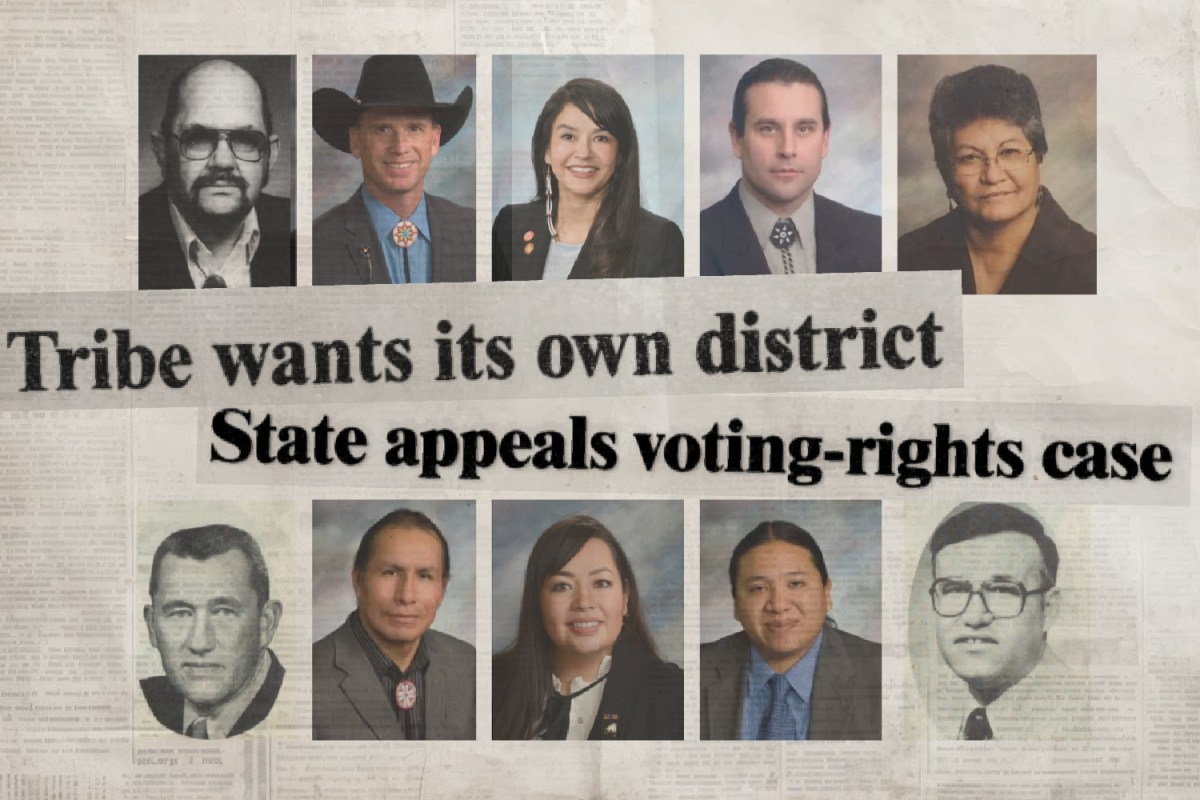
South Dakota has a strained relationship with the federal law. Some of the state’s redistricting changes in the last 50 years stem from requirements enforced at the federal level — and a majority of Native Americans who’ve earned seats in the Legislature have been elected from districts influenced by the law.
What the ruling means for South Dakota
The Supreme Court ruling has already set off redistricting battles in some states that have multiple members of the U.S. House of Representatives. That won’t happen in South Dakota, where the state’s small population entitles it to only one member of the House.
But the Legislature is required by the state constitution to redraw its districts every 10 years after the census. When that happens next in 2031, advocates will lose the legal tools they used to create and defend Native-majority districts. Under the old Section 2 standard, a map could be challenged by showing it had a discriminatory effect — even without proving intent. Now, challengers must prove lawmakers deliberately discriminated.
“It’s very hard to prove intentional discrimination,” Lembrich said. “People who are doing something to intentionally discriminate usually don’t admit that’s what they’re doing.”
In South Dakota, Section 2 caused the creation of split districts — single districts divided into subdistricts, each electing one state House member, with both sharing one at-large state senator. Districts 26 and 28, which include the Rosebud, Lower Brule, Crow Creek, Cheyenne River and Standing Rock reservations, are split districts.
The structure gives Native American voters the power to elect a candidate of their choice without stripping non-Native voters of the same opportunity, Lembrich said. District 27, which includes the Pine Ridge Reservation, has a majority Native American voting population.
Former Republican lawmaker Jim Bolin, who represented the Canton area, served on the 2011 and 2021 redistricting committees — both of which produced district maps that avoided litigation. He said lawmakers on the committees in both years went “out of their way” to include Native American voters and “ensure the Native American population would be able to win an election.”
In 2011, the Legislature expanded District 26 to include the Crow Creek and Lower Brule reservations.
In 2021, the Legislature consolidated a large urban Native population in northern Rapid City into one district rather than splitting it, and a Democrat was elected from District 32 for the first time in 18 years. The Legislature also expanded District 26 to follow Crow Creek reservation lines rather than county lines, and the voting population for Native-heavy districts was kept lower to avoid diluting Native voters.
Lembrich isn’t sure legislative leaders will feel compelled to redraw those districts dramatically in 2031. Although many of the Native Americans who have been elected to the Legislature have been Democrats, Republicans currently hold 97 of the Legislature’s 105 positions.
“Republicans consistently have a super majority in both chambers,” Lembrich said. “They don’t need the extra seats. It may not be worth the PR and the lawsuits of trying to change it.”
