
Editor’s Note: This article on Oscar Smith Bunn by golf historian Dr. Mark Wagner includes excerpts from Wagner’s book, “Native Links, the Surprising History of Our First People in Golf,” published by Back Nine Press in 2024.
Mark Wagner
Special to ICT
The name Oscar Smith Bunn first graced my ears in the fall of 2022.
I had begun a series of articles about how a number of tribes in the new millennium had built resort golf courses, employing some of the finest architects of our era: the Jones brothers, golfer Ben Crenshaw and his business partner Bill Coore, Jeff Brauer, Christine Fraser, and Notah Begay III, a professional-golfer-turned-TV-analyst.
Some 55 tribes now own and operate golf courses, and some have hosted events by the Professional Golf Association and the Ladies Professional Golf Association. This work led me to discovering the Native individuals who played a role in golf, including Frank Dufina, Rod Curl and others.
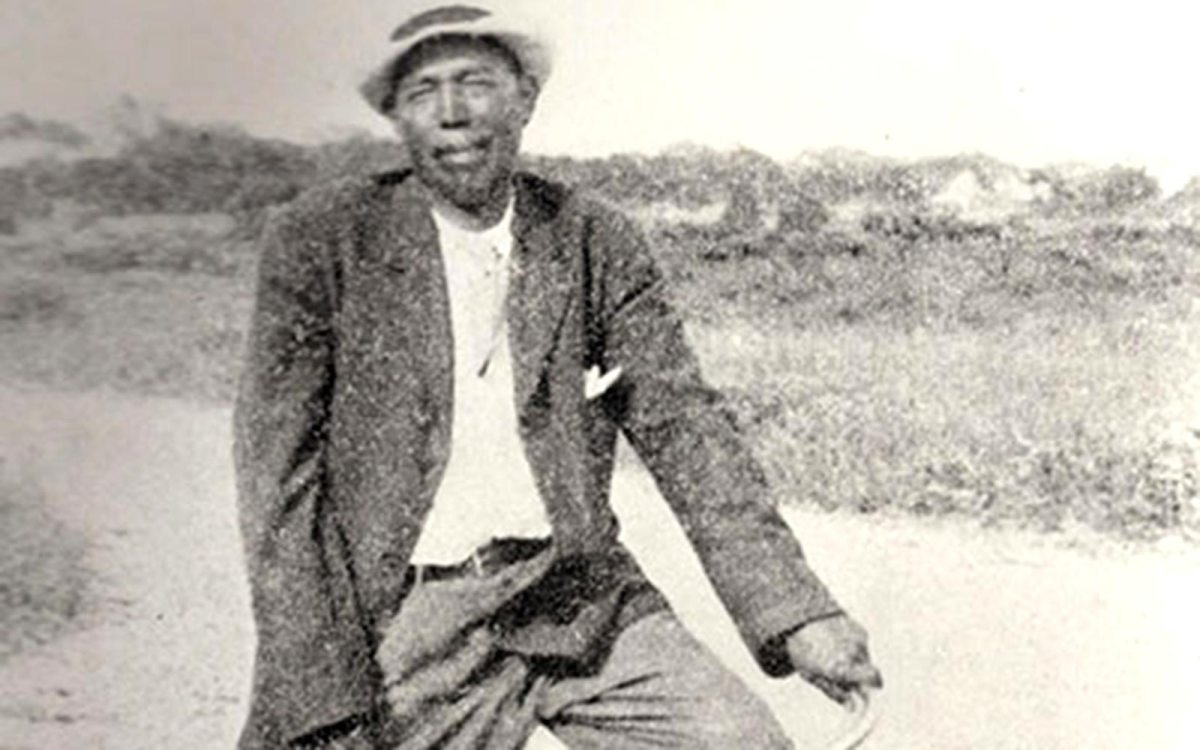
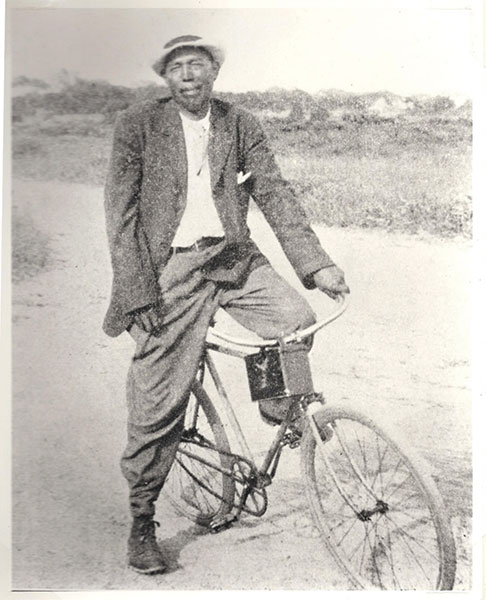
This aspect of Native history, however, indisputably begins with Bunn, who was born about 1875 on the Shinnecock Reservation on Long Island and went on to become a Shinnecock tribal trustee, a Hall of Fame caddie, a professional golfer and teacher, and a woodcarving artist.
He became the first Native professional golfer in 1896, when he represented Shinnecock Hills Golf Course in the second U.S. Open, alongside his friend, African-American golfer John Shippen. Their presence was initially challenged by a group of White golfers, but they were allowed to play.
Excelling in a sport that has long been considered White and elitist, Bunn created a lasting legacy that is now gaining new recognition. He was inducted posthumously into the Caddie Hall of Fame in 2009 for his work making golf more inclusive, and in 2019, the Oscar Bunn Tribal Golfing Facility opened on the Shinnecock Reservation.
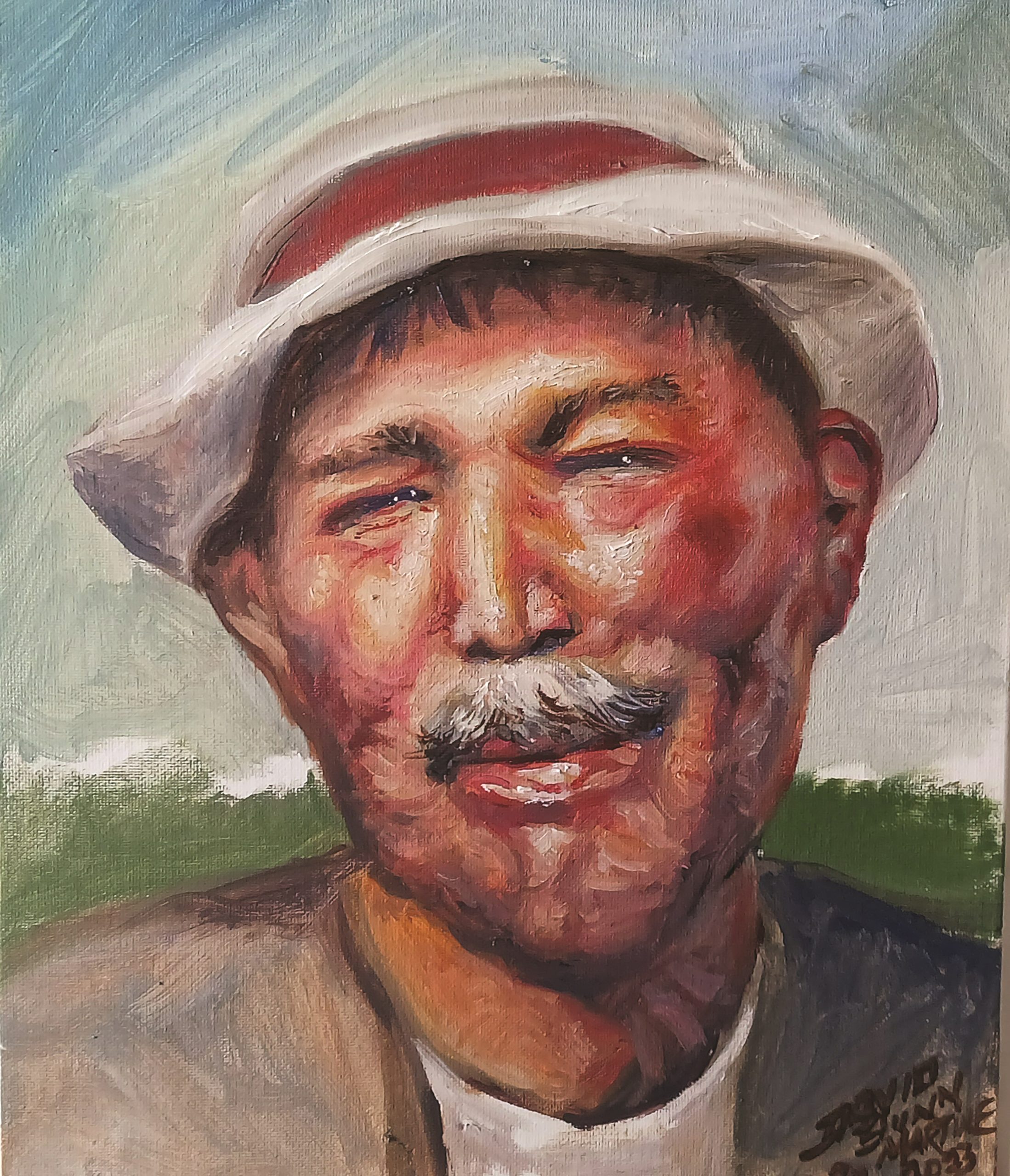
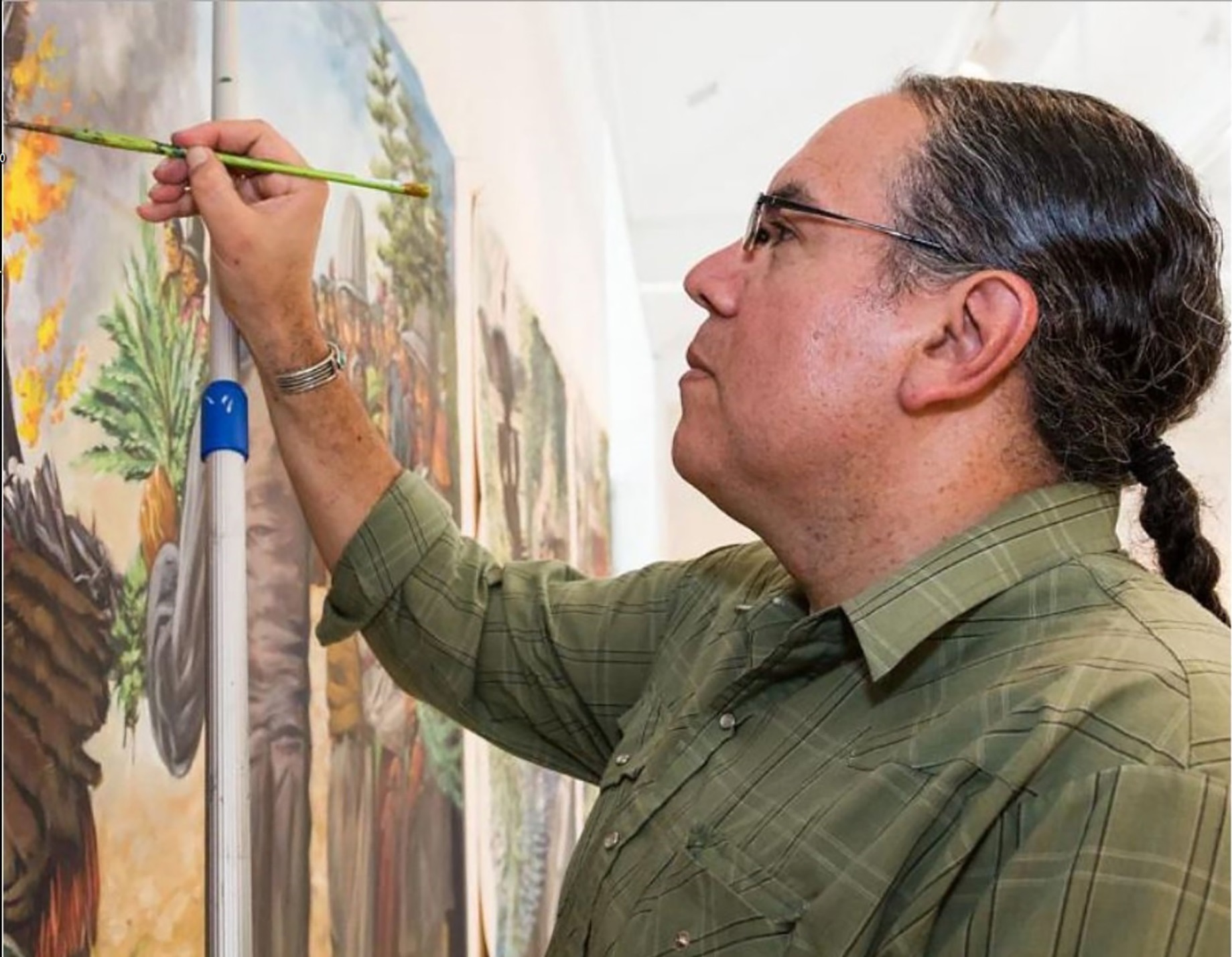
Now, a portrait of him will hang in the U.S. Golf Association’s Golf Museum in New Jersey. Bunn’s great-grand-nephew, artist David Bunn Martine, has been commissioned to paint a portrait for the museum.
“He excelled at the sport,” Martine said recently. “He became well respected as a player and a teacher, not just in New England, but also in Florida and South America. He blazed a trail that today can serve as an inspiration to other Native Americans who want to play the game of golf, and also for anyone to attempt to achieve something even though the expectations for them may be very low.”
His legacy is also drawing new attention to Native golfers, who will be featured in the Third Annual Native American Open golf tournament to be held Oct. 20-23 at the Santa Ana Pueblo’s Twin Warriors Golf Club in New Mexico.
Twin Warriors, regularly named one of the top golf courses in the country by Golf magazine, will host competitors from as many as 17 states and provinces, representing 55 tribes, bands or nations. Last year’s Native American Open featured the first Native woman to qualify for the LPGA tour, Gabby Lemieux.
But first came Oscar Bunn.
Building a legacy
Bunn grew up on the Shinnecock Indian Nation reservation on the eastern edge of what is now Long Island, New York.
The Shinnecock people provided much of the labor to build the historic Shinnecock Hills Golf Club in 1891 on ancestral lands, and today it is one of the oldest incorporated golf clubs in the country and one of five founding club members of the U.S. Golf Association.
Bunn, like many other Shinnecock youths, went to work at the golf club, eventually becoming a caddie and playing on the course. In 1896, when the U.S. Open tournament was held at Shinnecock Hills, Bunn was tapped to represent the golf club along with Shippen, who also played in the tournament and became the first Black professional golfer.
The two men were not welcomed by the field, according to a 2017 article by Bayliss Green in The Southampton Review.
“Their presence caused a protest among the white golfers at the Open — mostly Scots and Englishmen — a revolt that was famously put down by Theodore Augustus Havemeyer, the first head of the United States Golfers Association, who decreed if the Scots and English golfers didn’t take up their irons, he’d simply run Bunn and Shippen out there to play by themselves,” the article notes.
It made a mark on the golf world.
“This was a watershed moment,” said Victoria Nenno, senior historian at the U.S. Golf Association’s Golf Museum. “The participation of Bunn and Shippen set a precedent that the U.S. Open would remain an open championship. The competitors would be the best in the world, regardless of background, nationality, or social standing.”
Frederick Havemeyer, the great-grandson of Theodore Havemeyer, reflected on the moment when the second U.S. Open was called into question.
“My great-grandfather traveled extensively and had a broad mind,” Frederick Havemeyer said. “He was extremely intellectual and was up on things. If you have any brains, and you like a sport, you won’t restrict it to a race or religion to qualify to play the game. The game was the game. If you’re good at it, you play it and let the best man win.”
Both men played well. Bunn placed 21st in the U.S. Open that year, and Shippen finished in 5th place. Famously, Shippen might have won had he not taken an 11 on a hole when he hit into a wheel rut. The two men also played in the 1899 U.S. Open at Roland Park in Baltimore.
The legacy of Bunn and Shippen at the U.S. Open, however, is only part of the story of Bunn’s influence. On Oct. 20, 1901, The Brooklyn Daily Eagle ran a feature, “Shinnecock Indian Expert Tells How Golf Should Be Played,” that includes an interview and a four-panel illustration of Bunn demonstrating the proper swing of a club.
The article is a stunning turn away from the normal headlines involving the Shinnecock and other tribes on Long Island, and stands as a testament to Bunn’s high place in golf history.
As the game gained traction in the United States, Bunn was a marquee name. A July 15, 1905, New York Times headline read, “Indian Contestant Holds His Own Well Against Scotch Rivals,” as Bunn was representing Shinnecock Hills at an event at Van Cortlandt Park, New York.
Further review of the literature finds him listed as a professional at or a representative of a number of clubs in his career, including Shinnecock Hills, The Florida Country Club in Jacksonville, the Lake Placid Golf Club in New York, and the Ampersand Hotel Golf Course in Saranac Lake, also in New York. An entry from June 1899 in the Official Bulletin of the U.S. Golf Association shows that he held the record at The Florida Country Club in Jacksonville, as well.
“The professional record of 36 plus 39 equals 75 is held by Oscar Bunn, the club instructor who, although young, has proved himself to be a first-rate golfer as well as a capital instructor and clubmaker,” the report noted. “His teaching has given the game a great interest than any it has received during the four years of the club’s existence.”
Bunn studied golf, course design and club making under Scotsman Willie Dunn, and rose to such prominence in the field that he played many exhibition matches, including with Walter Travis, a top American amateur to whom Bunn lost 1 Up, and to Harry Vardon, the top-ranked golfer in the world around the turn of the century.
As to his match with Vardon, Bunn, who at the time was a golf instructor and professional at the Lake Placid Golf Club, said, “I was nervous, of course, meeting the player ranked best in the world, and I am sure only for that I would have won.”
What is less known is this: An article in The Argus, “Vardon’s Waterloo,” on Aug. 20, 1900, describes Bunn as playing a nine-hole rematch with Vardon at the Stevens Links in Lake Placid, and notes that Bunn defeated Vardon 33-38 “in a fashion Vardon is not likely to forget.” Bunn went One Up and One Down against the great golfer of his era.
Gaps in the records
As with many incidents in Native history, there are ironies at work in Bunn’s legacy.
As his great-grand-nephew Martine noted in a recent interview, details are scarce about his rise to prominence.
“Oscar is in the Caddie Hall of Fame, but there really is no record of him caddying,” said Martine, who owns a gallery of Native American portraits and runs a cultural center on the Shinnecock Reservation in Southampton, New York.
“While he most definitely did caddie, as a lot of the Shinnecock Tribe did, the record is he is the only one of them to become a golf professional,” said Martine, a citizen of the Shinnecock Tribe who is also Montauk and a descendant of the Fort Sill Chiricahua Apache Tribe of Apache, Oklahoma.
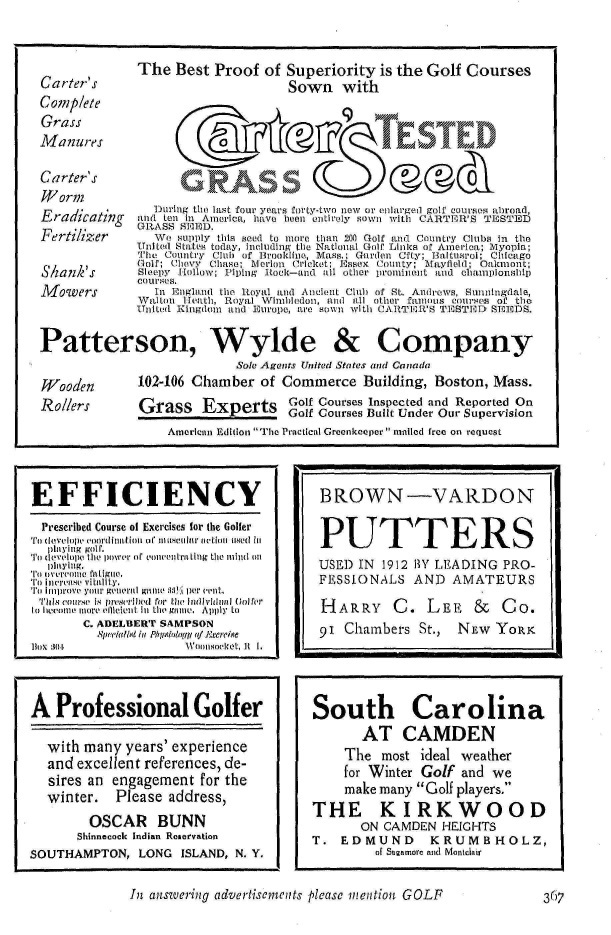
The early days of the 20th century when Oscar Bunn lived was a very harsh time in the United States for most Native Americans. This was the time of the boarding schools, when Native children were removed from their homes. Eastern Long Island was a place where the Shinnecock Montauk had been in contact with the European settlers for generations.
“Some of our people, who made their living from the natural out-of-doors environment, came to know many of the wealthier people who had come to live all around on the remaining lands of the Shinnecock and Montauk,” Martine said. “So, Oscar would have intermingled with many of the people who originated the game of golf on Shinnecock land.”
His efforts are no doubt reflected in those who came after him.
Golfer Frank Dufina, Mackinac Bands of Chippewa and Ottawa Indians, came soon after Bunn, beginning his career in 1899 at the Wawashkamo Golf Club on Mackinac Island and going on to become what is believed to be the longest teaching golf professional ever. He began as a caddie and retired 67 years later as the club professional.
Rod Curl, Wintu, now 80 and living in Florida, became the first Native golfer to win a PGA tour with his 1974 one-stroke win over Jack Nicklaus at the Colonial National Invitation tournament in Fort Worth, Texas.
And a subculture of teachers and professionals have followed, including both of Curl’s sons – Rod Curl Jr. and Jeff Curl. Notah Begay III, Diné, has won three times on the PGA tour, and, in 2022, Lemieux became the first Native to qualify for the LPGA.
The U.S. Golf Association joined with the Shinnecock Tribe to open the Oscar Bunn golf facility in 2019 to support accessibility to golf and to recognize the Shinnecock contributions. The USGA designed and funded the facility, and is providing for its ongoing maintenance.
And this year, the USGA Golf Museum commissioned the portrait of Bunn to grace the museum walls in Liberty Corner, New Jersey.
Later life
Despite his successes, a long life was not in the cards for Bunn.
He went on to marry Mary Della, a Shinnecock Tribe member, and, though they had no children, their home on the Shinnecock reservation was known as a center of social life. One side of the house featured a dance floor with a piano, and the Bunns were known to like dancing and socializing.
In December 1916, Bunn filed for an American passport, listing “Golf Instruction” as his profession, according to Martine’s work, “Time and Memories: Oral Histories of a Family of Shinnecock, Apache and Hungarian Origins.”
The words were typed by James Richardson, clerk of the New York State Supreme Court in Riverhead, New York, on Dec. 20, 1916.
With plans to teach golf in Argentina and Brazil, Bunn departed on Jan. 6, 1917, from the Port of New York aboard the S.S. Vauban, a Belfast-built, 500-foot bow-to-stern ocean liner with a crew of 250.
Although Bunn’s trail across South America is old, Martine has suggested that someone might eventually track down his travels using golf archives.
For now, we know the year of 2017 saw ocean passages rife with soldiers and equipment heading into what would be the deadliest war in human history. Influenza infections accompanied with a high mortality were only the beginning in the winter of 1916–1917; by 1918, the Spanish flu would kill 50 million people worldwide.
It was in this historical setting that Bunn returned home by ship from his teaching engagements in South America. He was, however, “apparently unprepared for the cold weather and caught pneumonia … from which he never recovered,” according to his obituary in the Jan. 31, 1918, edition of The Southampton Press.
He became sick in October 1917 and died on Jan. 24, 1918. He was 41 years old.

Our stories are worth telling. Our stories are worth sharing. Our stories are worth your support. Contribute $5 or $10 today to help ICT carry out its critical mission. Sign up for ICT’s free newsletter.
