
Deusdedit Ruhangariyo
Special to ICT
Around the world: A Presbyterian church apologizes for abuse, holograms help Northern Tutchone preserve language, and customary law empowers a villages on behalf of a critically endangered songbird
NEW ZEALAND: Church apologizes for abuse
More than a year after the Royal Commission of Inquiry into Abuse in Care released its report, the Presbyterian Church has issued a formal apology acknowledging failures to protect children and vulnerable people in its institutions, RNZ radio reported on Oct. 5.
A ceremony on Saturday, Oct. 4, in Auckland, New Zealand, was deliberately held away from church grounds at Manukau’s Due Drop Events Centre. The ceremony opened with survivors reading poetry through tears, setting a sober tone for what followed, RNZ reported.
Reverend Rose Luxford, moderator of the general assembly, said the church and its people had caused harm and offered what she called a “sincere and unreserved apology.”
“It was our responsibility to care for you,” she said, according to RNZ. “We failed. Abuse happened in our care, because we failed to provide protection and we didn’t act when alarms were raised. Such a breach of trust is unjustifiable.”
Luxford also acknowledged that not all survivors chose to attend. “To those people, we acknowledge we’ve lost your trust,” she said, according to RNZ. “We must build a culture here where speaking up is welcomed and acted on, and — critically — where abuse cannot occur.”
Luxford announced the church will launch its own “survivor-designed holistic redress system,” signalling a shift in both control and design. “Holistic redress could include financial payments, personal apologies and acknowledgements, ongoing wellbeing support and accountability,” she said, emphasizing that survivors would shape both process and outcome.
For many, the question now is whether words become deeds, RNZ reported. State-abuse survivor Eugene Ryder said he was encouraged but remained focused on follow-through.
“Words are just that — they’re words,” he said, according to RNZ.
CANADA: Preserving Indigenous language
Fewer than a dozen people are now fluent in the Northern Tutchone speakers in Mayo, Yukon — most of them elders. So the First Nation of Na-Cho Nyӓk Dun is turning to technology to keep the language alive, CBC News reported on Oct. 4.
The community has launched Kwän Dék’án’ Do — “to keep the fire burning” — a project blending virtual reality games, a holographic display, a digital archive of community objects, and an AI-supported language model to capture voices, stories, and vocabulary before they’re lost.
Inside Mayo’s community hall, Carleton University Professor Ali Arya demonstrates a boxy, glowing display. With a few swipes, he taps the face of an elder, and 78-year-old Walter Peter seems to appear inside the box, telling a story as if seated before the audience.
“The main attraction of this particular device is that it allows you to have a virtual presence that is very engaging, very three-dimensional and realistic,” he said, according to CBC News.
Community member Krystal Profeit whispers in response, “It’s amazing… I actually have goosebumps.”
The devices first arrived to improve remote meetings between Carleton and Na-Cho Nyӓk Dun. But the First Nation quickly saw something more: a way to teach children when recruiting teachers is difficult.
At first, not everyone was convinced. Elder Franklin Lee Patterson, 70, worried that phones had swallowed young people’s attention. He contrasted that with his own upbringing before concluding the community had to guide the tools shaping its children.
“We rode on our mum’s back inside a beaded strap, and we learned the language,” he said. “We have to be involved with the change in order to make it good for the children… When I leave to the spirit world, I’m going to leave my knowledge behind on that machine.”
The urgency is profound. Commissioner Ronald Ignace reminds that many Indigenous languages are critically endangered after church and government policies “denigrated, denied and belittled” them.
“Language is the cradle of our spirit,” he said, according to CBC News.
INDONESIA: Indigenous efforts bring songbird back from near-extinction
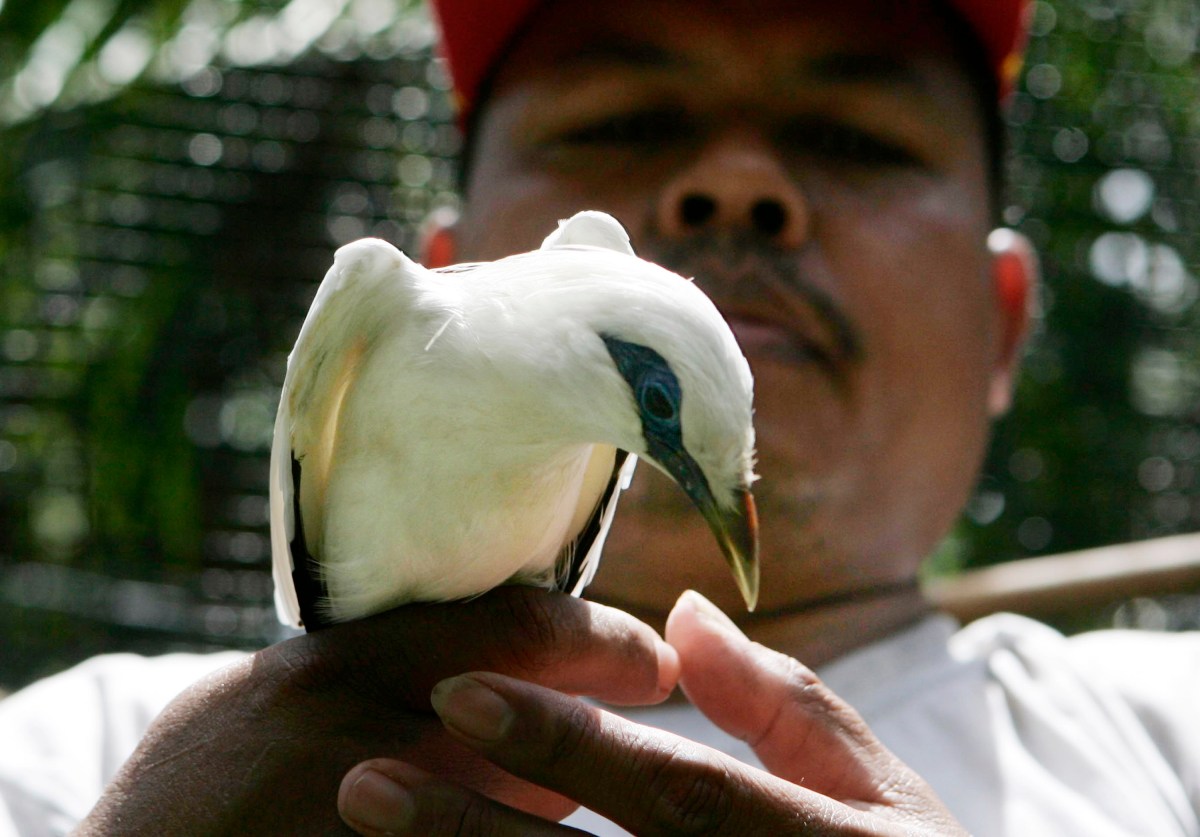
Once coveted for its snowy plumage and liquid call, the Bali starling — the only vertebrate found solely on Bali — was driven to the brink of extinction by poaching at habitat loss, Mongabay reported on Oct. 2.
Despite special protections since 1958, weak enforcement and a thriving trade hollowed out the species, and by 2001 just six wild birds remained.
The songbird is now making a comeback through Indigenous-led protections that include traditional awig-awig regulations, Hindu-based customary law passed by whole communities, Mongabay reported.
The system creates cultural, social and financial deterrents to poaching, Mongabay reported.
“You get everyone in your community in a wild bird preserving culture, and it becomes self-regulating,” said Jessica Lee of Mandai Nature, according to Mongabay.
Results followed. On Nusa Penida, 64 releases grew to about 100 birds by 2009, dispersing and breeding more successfully than in BBNP thanks to food and reduced poaching.
The success was evident in a recent trip into a coconut grove on Nusa Penida by two conservation workers. After about 10 minutes, they saw the white flash of a Bali starling peek out from a hollow palm then settling onto a branch, Mongabay reported.
The natural cavity — beside an artificial box — is only the second such wild nest ever recorded on the small island off Bali, a fragile sign of return for one of the world’s rarest birds, Mongabay reported.
My final thoughts
My thoughts are about this week’s three stories —an overdue church apology in New Zealand, a Northern Tutchone language revival in Yukon that mixes holograms with archiving and Artificial Intelligence, and a Balinese bird brought back by custom law.
They trace the same arc from failure to stewardship, and they show where praise, censure, and practical counsel belong.
Commend, first, what moves beyond symbolism. When a church admits institutional failure and promises survivor-designed redress, it shifts from performance to governance. The measure is not the microphone but the mechanism: eligibility rules that don’t retraumatize, budgets that match the scale of harm, timelines that are public, and an independent board with survivor seats and disclosure duties so today’s contrition outlives today’s leaders.
In Yukon, a small First Nation is turning technology into a servant of memory rather than a rival to it, by capturing elders’ stories in three dimensions, digitizing tapes before they decay, and shaping an Indigenous-governed language model so learners can speak with their ancestors’ voices tomorrow.
On Nusa Penida, villages wrote protection into customary law, aligned livelihoods with guardianship, and transformed an elusive icon — once down to a handful of wild birds — into a living asset that draws visitors, funds reforestation and rewards care.
Condemn, too, what enabled the losses. Abuse in care was not a one-off lapse; it thrived where authority met opacity and alarms were ignored. The erosion of Indigenous languages did not happen by accident; it followed policies that punished speech, shamed children, and starved communities of resources. The songbird crisis revealed the limits of pure enforcement and one-way “releases” that turned birds into targets and rangers into underfunded referees. In each case, institutions asked communities to trust them while offering too little proof they were trustworthy.
Then words changed to work. The church published a survivor-led redress plan with dates, budgets, trauma-informed processes, an external review, and paired compensation with ongoing support.
For the Northern Tutchone project, set up a pathway with cultural protocols, community-controlled storage and other guidance so local youth could become the project’s technologists and archivists.
For the Bali starling, the villages became the center of gravity. They maintained customary sanctions, paid monitors, tracked nesting success and poaching attempts on a shared dashboard, and managed habitat and predator.
What ties these geographies together is simple accountability, where survivors write the rules, communities own the data and the means, and the law lives in village halls and not only in distant codes,.
Where apologies lack budgets, where archives lack consent and conservation lacks livelihoods, harm repeats in quieter forms. The path forward is not mysterious: embed the people most affected at the center, bind promises to structures that can be audited, and let results speak for themselves.

