
Deusdedit Ruhangariyo
Special to ICT
Around the world: Deforestation and other violent encroachments have a new force to reckon with in Peru, Aboriginal artwork takes center stage in Australia, and Canada grants $95M in aid to help families of MMIW
PERU: Indigenous guard fights back against encroachment
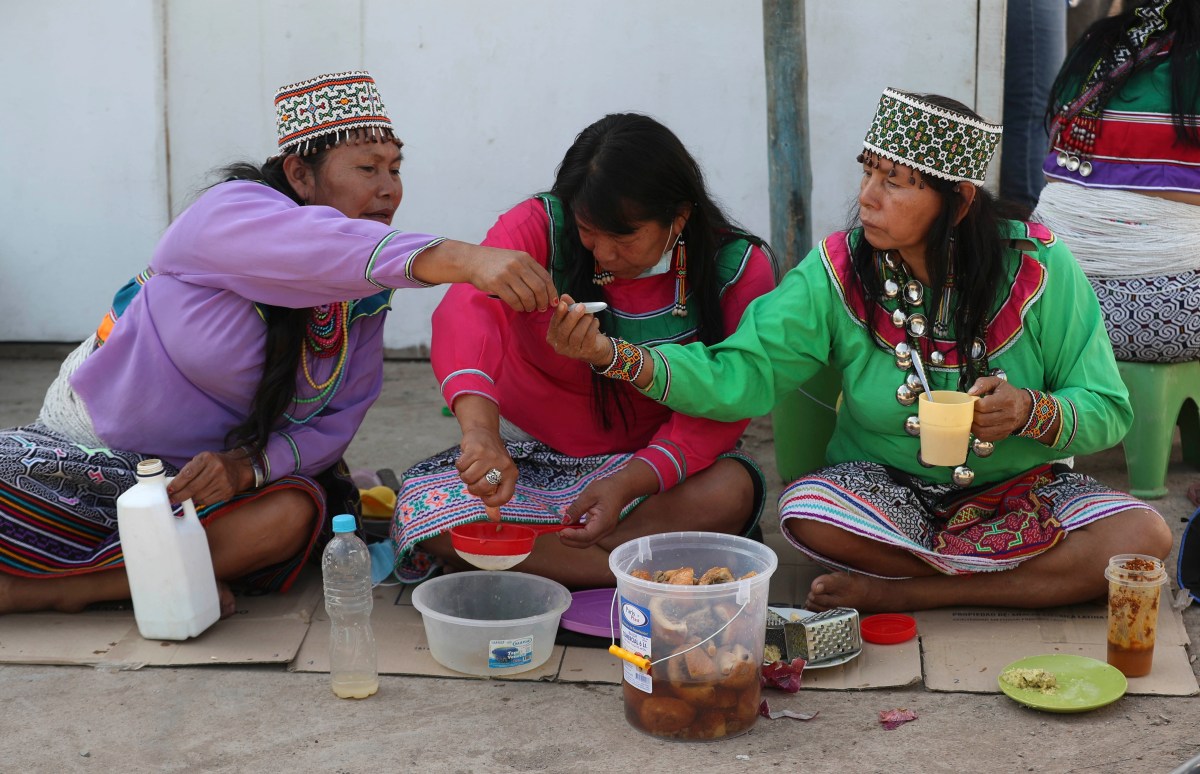
The Shipibo-Konibo-Xetebo people in Peru have formed an Indigenous guard known as La Guardia Indigena to offer protection against deforestation, logging, drug trafficking, oil spills and other encroachments onto Indigenous lands, Mongabay reported on May 30.
SUPPORT INDIGENOUS JOURNALISM. CONTRIBUTE TODAY.
The collective effort will conduct patrols spanning 175 Indigenous communities in the Peruvian Amazon, serving as their last hope for protection amid escalating violence and government neglect, Mongabay reported.
Indigenous people and their lands in the Peruvian Amazing face numerous threats, including drug trafficking, logging, expansion of oil palm plantations, oil spills, highway construction, illegal fishing, and the encroachment by Mennonite farming communities, Mongabay reported.
“The government has an obligation to guarantee the safety of human life as well as flora and fauna. But it’s not,” said Lizardo Cauper, the council president of the Shipibo-Konibo-Xetebo peoples, according to Mongabay. “We have to do this because it’s the only way to ensure the lives of generations. We have to act in accordance with our uses and customs to defend this land.”
According to community leaders, the Indigenous guard has conducted 45 interventions to expel illegal fishermen from the area, and officials are currently working to ensure coordination among different communities, understand their distinct threats, and plan effective patrols.
The Ucayali department in Peru faces alarming deforestation rates, with the Flor de Ucayali community alone losing more than 50,000 acres of forest in the past decade. Road construction has further caused significant deforestation, with more than 20,000 acres disappearing between 2008 and 2018.
Mennonite communities engaged in agriculture have also contributed to deforestation, clearing nearly 2,500 acres between 2017 and 2022. Organized crime, including illegal fishing and the expansion of coca cultivation for cocaine production, poses additional challenges, Mongabay reported.
AUSTRALIA: Aboriginal artwork takes center stage
The Telstra National Aboriginal and Torres Strait Islander Art Awards has announced 63 finalists for its annual awards, which recognize the contributions of artists and curators, National Indigenous Times reported on May 30.
Among the finalists are 31 from Australia’s Northern Territory, 13 from South Australia, eight from Queensland, six from Western Australia, two from the Australian Capital Territory, and one each from New South Wales, Tasmania, and Victoria. Sixteen of the finalists are considered emerging artists.
Among them, sixteen finalists fall under the category of emerging artists.
The award ceremony is scheduled to take place on Friday, Aug. 11, on Larrakia Country (Darwin), with cash prizes totalling $190,000 distributed across seven different categories.
Organizers noted that Telstra NATSIAA is the longest-running Aboriginal and Torres Strait Islander art awards in Australia, and is “a celebration of culture, artistic practice and connection to Country.”
Last year, the prize pool was increased to encourage more emerging and established artists to participate.
“For four decades, NATSIAA has provided an opportunity for the rick and diverse stories of our First Nations people to be told,” Telstra’s chief executive, Vicki Brady, told National Indigenous Times.
Since 1984, the Museum and Art Gallery of the Northern Territory has been hosting the prestigious awards, coinciding with a pivotal moment when Aboriginal and Torres Strait Islander art and artists first gained substantial recognition for their artwork in the commercial realm.
CANADA: Ottawa grants $95M to aid families of MMIW
The government of Ottawa has committed to providing more than $95 million in funding over five years to support Indigenous families in obtaining information regarding their missing or murdered loved ones, CBC News reported on May 29.
Justice Minister David Lametti unveiled the funding, which will include an additional $20.4 million each year to sustain ongoing support programs.
“We are baking in the resources so that the resources themselves are not in question,” Lametti said, according to CBC News.
The funding, outlined in the 2023 federal budget, includes:
*$37.3 million over five years, and $7.75 million annually, to renew and expand Family Information Liaison Units.
*$20 million over five years, and $4.15 million annually, to support families with Indigenous-led healing initiatives.
*$38.6 million over five years, and $8.45 million annually, for a wide range of Indigenous-led activities for victims of crime and survivors of violence.
Meggie Cywink, an advocate for missing and murdered Indigenous women and girls, called the announcement a good start but said that how the funding is distributed will matter.
“How the funds flow to grassroots organizations and families will be critical to its success,” Cywink said, according to CBC News.
My final thoughts
My final thoughts are in Peru, where rising violence and neglect by the government has led the Shipibo-Konibo-Xetebo people from Ucayali department to unite and form an Indigenous guard known as “La Guardia Indígena’’ to defend their lands.
In order to move forward as a strong force against the violence and encroachment, the Shipibo-Konibo-Xetebo people and their Indigenous guard will need immediate support from the Peruvian government and international organizations.
To enhance the effectiveness of the Indigenous guard, it is necessary to provide them with ample resources, funding and training to strengthen their efforts.
This could offer a sustainable solution that encourages the rights and well-being of the Shipibo-Konibo-Xetebo people.

Our stories are worth telling. Our stories are worth sharing. Our stories are worth your support. Contribute $5 or $10 today to help ICT carry out its critical mission. Sign up for ICT’s free newsletter.
