
Deusdedit Ruhangariyo
Special to ICT
Around the world: Canada returns land to Tyendinaga Mohawk Territory, a Ngarrindjeri elder is honored for protecting the environment, Maasai herders lose an eviction claim, Māori women boxers rank at the top of the world, Western Australia government reviews youth offender laws.
CANADA: Minister signs deal to return Mohawk land
The Canadian government has agreed to return nearly 300 acres of disputed lands with $31 million in compensation to the Mohawks of the Bay of Quinte in Ontario, CBC News reported on Oct. 3.
The deal to return the lands to the Tyendinaga Mohawk Territory – marked in a ceremonial signing by Crown-Indigenous Relations Minister Marc Miller – settles part of a bitter dispute over about 900 acres of land now largely held by private owners about 125 miles east of Toronto.
SUPPORT INDIGENOUS JOURNALISM. CONTRIBUTE TODAY.
MBQ Chief Don Maracle told CBC News that the band has offered a financial settlement package to the adjacent town of Deseronto, but he couldn’t offer a timeline about resolving the rest of the claim.
“It’s willing seller, willing buyer,” he said, according to CBC News. “If somebody wants to sell their land, they’ll let us know.”
The disputed land, known as the Culbertson Tract, includes 448 separate parcels of land that cover most of Deseronto.
The deal will now move into the government’s complicated “additions-to-reserve” program that Miller called “morbid” and “broken.”
“The whole process itself is one that is vested in the Indian Act,” he said, according to CBC News.
The land dispute began in 1837 when the government illegally granted about 900 acres of unsurrendered Mohawk territory to John Culbertson, grandson of community founder John Deserontyon, CBC News reported.
AUSTRALIA: Elder honored for environmental work
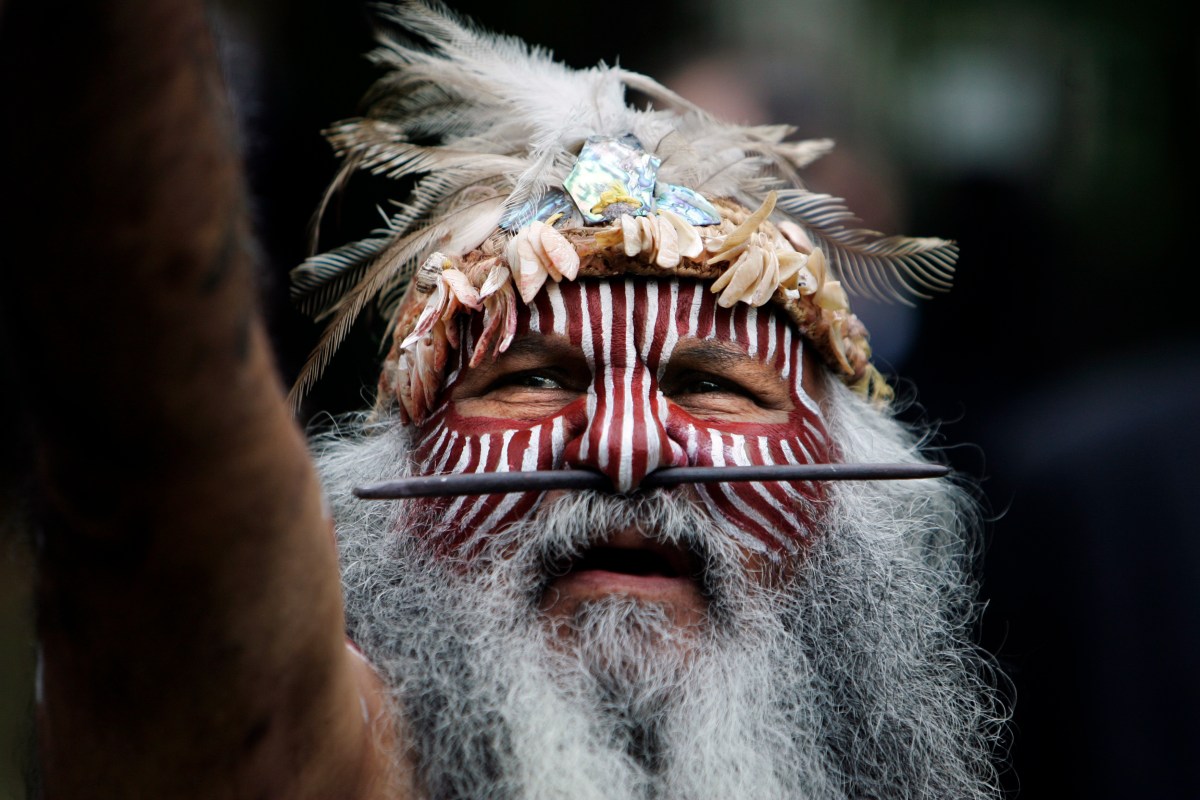
Elder Major “Moogy” Sumner has been honored with a lifetime achievement award and induction into the South Australian Environment Hall of Fame, National Indigenous Times reported on Oct. 5.
Sumner, a cultural ambassador of traditional culture who has long fought for protection of the environment, was honored at the South Australian Environment Awards.
He has also championed the Ngarrindjeri people and other First Nations people, and campaigned against systems that allowed rivers to be drained and oil and gas drilling in the Great Australian Bight, a bay off the southern coast of Australia, NIT reported.
“Aboriginal people are very patient people, but when we see that things are being done wrong, like they are for the river, we’ve got to come together and say it’s wrong, and do something about it,” Sumner said in a statement on the Hall of Fame website.
Sumner has helped the First Nations people in South Australia, reigniting ceremonial fires along traditional Aboriginal trade routes and reconnecting the area with traditional Ngarrindjeri canoe building.
He is also an artist, with his works covering traditional dance and song, arts and crafts such as wood carving, and martial arts techniques using traditional shields, clubs, boomerangs and spears, NIT reported.
“Caring for country is a profound connection of listening and looking after our environment and people – it is healing for our spirit,” he said, according to CBC News. “We truly are a force of nature – we come from nature. To look after country is to look after community.”
Sumner was one of ten SA Environment Award recipients, five of whom received lifetime achievement awards.
TANZANIA: ‘Shocking blow’ to Indigenous land rights
A Tanzanian court has dismissed a lawsuit filed by Maasai herders who are fighting government efforts to forcibly remove them from their lands to make way for a luxury game reserve, The Guardian reported on Oct. 5.
The herders are appealing the ruling by the East African court of justice, which activists said was a “a shocking blow” to Indigenous land rights, The Guardian reported.
The Maasai say the Tanzanian government is trying to evict them to make way for a United Arab Emirates company to open a game reserve, according to The Guardian.
Donald Deya, lead attorney for the herders and chief executive of the Pan-African Lawyers Union, said the ruling “disregarded the compelling multitude” of evidence presented in court.
The legal fight started in 2017, when residents of four Maasai villages in northern Tanzania went to court to stop the authorities evicting them from about 580 square miles of land in Loliondo, bordering the Serengeti national park. The lands are home to more than 70,000 Maasai.
The herders say the land has been rightfully theirs for generations, but the government says the land is within the park and used for conservation rather than being disrupted by human activity.
Evictions began in 2017 with what activists said were the burning of homes and confiscation of livestock. The government denied those actions, but a court order in 2018 temporarily halted the evictions.
New tensions erupted in June between police and Maasai demonstrators after government authorities began to draw land boundaries.
In the latest ruling, the court found that the Maasai had failed to prove they had been evicted from their village land and not from the Serengeti itself and did not provide evidence of loss or injury from the evictions.
NEW ZEALAND: Māori boxers climb in world rankings
Two Māori boxers are at the top of the heavyweight female rankings with negotiations underway to put them together in the ring, Te Ao Maori News reported on Oct. 8.
Lani Daniels, Ngāti Hine/Ngāpuhi, a three-time New Zealand boxing champion, is at the top of the ranking list by the World Boxing Council and Boxrec, and is ranked second by the World Boxing Association.
Sequita Hemmingway, Ngāti Tūwharetoa/Tūhoe, is ranked third in the World Boxing Association ranking. She moved up in the rankings after defeating previously unbeaten former New Zealand champion Alrie Meleisea before subsequently losing to Daniels.
Promoter Craig Thomson is in negotiations to put Daniels and Hemmingway together for a fight that could leave the winner in line for a world title fight, Te Ao Maori News reported.
Previously, three New Zealand women who have won the world title, including Daniella Smith, Ngāpuhi; Geovana Peres, who is the current International Boxing Federation super bantamweight champion; and New Zealand-born Australian Cherneka Johnson, Ngāti Ranginui.
AUSTRALIA: Government to review youth offender laws
Government officials announced they will undertake a review of youth offender laws after years of problems in Western Australia’s youth justice system, National Indigenous Timesreported on Oct. 4.
Corrective Services Minister Bill Johnston has ordered the Department of Justice to evaluate the success of the Young Offenders Act of 1994 in achieving its objectives.
Western Australia’s only dedicated youth detention facility, Banksia Hill, has been the scene of multiple disturbances, including riots in 2013 and 2017, National Indigenous Times reported.
Aboriginal children are overrepresented in the youth justice system in Western Australia, and are 21 times more likely than non-Indigenous youth to be incarcerated, according to recent data.
According to recent data, Indigenous young people are 21 times more likely than non-Indigenous youth to be incarcerated in WA.
Hannah McGlade, an Indigenous and international human rights law expert, said urgent reforms are needed.
“The review is important but there are immediate actions the government needs to take to ensure that the well-being of Aboriginal children and youth incarcerated at Banksia Hill and Casuarina Prison in particular is addressed,” she told the National Indigenous Times.
“A youth justice task force needs to be urgently established to address the crisis. There are serious concerns Aboriginal children and youth are at high risk of self-harm including suicide.”
She also called for the government to provide culturally appropriate health care from the Derbarl Yerrigan Health Service.”
McGlade said the Western Australia government has been repeatedly warned that mandatory sentencing laws are inconsistent with human rights obligations under international law and should be repealed.
The government should outlaw the use of solitary confinement and raise the age at which a child is held criminally responsible, she said.
My final thoughts
My final thoughts go to the 70,000 Maasai in East Africa who face eviction from their ancestral lands after an East African court of justice threw out their case against government authorities. The land reportedly is being considered for a luxury game reserve to be run by the United Arab Emirates. It is quite unfortunate that a government could do a thing like this to its citizens. The Maasai have appealed against the absurd ruling, and I hope that justice will prevail in this sensitive matter involving tens of thousands of Indigenous people in Tanzania.
Global Indigenous is a weekly news roundup published every Wednesday by ICT (formerly Indian Country Today) with some of the key stories about Indigenous peoples around the world.

Our stories are worth telling. Our stories are worth sharing. Our stories are worth your support. Contribute $5 or $10 today to help ICT carry out its critical mission. Sign up for ICT’s free newsletter.

