
Deusdedit Ruhangariyo
ICT
Around the World: Innu Nation draws firm line against mining; pipeline ruling deals blow to community justice; ancient Māori war cloak returns home; and Indigenous agriculture gains trust and market power in Australia.
CANADA: Innu Nation draws firm line against mining
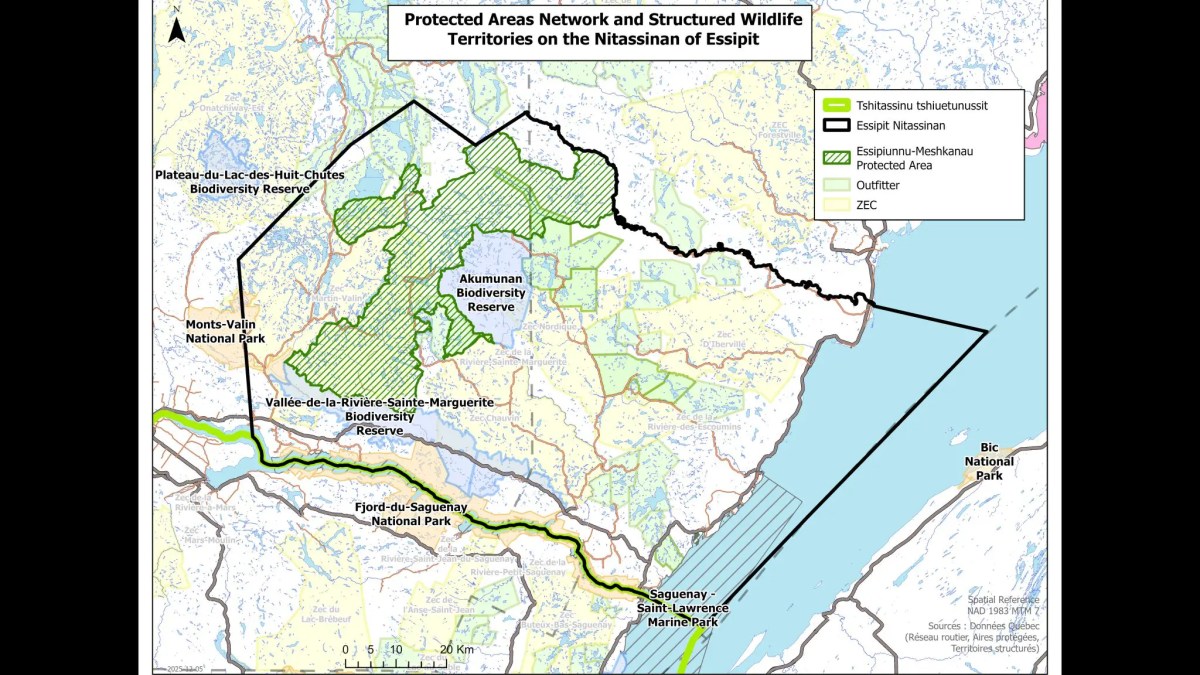
The Essipit Innu First Nation has drawn a clear boundary around its territory, announcing that mining exploration will not be permitted within a newly declared protected area on its ancestral lands. The decision, reported by APTN News on Dec. 12, reflects a broader assertion of Indigenous authority over land stewardship amid rising pressure from the mining sector.
On Dec. 9, Essipit leadership issued a public statement affirming that developers must stay out of the Essipiunnu-Meshkanau Protected Area, a 1,200-square-kilometer (463-square-mile) section of Nitassinan, the Innu homeland located north of the St. Lawrence River–Saguenay Fjord junction. The council emphasized its commitment to maintaining equilibrium between economic development and ecological protection.
While the Nation is firm in its refusal to allow exploration in the protected zone, it is not positioning itself in opposition to mining altogether. Instead, Essipit leaders have stressed their openness to dialogue and partnership with mining companies seeking to operate elsewhere within Nitassinan, provided projects respect Indigenous consent and environmental safeguards.
The protected area was officially announced in late November 2023 with the aim of preserving biodiversity, particularly critical habitat for caribou. Since then, interest in the mineral potential of the region has surged. According to Essipit officials, mining claims within the proposed protected area more than doubled over the past year, increasing from roughly 100 to 210 claims.
Michael Ross, Essipit’s director of territory and development, attributed the surge to Quebec government initiatives promoting exploration for rare earths and other strategic minerals. Even at the exploration stage, Ross warned, mining activity can significantly disrupt ecosystems through road construction, deforestation, land stripping, and drilling.
From Essipit’s perspective, such activities fragment the territory and threaten species the Nation is working to protect. This urgency prompted leadership to act decisively before potential mineral discoveries make conservation efforts more difficult to enforce.
Ross emphasized that collaboration remains possible outside the protected zone. Several mining companies, he said, have already engaged constructively with Essipit leadership and demonstrated an understanding of Indigenous priorities. When approached respectfully, mining projects can generate shared benefits, including regional economic development, employment opportunities for Essipit members, and returns for investors.
Still, the Nation is prepared to strengthen protections if companies attempt to proceed without consent. Ross noted that opposition from First Nations can significantly complicate projects, given their constitutionally recognized ancestral rights.
Beyond local benefits, Essipit leaders framed their initiative as contributing to broader environmental goals. Canada and Quebec have committed to protecting 30 percent of their lands by 2030, a target established at COP15. Essipit has adopted the same objective for its territory, aligning Indigenous stewardship with international conservation commitments.
EAST AFRICA: Pipeline ruling deals blow to community justice
Communities affected by the East African Crude Oil Pipeline suffered a major setback after the East African Court of Justice dismissed an appeal challenging the controversial project. The ruling, reported by Mongabay on December 8, effectively closes a landmark legal case that sought to halt or reassess one of the world’s longest heated crude oil pipelines.
First filed in 2020 by four African non-governmental organizations (NGOs), the case contested the pipeline’s environmental and social impacts, arguing that construction had proceeded without adequate public participation or environmental safeguards. The 1,443-kilometer (897 miles) pipeline runs from Uganda’s oil fields to the Tanzanian port of Tanga and is led by TotalEnergies alongside state-owned partners from Uganda, Tanzania, and China.
The pipeline cuts across more than 40 protected areas and passes near Lake Albert and Lake Victoria, two of Africa’s most vital freshwater sources. Its estimated carbon footprint – around 34 million tons of CO₂ annually – exceeds the yearly emissions of both Uganda and Tanzania combined.
In November 2023, the East African Court of Justice dismissed the case on procedural grounds, agreeing with government arguments that the NGOs had missed a 60-day filing deadline following the project’s 2017 agreements. The NGOs maintained they only became fully aware of the project’s details in 2020 and appealed for the case to be heard on its merits.
That appeal has now been rejected.
For affected communities, the decision was deeply disheartening. Balach Bakundane, a representative of the Uganda-based East African Crude Oil Pipeline Host Communities organization, said the ruling ignored the realities on the ground. According to residents, construction has already led to land dispossession, damaged livelihoods, and environmental degradation, including flooding caused by excavation work.
Bakundane described increased pressure from authorities, including police summons, aimed at silencing opposition. Despite this, he and others remain determined to resist. Communities along Lake Albert, he noted, are exploring alternative avenues for accountability and organizing stronger local resistance.
Legal counsel for the NGOs expressed frustration that evidence of harm would never be examined in court. With the legal route blocked, affected groups face an uphill battle in challenging a project that has already reshaped landscapes and communities.
Yet, Bakundane insisted that resistance would continue. For many, the struggle against the East African Crude Oil Pipeline has become emblematic of broader concerns about climate justice, community rights, and the limits of legal protection in the face of powerful extractive interests.
NEW ZEALAND: Ancient Māori war cloak returns home
An ancient Māori war cloak has returned to Aotearoa after decades overseas, marking a deeply emotional moment for cultural practitioners and museum professionals alike. The taonga, known as a pauku, was formally welcomed back to Auckland Museum, following its long-term storage at Durham University’s Oriental Museum in England, Te Ao Maori News reported on Dec. 12.
Only five such cloaks are known to exist. Woven using whatu patahi, a single-pair weft twining technique, the pauku was designed for close-quarters combat. Its dense construction, often strengthened by soaking in water or mud, allowed it to absorb blows while retaining flexibility – an early example of sophisticated textile engineering.
Expert weaver Kahutoi Te Kanawa, daughter of renowned tohunga raranga Diggeress Te Kanawa, explained that the cloak functioned as both armour and cultural expression. Holding or wearing the pauku during battle, warriors relied on ancestral knowledge embedded in its design.
The cloak’s rediscovery brought strong emotions. Māori researchers and weavers who examined it in Durham described the experience as overwhelming. Many museum staff were similarly affected, realizing the cultural significance of an object that had sat largely unnoticed in storage for decades.
Durham curator Rachel Barclay said the pauku revealed a level of textile innovation unmatched elsewhere. Unlike rigid armour, she noted, textiles respond dynamically to impact, offering protection through movement and resilience. Encountering Māori experts transformed the museum’s understanding of its responsibilities toward Indigenous collections.
Records show the cloak dates to the 18th century and was loaned to Durham in the mid-1960s before being formally gifted in 1971. Its exact origins remain unknown, but renewed engagement with Māori experts reshaped how the object was understood and cared for.
The return of the pauku reflects a growing global movement among museums to confront colonial collection practices and to work collaboratively with source communities. For Auckland Museum, housing the cloak now carries obligations of cultural safety, respect, and appropriate custodianship.
Beyond its physical return, the pauku symbolizes reconnection – between people and ancestors, knowledge and practice, and institutions and the communities whose heritage they hold.
AUSTRALIA: Indigenous agriculture gains trust, market power
Australian consumers are increasingly willing to pay a premium for authentic Indigenous agricultural products, according to a landmark report highlighted by the National Indigenous Times on Dec. 12. The findings suggest strong market potential for First Nations producers when cultural integrity and verified provenance are clearly established.
The Indigenous Agriculture Product Framework project found that more than half of surveyed consumers would prefer Indigenous products over comparable alternatives, while around 30 percent would pay extra for verified First Nations goods. The project was commissioned by the Department of Agriculture, Fisheries and Forestry and delivered in partnership with the National Farmers’ Federation and the Indigenous Land and Sea Corporation.
Project chair Natalie Sommerville said Indigenous agriculture already contributes an estimated $1.4 billion annually to the national economy and supports around 1,900 jobs. She emphasized that a culturally grounded credential could help Indigenous producers better differentiate their goods in domestic and international markets.
Importantly, the framework is not limited to bush foods or native species. It encompasses all agricultural products produced under Indigenous custodianship, reflecting the diversity of Indigenous engagement across Australia’s agricultural sector.
Industry leaders welcomed the findings. Wayne Bergmann of Kimberley Agriculture and Pastoral Company said a robust credentialing system could build consumer confidence while amplifying social impact. Such a framework, he noted, would support enterprises that employ Indigenous people, care for country, and reinvest benefits into communities – without imposing excessive administrative burdens.
Indigenous Land and Sea Corporation Chief Executive Joe Morrison described the project as a foundational step toward long-term economic self-determination for Indigenous producers. He stressed the importance of continued investment in skills, infrastructure, and business development to realize the sector’s full potential.
National Farmers’ Federation President Hamish McIntyre highlighted the collaborative nature of the project, noting that Indigenous producers guided its direction. Beyond certification, the process created space for producers to share insights, challenges, and aspirations for the sector as a whole.
International market access was also a key theme. Neal Finch of the Australian Wild Game Industry Council said a verifiable Indigenous credential could counter misinformation abroad and reassure overseas customers of ethical and sustainable practices.
Together, the findings point to a future where Indigenous agriculture is not marginal, but central – economically viable, culturally grounded, and globally competitive.
My final thoughts
Across continents, these stories reveal a common thread: communities asserting agency over land, culture, justice and markets in systems that have long sidelined them.
In Canada, the Essipit Innu Nation demonstrates that protection and development are not opposites, but choices that require consent and restraint. In East Africa, communities confronting the East African Crude Oil Pipeline expose the fragility of legal pathways when power, capital, and climate collide. In New Zealand, the return of a Māori pauku reminds us that cultural repair is as vital as environmental restoration. In Australia, Indigenous producers show that authenticity and stewardship can command trust – and economic value – in global markets.
What unites these stories is not resistance alone, but governance. Each case illustrates what happens when communities insist on shaping decisions that affect their futures. Where institutions listen, balance becomes possible. Where they do not, harm accumulates quietly.
As climate pressures intensify, the question is no longer whether Indigenous knowledge and community consent matter. It is whether systems are designed to honor them over time. These stories suggest that when agency is respected – whether in land protection, cultural heritage, legal struggle, or agriculture – the outcomes are not just fairer, but more resilient.
That lesson, spanning four regions this week, may be one of the most important signals for the year ahead.

