
Renata Birkenbuel
Special to ICT
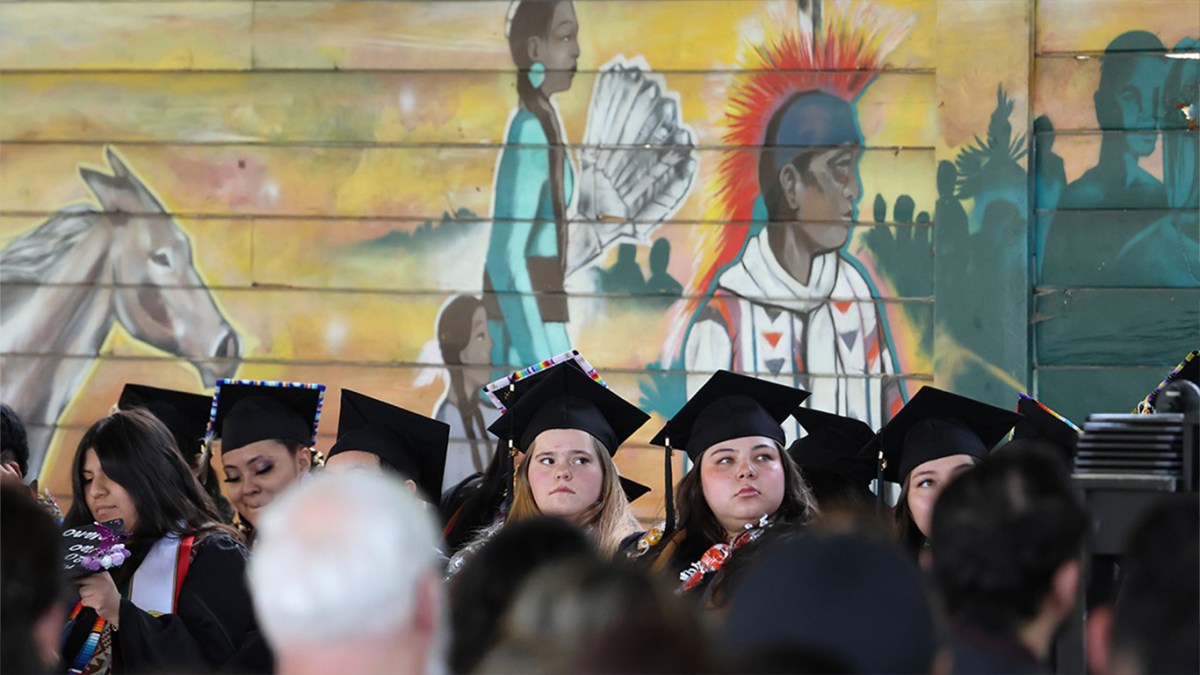
More Native students than ever before will graduate this year with regalia on their traditional caps and gowns as a growing number of states pass laws that allow beadwork, feathers, painting and other cultural adornments.
After years of facing possible removal from graduation ceremonies or confiscation of their caps or gowns, students in at least 20 states have now received official approval from their lawmakers to celebrate their heritage while they collect their diploma.
SUPPORT INDIGENOUS JOURNALISM. CONTRIBUTE TODAY.
“Graduation is a hard-won, major life accomplishment,” said Matthew L. Campbell, deputy director of the Native American Rights Fund. “No Native student should have to choose between their right to wear tribal regalia and attending their high school graduation ceremony.”
New Mexico is the latest state to enact graduation protections for Native students. Gov. Michelle Lujan Grisham signed into law Senate Bill 163 on March 19, granting leeway for students to express their cultural and spiritual heritage at school ceremonies.
Both chambers of the New Mexico Legislature gave unanimous support to the new legislation, which specifically prohibits school boards and charter schools from preventing Native students from wearing culturally significant clothing, accessories and objects during graduation events.
The new law went into effect immediately, just in time for this year’s graduation ceremonies.
“This legislation represents our commitment to honoring and respecting the rich cultural heritage of New Mexico’s Native communities,” Grisham said at the signing. “Every student deserves to celebrate their academic achievements in a way that honors their identity and traditions.”
Nineteen other states now have similar laws, according to the Native American Rights Fund, including Alaska, Arizona, California, Colorado, Illinois, Kansas, Michigan, Minnesota, Mississippi, Montana, Nebraska, Nevada, North Carolina, North Dakota, Oklahoma, Oregon, South Dakota, Utah, and Washington. Regalia bills are also pending in Wisconsin.
“Whether an eagle feather or plume, beadwork, sealskin cap, moccasins, or other forms of traditional dress, tribal regalia plays a unique role, spiritually and culturally, for graduating Indigenous students,” according to a statement from the American Civil Liberties Union.
‘Disruptions’
The legislative victories have come after long-fought battles to allow regalia at graduations.
Bestowing an eagle feather or plume on graduate graduation caps, for example, can represent honesty, truth, majesty, strength, courage, wisdom, power, and freedom among many of the 574 federally recognized tribes in the United States.
Some school officials, however, have maintained the adornments cause “disruptions” for graduation ceremonies, or violate dress codes.

In 2024, several incidents upended graduation for Indigenous students. In Tacoma, Washington, a public school student was told she couldn’t collect her diploma wearing a sacred button blanket that she had been given by her tribe. The student filed suit in late 2024.
And in Farmington, New Mexico, a school official confiscated a student’s graduation cap that had been beaded around the rim and included an eagle feather. The incident sparked outrage from the Navajo Nation.
A Native student in Oklahoma also sued after officials tried to take an eagle plume from her cap during the ceremony. And in Liberty Hill, Texas, near Austin, a Navajo student was told she could not graduate with purple beading and a feather on her graduation cap.
Two school principals last year in southern Utah tried to bar two Native students from wearing forms of tribal regalia at their graduation ceremonies, and in Montana, a school administrator prevented a student from wearing a graduation cap that had been painted with a Native design by his grandmother.
The turmoil can cause unnecessary stresses for Native students who should be celebrating their big day.
Sarah Adams-Cornell, a Choctaw Nation parent and a board member of the ACLU Oklahoma, said in a national 2023 ACLU video on tribal regalia that the first time she tried on her own Choctaw dress was pivotal to her identity.
“I feel the gravity as an Indigenous person to have all those things stripped from us, to have assimilation policies and boarding schools,” Adams-Cornell says in the video. “And there is this incredible time that we get to live in right now to reclaim and restore Indigeneity. I feel that if people understood the meaning behind these items, they can understand why it’s important that our kids have the opportunity to wear them at graduation.”
Her daughter, college graduate Isabella Blu Aiukli Cornell, connects regalia to storytelling.
“Representing yourself and your culture is an honor and everybody should be able to do it,” Cornell said in the video. “Our regalia has stories in it. It tells us who we are as people.”
Resources abound
Resources are available for students to learn about their rights in their state or local community.
The Native American Rights Fund posts a guide for wearing eagle feathers at graduation, and school personnel may also access a Native American Rights Fund guide on how to handle the wearing of regalia.
NARF often advises students and their families on regalia questions, especially as commencements approach. Every year, concerned families inquire about possible bans on wearing eagle feathers or traditional outfits at graduation ceremonies.
The American Civil Liberties Union also provides guidance on the issue of regalia, with a “Know Your Rights: Tribal Regalia” guide on its website.
Angelique Albert, Native Forward Scholars Fund chief executive and Confederated Salish and Kootenai Tribes, said wearing regalia is one way to increase visibility of Natives in higher education.
Since its founding 50 years ago, Native Forward Scholars Fund has awarded $400 million in scholarships and provided follow-up services for more than 22,000 students from more than 500 tribes in all 50 states. Recipients include those studying in undergraduate, graduate and professional degrees programs.
Education remains key
Education remains key to broadening the understanding of public displays of Native pride and recognition, said Cheryl Crazy Bull, Sicangu Lakota and president of the American Indian College Fund.
“Laws such as those passed by the New Mexico legislature affirm Native students’ right to celebrate their cultural identities during events — graduations, convocations, ceremonies — that are also a time when Native people reclaim education,” said Crazy Bull, otherwise known as Wacinyanpi Win, translated as “They Depend on Her.”
“Our historical experience with boarding schools and removal from our communities means we are still striving for that reclamation,” Crazy Bull said. “For Native people, education is an opportunity and a celebration.”
As the coalition of pro-regalia states has increased, so has school recognition.
In May 2024, a feather-tying ceremony at a joint commencement of Bismarck Public Schools and Mandan Public Schools celebrated Indigenous graduates’ achievements and their protected rights to wear eagle feathers and tribal regalia.
“The College Fund joins with Native Scholars Fund, AISES, and Cobell Scholarships to also celebrate students’ education achievements through our online graduation walk,” added Crazy Bull, who encourages recipients to share their experiences. “All graduates can join the celebration by posting their photos and videos to their social media channels with the hashtags #NativePathways and #EducationIsTheAnswer.”
Josett Monette, Turtle Mountain Band of Chippewa Indians and secretary of New Mexico Indian Affairs, wants the New Mexico law to ease student fears. She is also the mother of three public school graduates.
“I’m hopeful that this just makes one of those steps a little bit easier for students.” Monette said. “To be able to say, I know I get to wear my moccasins if I want to. I know I can wear my traditional dress if I want to, or I can wear my traditional slacks or a ribbon or whatever it may be if I want to.”

Our stories are worth telling. Our stories are worth sharing. Our stories are worth your support. Contribute today to help ICT carry out its critical mission. Sign up for ICT’s free newsletter.

