
Mary Annette Pember
ICT
My birthday was last month. Like many of my past celebrations, (I’m not revealing how many) the festivities were muted but loving, roses and a breakfast pastry from my husband, handmade cards from my children, texts and emails from friends and colleagues.
This year, however, I received something momentous, the gift of a lifetime.
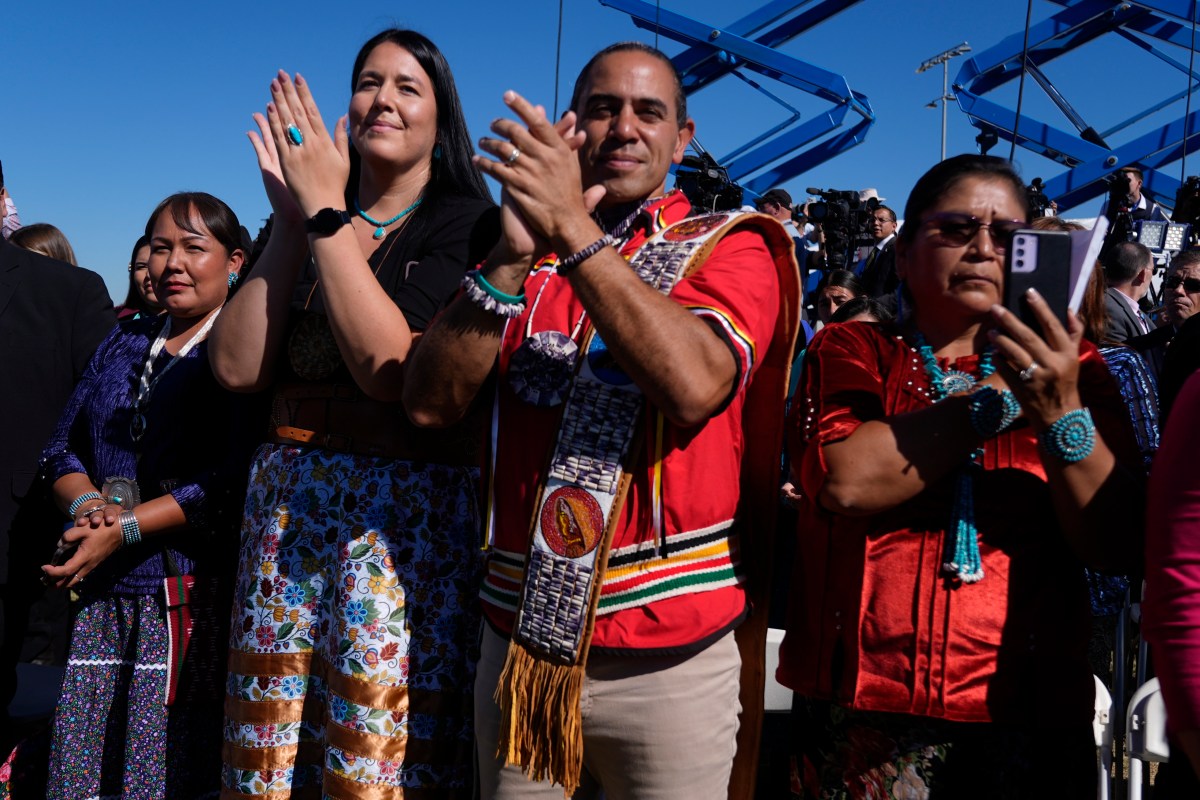
President Joe Biden apologized to Native Americans on behalf of the United States for our country’s past Indian boarding school policies, part of the nation’s assimilationist agenda that sought to wipe out Native people, culture and language.
SUPPORT INDIGENOUS JOURNALISM. CONTRIBUTE TODAY.
As a journalist, it doesn’t get much better than this. I had the honor of writing about his speech and apology delivered on the lands of the Akimel O’Ootham (Pima) people at the Gila River Indian Community south of Phoenix.
I harbor no illusions that an apology without any specific deliverables offered on the eve of a desperately close presidential election could wipe out the generational effect of 150 years of entrenched racist federal policies. But for me and many others who have reported on this issue over the years and worked to bring it to the attention of the American public, the apology represents an essential first step, acknowledging the truth.
Unlike the apologies offered in 2022 by Pope Francis in Canada for the role of the Catholic Church in operating residential schools there and that of the U.S. Conference of Catholic Bishops in 2024 for the churches’ role here, President Biden did not qualify his words.
His apology wasn’t a half-hearted attempt to shift responsibility away from the federal government. He described the intentional destructive nature of assimilationist policies, which mandated the removal of tens of thousands of children from their homes and communities, the horrific abuses at the schools that traumatized and sometimes killed generations of Native children. He observed that Native people today continue to suffer from the pain and fallout from these policies.
President Biden also noted that accounts of these policies are a chapter of history that most Americans have never heard about.
“I have to ask myself,” said Jennifer Wood of the Neyaashiinigmiing First Nation Ojibway. “How come a country as large as the United States of America didn’t know enough to apologize for the atrocities of taking children and forcing them into boarding homes?”
Miles Morrisseau, ICT’s special correspondent in Canada, quoted Wood, a survivor of Canada’s Indian residential schools, in his story about Canada’s reaction to Biden’s apology.
The answer is simple. Americans ignored this history because they could.
I recall an article I wrote in 2011 for the Tribal College Journal about a non-Native man, Roger Bollinger, who returned a photo album to Haskell Indian Nations University. He had no information on how the 1884 leather bound album of photos of the school’s first class of students came to be in his family’s possession. But sensing it was important somehow, he chose to donate it to Haskell’s Cultural Center.
During our telephone conversation, Bollinger described himself as a supporter of education and cultural understanding. He was skeptical and dismissive, however, of my claims that many Native children didn’t go willingly to boarding schools and that the early curriculum was aimed at destroying Native culture and language.
Bollinger gently glossed over my claims. He speculated instead that the schools were created to “educate Indians in an organized fashion so that they might better survive in the White man’s world.” To his credit, Bollinger noted that unfair things may have happened in the past and that “the early relationship between Whites and Indians was a clash of cultures that evolved over time.”
In covering President Biden’s apology, I thought of Mr. Bollinger again. I envied his luxury of ignorance and casual relationship with history. I wonder, even today, if there were a choice involved, would I also embrace the soothing myth most Americans hear about this country’s relationship and history with its Indigenous peoples? That myth is one of an inevitable, righteous Manifest Destiny in which a few Native people were unintentionally sacrificed for the greater American good.
It’s certainly more noble than the truth in which Indigenous lands, culture, language and children were stolen and sacrificed through federal policies specifically designed to eradicate us as a people.
But like many Native people, I have no choice in the matter. Instead, I’ve lived with the relentless repercussions of the boarding school experience through my mother’s mysterious, inexplicable shame and anger, her unacknowledged mental illness and fear. My mother was taken from her family at age five and sent to St. Mary’s Catholic Indian boarding school on the Bad River Reservation in Wisconsin. The people called it “the Sister School.”
Her stories have always been with me, occupying the fish bowl world she created for us, the place where she could safely share her secrets. She whispered them to me at night in bed; they became my awful childhood fairy tales.
But telling her little girl didn’t lessen the power of the stories’ evil over her. The legacy of the beatings, humiliations, loneliness, helplessness, and resentment were simply handed on to us, her children. That bequest survived in the often-misguided ways she tried to mother us, devoid as she was of the experience of family.
Eventually I began to work my way through all the secrecy and shame towards knowledge and understanding of hers and of others boarding school histories. As I matured, her stories took on a special directive, placing me on a life-long quest to tell the world the truth of all that happened not only to her but to generations of Native children.
And so, this strange, inexplicable quest has dominated my personal and professional life for decades as I’ve explored the real destructive intentions of federal Indian policies and the subsequent impact of generational trauma on families.
In the process, I’ve received a measure of personal healing and peace, a sort of authority over all that happened, an authority that comes with knowledge even if the truth is ugly. This year, I finished writing a book, “Medicine River,” about the subject and my family’s experiences.
During many years researching the book, I covered the work of Canada’s Truth and Reconciliation Commission, which was kicked off in 2008 by an apology from then-Prime Minister Steven Harper for the country’s Indian residential school policies, similar in scope and design to those in the U.S.
Wilton Littlechild, a residential school survivor from the Ermineskin Cree Nation who served on Canada’s Truth and Reconciliation Commission, told me in a 2014 interview that when the commission began its work in 2008, only 5 percent of the Canadian public claimed any knowledge of Indian residential school history. But in a 2023 interview, Littlechild said that a subsequent poll showed that 59 percent of Canadians had knowledge of that history.
Now, here in the U.S, after Secretary of the Interior Deb Haaland launched the Federal Indian Boarding School Initiative in 2022 which included two volumes of investigation into this country’s boarding school history, it appears Americans are making their first steps towards learning that past.
President Biden described his apology as the culmination of decades of work by many people like Haaland, Laguna Pueblo, whose grandparents attended boarding schools.
“They include survivors, descendants, allies and advocates including the National Native American Boarding School Healing Coalition,” he said.
But the apology doesn’t represent a conclusion, according to Biden.
“While darkness can hide much, it erases nothing,” he said.
Then, slapping the podium for emphasis like an old-time elder, he said, “We must know the good, the bad, the truth of who we are as a nation. We remember so we can heal as a nation.”
He added, “There is a lot more to do, but today we’re finally moving forward toward the light.”
Indeed, for advocates like Deb Parker, chief executive director of the healing coalition and a citizen of the Tulalip Tribes, this is only the beginning.
“The hope is that this apology from the president will bring forth passage of the Truth and Healing Commission on Indian Boarding School Healing Act now before Congress,” Parker said in an interview.
The act would establish a commission to formally investigate, document and report on histories of boarding schools, and develop recommendations promoting healing for survivors, descendants and communities.
And so the work continues, even in these uncertain times when justice and meaning feel elusive.
As Leo Tolstoy instructed so long ago, “We add our light to the sum of light.” In this way we chart a way forward for Native people and the country.
Editor’s note: ICT National Correspondent Mary Annette Pember’s book, “Medicine River: A Story of Survival and the Legacy of Indian Boarding Schools,” is expected to be released in April 2025 by Penguin Random House.

Our stories are worth telling. Our stories are worth sharing. Our stories are worth your support. Contribute today to help ICT carry out its critical mission. Sign up for ICT’s free newsletter.

