
This story was originally published by the Maine Morning Star.
Emma Davis
Maine Morning Star
Maine led the country in enshrining the “right to food” in its state constitution. But the subjugation of the Wabanaki Nations has complicated that right for the original inhabitants of the land.
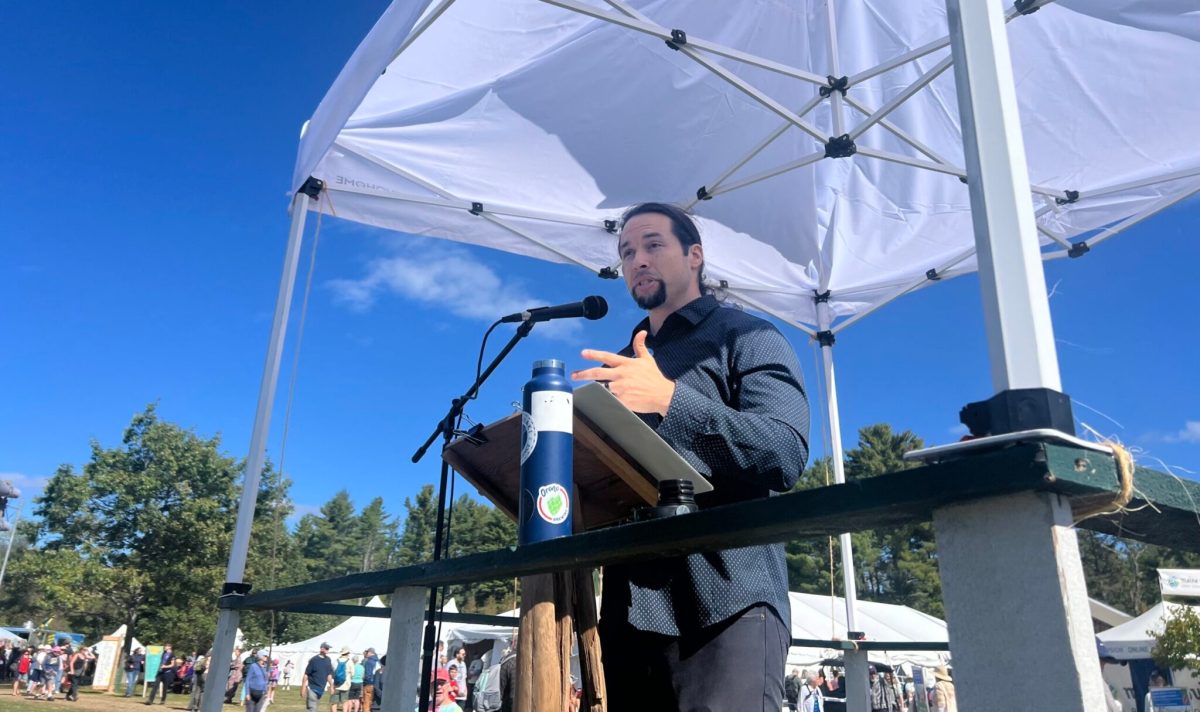
Anthony Sutton, assistant professor of Native American Programs and Cooperative Extension at the University of Maine, highlighted the differences between the traditional ways Indigenous communities use natural resources for food and cultural practices and the state’s current food sovereignty laws during his keynote speech at the Common Ground Fair in Unity on Friday.
“If we’re going to do the work of food sovereignty seriously, we need to recognize the rights that are allowed and the ones that aren’t,” said Sutton, who is also a faculty fellow of the university’s Senator George J. Mitchell Center for Sustainability Solutions.
In 2021, Maine became the first state to establish a right to food in its state constitution when voters approved an amendment by referendum. This right is defined as the ability of all people to “grow, raise, harvest, produce and consume the food of their own choosing for their own nourishment, sustenance, bodily health and well-being.”
The amendment built on the state’s food sovereignty law passed in 2017, which lets municipalities adopt ordinances that exempt local and direct producer-to-consumer food sales from some state regulations.
When Maine established these rights, Sutton said his Passamaquoddy mentor Ed Basset asked: What does this mean for tribal sustenance?
The Wabanaki Nations – the Houlton Band of Maliseet Indians, Mi’kmaq Nation, Passamaquoddy Tribe and Penobscot Nation – are treated differently than other federally recognized tribes. This is because of a 1980 land settlement agreement that has left them with a relationship to the state more akin to municipalities than sovereign nations.
The Tribes have been pushing for legislative changes that recognize the Wabanaki Nations’ inherent rights to self-governance, economic development and resource management for years. But Gov. Janet Mills, a Democrat, has so far rejected overhauling the agreement and instead approved some piecemeal adjustments on a case-by-case basis.
While Maine’s food freedom policies allow municipalities to manage local food businesses as a form of economic security, Sutton pointed out that the municipal distinction given to Wabanaki governments has had negative impacts.
A 2022 Harvard Kennedy School study concluded that the Wabanaki Nations’ inability to self-govern has stunted economic growth, both their own and the state’s.
Definitions are key when considering the impacts of state laws on tribal rights, Sutton said.
From the state of Maine’s perspective, sustenance means, “if I grab a fish out of the Unity stream with my bare hands, because that’s how I fish,” Sutton said jokingly, “and I put it on my table for my family, that’s sustenance.”
But Sutton said that definition oversimplifies sustenance and avoids the complex ways people of different backgrounds access and use food. That way of defining sustenance also has consequences for the broader idea of food sovereignty.
Quoting academic Raj Patel, known for his writings on global food injustice, Sutton said, “If we talk about food sovereignty, we talk about rights, and if we do that, we must talk about ways to ensure those rights are met across a range of geographies by everyone in substantive and meaningful ways.”
For example, Maine’s food sovereignty legislation centers small-scale “traditional” farming.
“Whose notion of traditional are we using?” Sutton questioned. “If we’re going to go real tradition, we would start with our creation stories, the stories that not only teach us skills, but the values and knowledge needed for caretaking.”
Municipal boundaries are another complicating factor when assessing tribal sustenance under the state’s food freedom laws, Sutton said.
While these policies support local food production within municipal boundaries, he explained that many Wabanaki foodways require movement that transcends such artificial boundaries.
“It’s the movement between those places and the knowledge systems that makes growing and distributing corn possible today, though Maine’s sovereignty legislation isn’t particularly good at dealing with movement,” Sutton said.
Land disposition also plays a role, as the Wabanaki Nations today have ownership over only a fraction of the land they originated.
“In short, non-Indigenous management systems are not good at thinking about the future — five, 10, 20 years, maybe, sure,” Sutton said. “But in Wabanaki notions of care, we’re considering how we act shapes the future abilities for our grandchildren’s grandchildren to be in relation with the land and water, which is something that we can all benefit from.”
The Maine Legislature is expected to consider another omnibus tribal sovereignty bill when lawmakers reconvene in January. That legislation aims to adopt the recommendations from the task force the state convened to study the settlement act in 2019. Several suggestions included changes that would provide the Wabanaki Nations with the authority to restrict hunting and fishing by non-tribal citizens on tribal lands.
Another bill that will be up for debate would provide an exception to Penobscot Nation citizens to prohibitions against buying, selling or offering for sale certain wild animals and wild birds.
Lawmakers could also consider a proposal to send another constitutional amendment to the voters to establish the right to hunt and fish. The chambers couldn’t agree on it this year and the bill was ultimately carried over into the next session.

