

Jordan Hansen
Daily Montanan
Sharing her story of being trafficked publicly for the first time, Cassie Hammond barely flinched.
For over 20 minutes during a Criminal Justice Oversight Council meeting last week, Hammond, part of a panel discussing human trafficking, articulated a story of terror, deception and pain.
She told the council about her captivity and brought specific asks of the body.
One of the main ones — echoed by other victim advocates — is to help train law enforcement on the signs of human trafficking. And more importantly, they said, how to get victims out of the situation.
“No officer ever made me feel comfortable enough to disclose what was really happening in my life. I was treated as a criminal, just another addict, another problem, when in reality, I was someone’s daughter being sold,” said Hammond, a victim advocate from Billings who survived almost five years of exploitation in Las Vegas, “That fear kept me silent. I wish every law enforcement agency required trauma-informed training. Officers need to recognize the signs of exploitation and how to respond in a way that makes victims feel safe.”
For nearly two hours last week, Montana’s Criminal Justice Oversight Council heard testimony from Hammond and other human trafficking victims along with requests for more funding and better training on the issue for state employees.
The state has taken steps in recent years to address human trafficking — including SB 245 in the 2025 legislative session, which trains bus drivers on the issue — but more emphasis on the issue is needed, advocates said.
Representatives from the Yellowstone Human Trafficking Task Force spoke for more than an hour to members of the committee, which includes legislators and representatives from multiple state agencies.
Two victim advocates shared deeply personal stories of being groomed, sold, raped, beaten, and cut off from their families during the meeting. They also explained why education on the issue is vital. State law enforcement officers are only required to have four hours of training on human trafficking.
The task force is a nonprofit co-founded in 2016 by Penny Ronning, who also spoke to the council — her mother was a human trafficking victim, she said. Around 2010, Ronning was a Court Appointed Special Advocate in Billings and worked with kids who had been trafficked.
“My very first CASA case that I had, it was a young, 15-year-old girl who was trafficked here in Billings through a fast food restaurant,” Ronning told the Daily Montanan in an interview. “And that’s when I learned that what had happened to my mom in the early 1940s in rural South Dakota was happening today to children in the community in which I lived.”
The task force has grown in size and scale over the past few years, becoming a nonprofit in 2020.
The task force was created to coordinate law enforcement, service providers, community groups and volunteers in the Yellowstone County area, the organization’s website states.
It’s also looking to help those groups “investigate and prosecute traffickers and buyers, to assist victims of labor and sex trafficking, to increase community awareness, and prevent future trafficking.”
Multiple members of the Federal Bureau of Investigation are on the task force, as is assistant U.S. Attorney Zeno Baucus. The Bureau of Indian Affairs and the state’s Department of Justice are among the many supporters and partners of the task force, according to the organization’s website.
Ronning said the organization has been invited to the White House twice and works closely with U.S. Sen. Steve Daines, a Republican, and previously worked with former U.S. Sen. Jon Tester, a Democrat, along with other politicians across the political spectrum. It has also begun work with two other members of Montana’s federal delegation, U.S. Sen. Tim Sheehy and U.S. Rep. Troy Downing, Ronning said.
The organization was awarded the FBI Director’s Community Leadership Award in 2021.
The organization was invited to be part of the panel earlier this year, which Ronning said they were “thrilled by” and provided statistics before the council heard from the victim advocates.
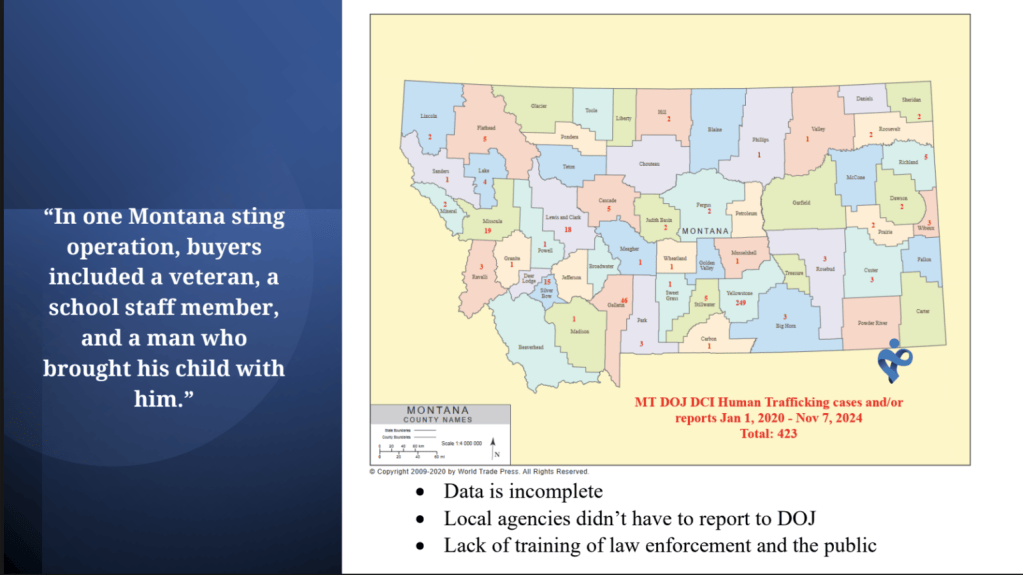
Data on the issue is a major hurdle, Ronning said, saying police reports do not always “separate prostitution and human trafficking” because they were not able to identify the difference, which she called “problematic.”
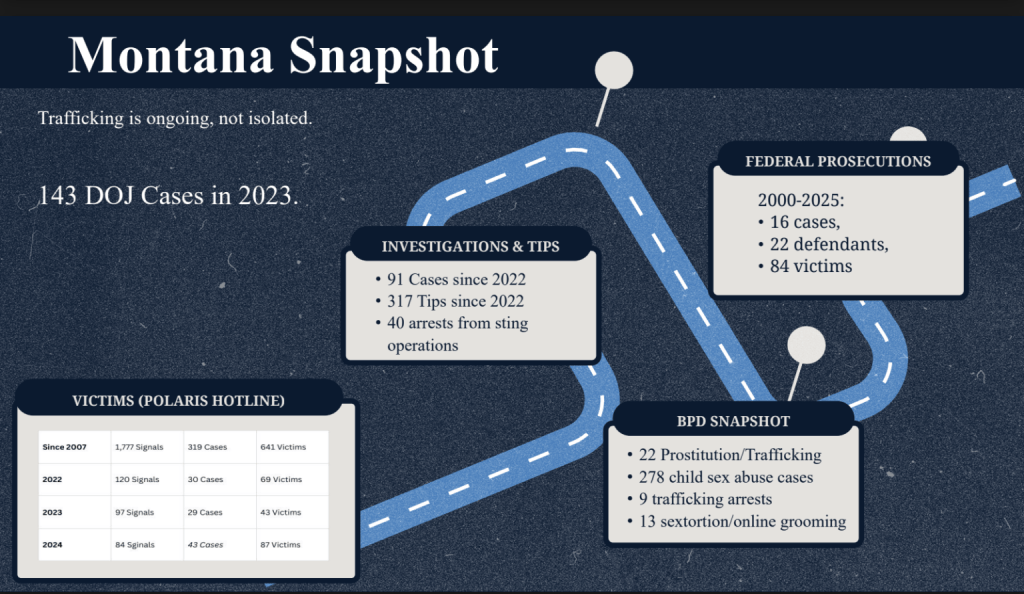
The state Department of Justice had 91 human trafficking cases and 40 arrests since 2022, according to data from the task force. But those numbers are likely low in relation to how common human trafficking is, Ronning cautioned.
Ronning also pointed to a large-scale study from Polaris, a human trafficking advocacy organization. It found that 90 percent of those trafficked are women and up to 50 percent are minors. Native American and Alaska Native women, who face high rates of sexual violence — over half experience it in their lifetime, according to the National Congress of American Indians — account for about 40 percent of sex trafficking victims, according to the University of Cincinnati.
According to the BIA, approximately 4,200 missing and murdered cases remain unsolved in the country.
Lea Wetzel, a victim advocate, also recounted her story to the council. She works with the state Department of Public Health and Human Services, and is an alternate for the Blackfeet Tribe on Montana’s Missing and Murdered Ingenious Women task force.
She thought he was a handsome guy, but said she was then manipulated.
“This is known as a Romeo-style grooming, and it works especially well on young people from small towns and rural states, because we don’t know any better,” Hammond said. “It feels new, exciting, glamorous. It feels like someone has come along like a white knight to fix all your problems, but not everything that glitters is gold. And in this case, what looked shiny and glamorous was in reality dark, violent and gruesome.”
Hammond said in Las Vegas, she moved to different strip clubs and between multiple traffickers. She eventually escaped after help from her mother.
“His violence escalated so badly over the years that I knew that if I didn’t get out, I was going to die. And at that moment, I decided that the risk of telling my mom the truth was less than the risk of staying,” Hammond said. “My mom bravely befriended my trafficker, and after six months of building his trust, she convinced him to let me come home temporarily to care for my grandfather. Once I was past airport security, I felt like I could breathe for the first time since October 6, 2011.”
Montana has taken steps to address the problem, with the state hiring full-time human trafficking investigators in 2019 after legislative action. The nonprofit has also pushed for a better phone tip hotline — which has gotten almost 400 tips in the last three years — which has helped with the speed of law enforcement response. Prior to advocacy on the issue, the phone line was operated by people out of state and communication speed is a problem the task force has sought to highlight.
Ronning would like to see increased trauma-informed care among law enforcement and corrections employees to help identify victims of human trafficking. The task force would also like to see more investigators, and it’s working on an assessment tool in partnership with the state Department of Corrections.
“There’s a need for those victims who have been incarcerated to be identified as victims of human trafficking,” Ronning said.
She said if people who are forced into crime need to get proper services, and those who work with them need to understand “forced criminality.”
“We need to be taking a different look at this,” Ronning said.
Human trafficking victims are sometimes arrested on prostitution charges, she said, and there’s a want to decriminalize the victim. That doesn’t, however, mean Ronning nor the organization support legalized prostitution, which she said would make things worse.
“Wherever full decriminalization has happened, now you’ve told violent individuals it’s fully legal to go rape that vulnerable person,” Ronning said. “Now it’s fully legal to go be violent against that individual who is now deemed a sex worker. What we know in prostitution is that 98 percent of what we would call victim workers in prostitution are not there because that is what they’re choosing to do.”
The organization has also been active in Billings, helping to push an ordinance targeting illicit massage parlors. Ronning is a former city councilor who also ran in the Democratic primary for the U.S. House of Representatives in the eastern district.
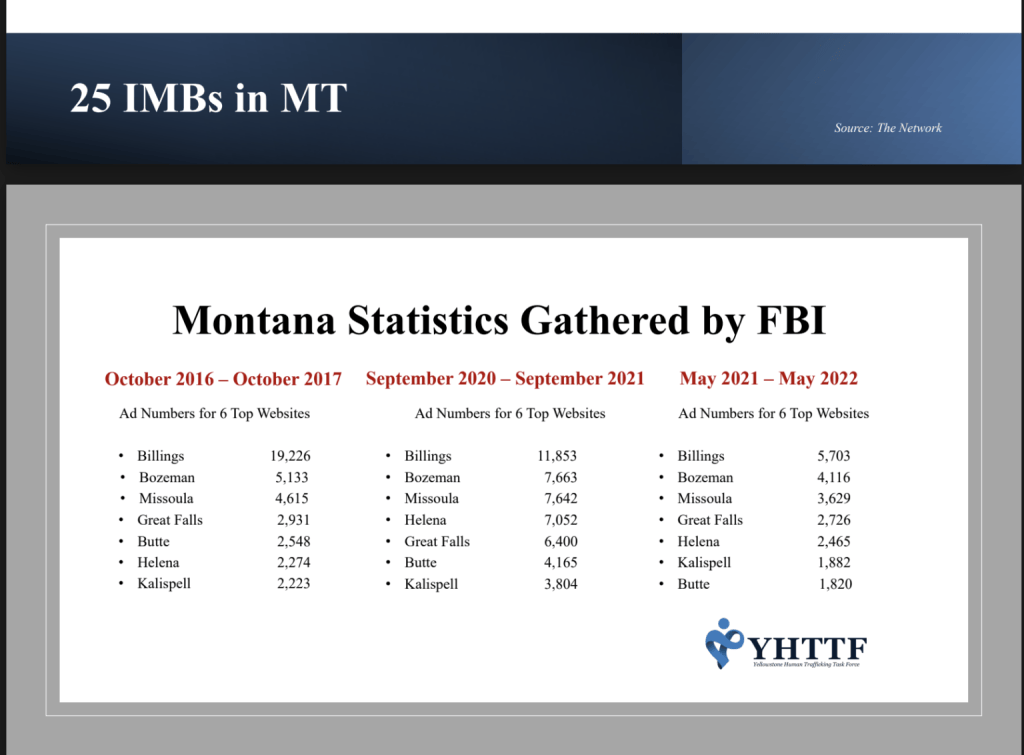
One female victim could generate between $3,800 to $18,000 a month, Ronning said. Part of the fight against trafficking, Ronning said, is understanding how traffickers are using technology to find their victims.
“Technology is evolving, so this is what we have to be focused on when it comes to youth,” Ronning told the committee. “This is how trafficking is happening now. It’s happening through digital means. This is the way that the trafficker and the buyers connect, and this is the way that victims are sold, and this is the way addiction to pornography is is really pushed through the algorithms.”
Bots using artificial intelligence to find buyers are one way law enforcement has used technology to fight human trafficking, something Ronning would like to see come to Montana.
Montana has begun to look at ways to address the issue — Rep. Amy Regier, for example, brought House Bill 408 during the 2025 Legislative session, which would have required companies to put an obscenity filter on electronic devices. That bill ultimately stalled in the Senate’s judiciary committee and was supported by the task force.
The effort built on laws passed during the 2023 Legislative session requiring adult websites to have age verification. Montana also passed Senate Bill 413, from Helena Democrat Sen. Laura Smith, surrounding so-called “deep fake” pornography, especially targeting images created by artificial intelligence software.
Regier said they need to look at putting “sideboards for kids” on some of this technology. She said it’s important to figure out what human traffickers are using and how they’re using it in order to stop it.
“It seems that the internet has a huge impact on human trafficking,” Regier said last week.

