
Sandra Hale Schulman
Special to ICT
The latest: New murals by a ‘shop tattoo’ artist raise questions about identity, an art installation focuses on immigration, and a film looks at high school mascots.
ART: New outdoor installation features tattoo art
Artist Cheyenne Randall is known for his “Shopped Tattoos,” where he layers tattoos that tell stories onto celebrities and historic figures while upending material and popular culture.
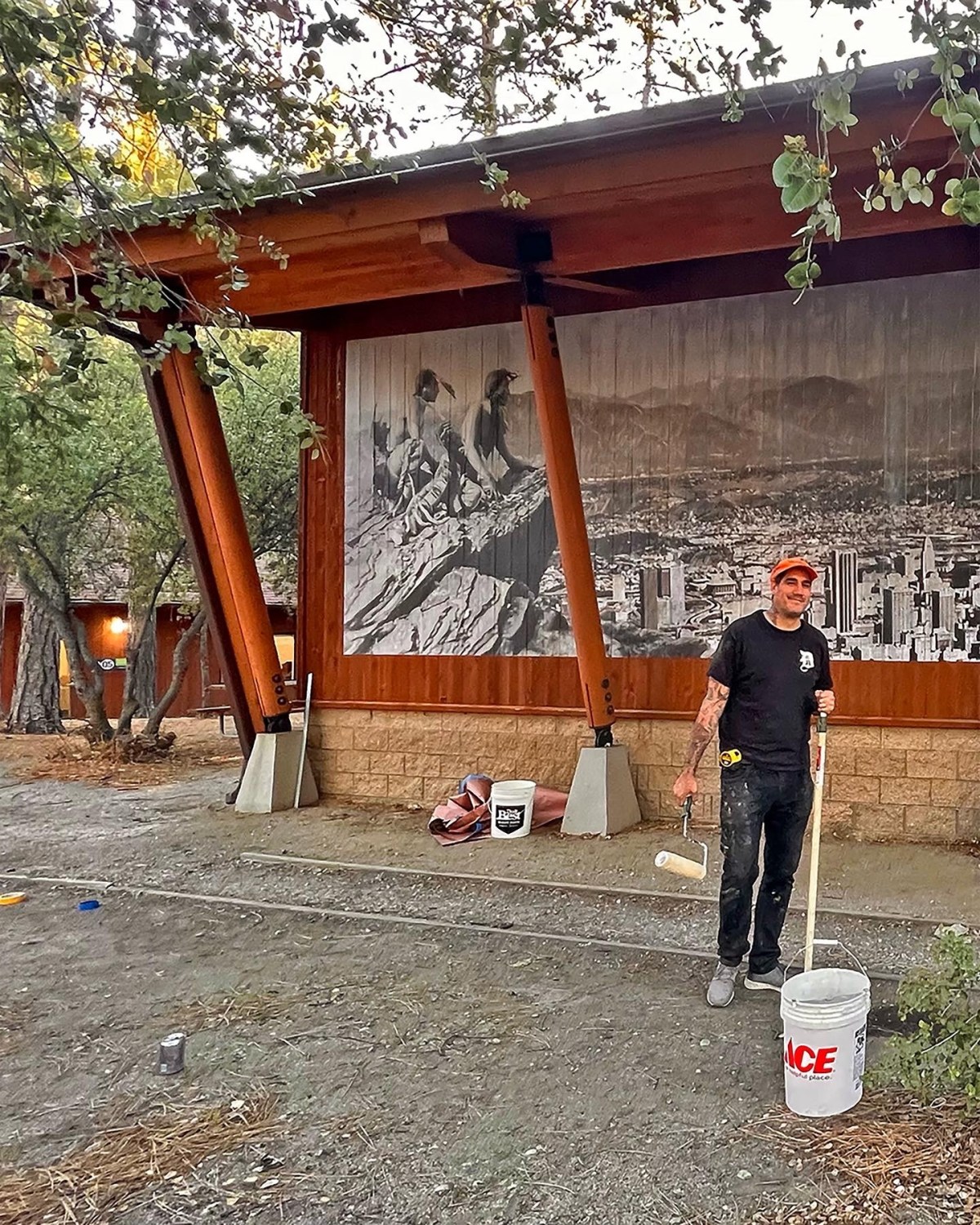
Exploring new visual realms, Randall, Cheyenne River Sioux, works in digital photography and paint, creating images online then blowing them up in print and wheat-pasting them onto the sides of walls.
In his latest installation, “Cheyenne Randall: Paste, Present, Future,” at the Idyllwild Arts Foundation and the Native American Arts Center in California, he has created four site-specific murals on outer walls, blending images of celebrities, Indigenous people depicted by non-Natives including Edward Curtis, and landscapes, with tattoo designs, text, and collage.
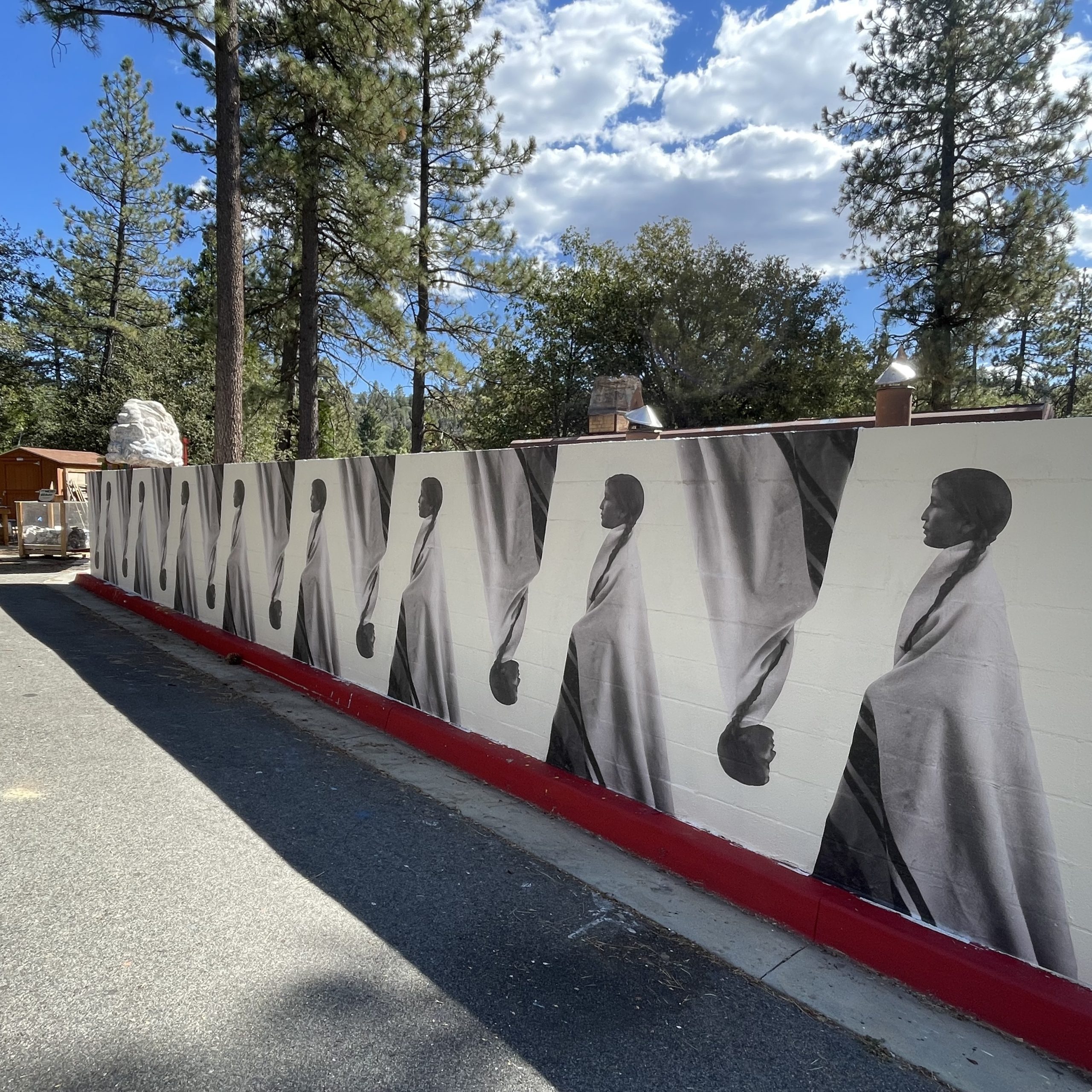
“I vandalize pop culture and experiment with tattoo design and placement in my work,” Randall said in a statement. “I am a self-taught artist, raised outside of my tribal lands. My intent with this installation is to ignite curiosity for viewers and create conversation around the ‘pre-history’ of America.”
Randall has been working in mixed media for 20 years. His work has drawn the attention of Hollywood’s designers and landed in the pages of Architectural Digest. He has created work for major motion pictures and done private commissions for musicians and actors.
SUPPORT INDIGENOUS JOURNALISM. CONTRIBUTE TODAY.
A non-commissioned project called #PastingtheWest found him pasting billboard-size images across abandoned barns and homes, leaving them either to be found or decay. The project led to a residency at the Heard Museum in Phoenix, and commissions in hotels, restaurants, and private homes.
The exhibition, organized by independent curator and art scholar Erin Joyce, went up Sept. 19 and will continue until natural elements, weather, and time deteriorate the papered murals.
ART: Installation mimics passport office
Inside the Idyllwild Art Center in California, Indigenous Mexican artist Erika Harrsch creates “Moving in the Borderlands” in the Parks Exhibition Center through Nov. 30.
As an immigrant who played the immigration lottery system, she presents, “United States of North America Passport,”; an installation that transports viewers into a passport office.
But this passport office has arbitrary borders between Canada and the United States, and the United States and Mexico, making an imagined United States of North America. It alludes to the North American Free Trade Agreement that allows for the transport of goods across national lines – but not people.
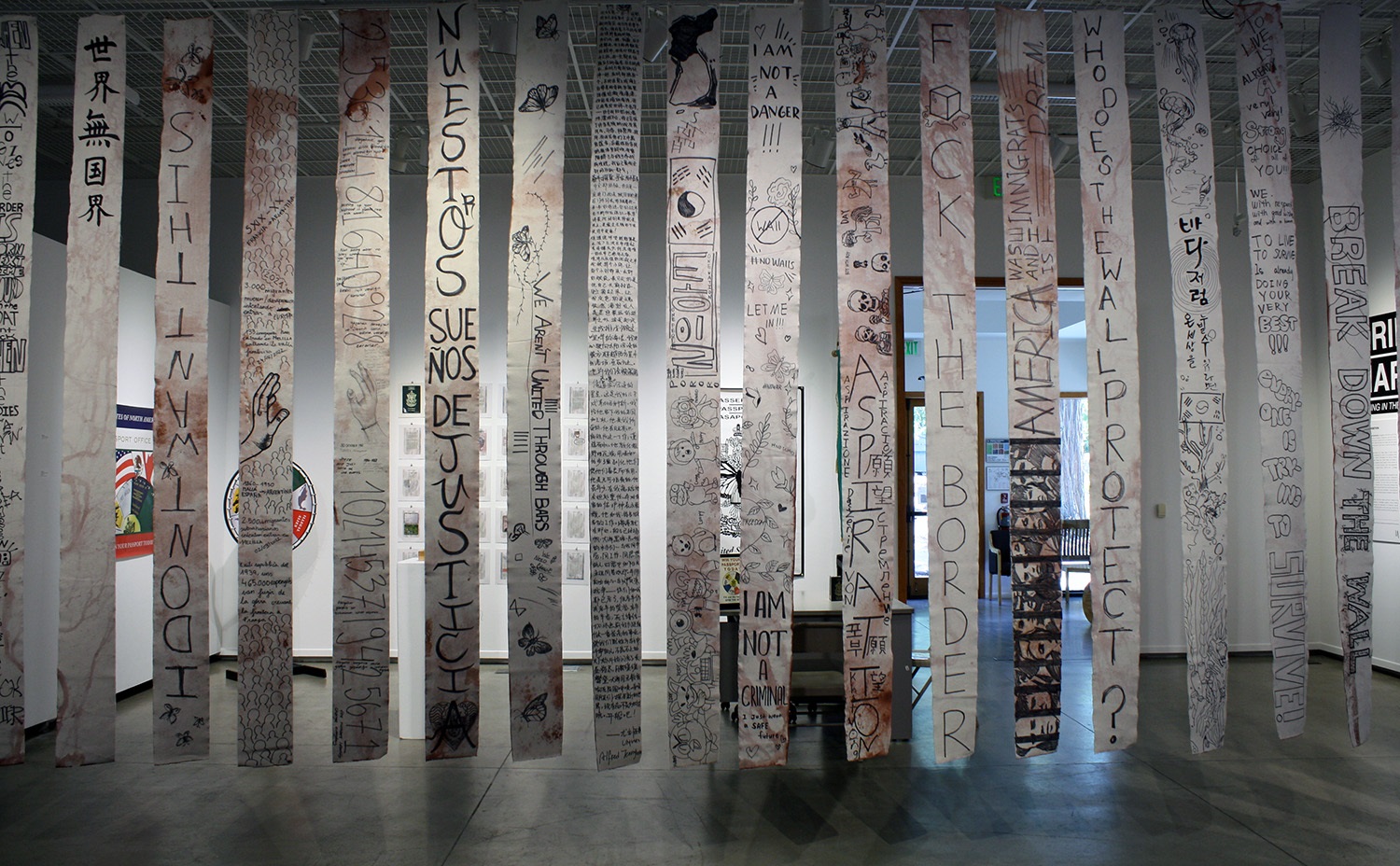
A large, fiber installation, “Shrouded Sky,” simulates a border wall. Made in collaboration with students from Idyllwild Arts Academy, it illustrates the ominous presence of the wall, stained with oxide-colored paint but also offering glimpses of sky and light.
Further installations depict the monarch butterfly and its long-distance migration between Canada and México. For six years she has included entomology research as part of her work, fascinated by butterflies as a metaphor for gender, identity, migration, nationality and nature’s fragility.
Harrsch has also worked as a musician, collaborating with cellist Jeffrey Zeigler and well-known musicians and composers such as Philip Glass, Claire Chase, Paola Prestini and Maya Beiser.
FILM: Documentary tackles school mascots
The State of Maine made history on May 16, 2019, by passing an act to ban Native American mascots in all public schools, the first legislation of its kind in the country. For Maine’s tribal nations, the landmark legislation was an end to a decades-long struggle to educate the public on the wrongs of Native “themed” mascots.
A new documentary, “Fighting Indians,” by Mark Cooley, chronicles the last and most contentious holdout in that state’s struggle, the homogeneously white Skowhegan High School, known for decades as “The Home of the Indians.”
The New England community – a small town divided against the backdrop of a nation divided – was forced to reckon with its identity, its stained history, and future relationship with Indigenous neighbors.
“I think our film is unique in that the story is grounded in a local case study of a community holding on to its ‘Indians’ school mascot in the face of the local Wabanaki tribes asking for it to be removed,” Cooley told ICT. “It’s a story full of heartache, but also an uplifting story, and has shown to be inspirational for communities pushing for change across the country.”
The film has drawn high praise.
“…not only a good film, it’s an important one,” said Suzan Shown Harjo, Cheyenne and Hodulgee Muscogee, a writer, poet, curator and policy advocate who has fought against Indigenous mascots for decades.
“This is a rare glimpse of grassroots-level democracy at work to achieve a peaceful and just end of a longstanding slur against Native Peoples in Maine,” Harjo said in a statement.
The National Congress of American Indians likewise praised the film.
“‘Fighting Indians’ is a powerful and moving film which captures the contentious landscape that communities navigate when retiring harmful Native-themed school mascots, while elevating tribal sovereignty and championing Native voices,” NCAI said in a statement.
Cooley served as director, writer and producer. He grew up in Maine and now lives in Virginia where he is a professor of new media and eco-art.

Our stories are worth telling. Our stories are worth sharing. Our stories are worth your support. Contribute $5 or $10 today to help ICT (formerly Indian Country Today) carry out its critical mission. Sign up for ICT’s free newsletter.
