
Sandra Hale Schulman
Special to ICT
The latest: Hawaiian girls hang ten, coyote art in San Francisco, and art as revolutionary clothing
FILM: New wave of women surfers in new docu-series
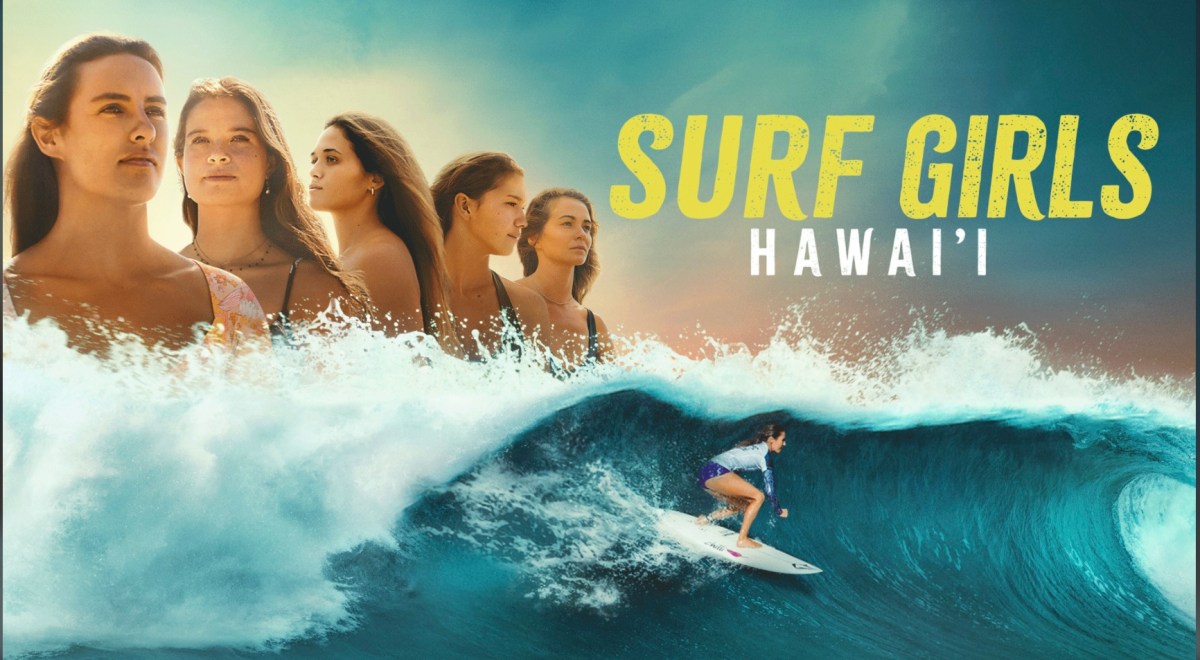
Cowabunga! A new four-part docu-series, “Surf Girls Hawai’i,” follows the next generation of Native Hawaiian female surfers while they compete for a coveted spot on the professional surfing World Tour.
The series, which premiered July 18 on Prime Video, provides behind-the-scenes access to five of the sport’s top young stars, all Native Hawaiians – Moana Jones Wong and her sister Ewelei’ula Wong; Maluhia Kinimaka, born and raised on Kauai, and the daughter of big wave legend, Titus Kinimaka; Pua DeSoto, whose father is 2010 world longboard champion Duane DeSoto and her mother Malia Ka’aihue comes from a long line of fishermen and water people; and Brianna Cope, who has succeeded despite being born with a misshapen left hand.

The group forms fast friendships as they train, navigate their family responsibilities, and compete in big waves against the highest-ranking surfers in the world to get to the top.
They also feel the added responsibility of representing their Native Hawaiian culture in the international world of competitive surfing. It’s a sports story and a coming-of-age story on the Pacific Ocean and the most beautiful beaches during an endless summer.
They all speak Hawaiian, and Wong has attended Hawaiian-immersion public charter schools that teach the language since she was in kindergarten.
“There’s really not many of us … who can speak Hawaiian,” Wong said to Spectrum Local News. “When I do get the chance to meet or speak or talk story with other Native Hawaiian women who surf, it’s really awesome … especially because it is our sport and our ancestors created it and I think that our language should be more heard and known in the surfing world.”
ART: Indigenous animal art from the desert to the bay
Choctaw painter Felicia Gabaldon has been selected to install artwork at Presidio Tunnel Tops on the shores of the bay by the Golden Gate Bridge in San Francisco as part of the Ancestral Futurism Public Art Mentorship.
Gabaldon is working with mentor, artist and environmental activist Favianna Rodriguez for the opening in July 2023 of the installation “Iconic Visions” as part of “Ancestral Futurism: Looking Back to Repair the Future.”
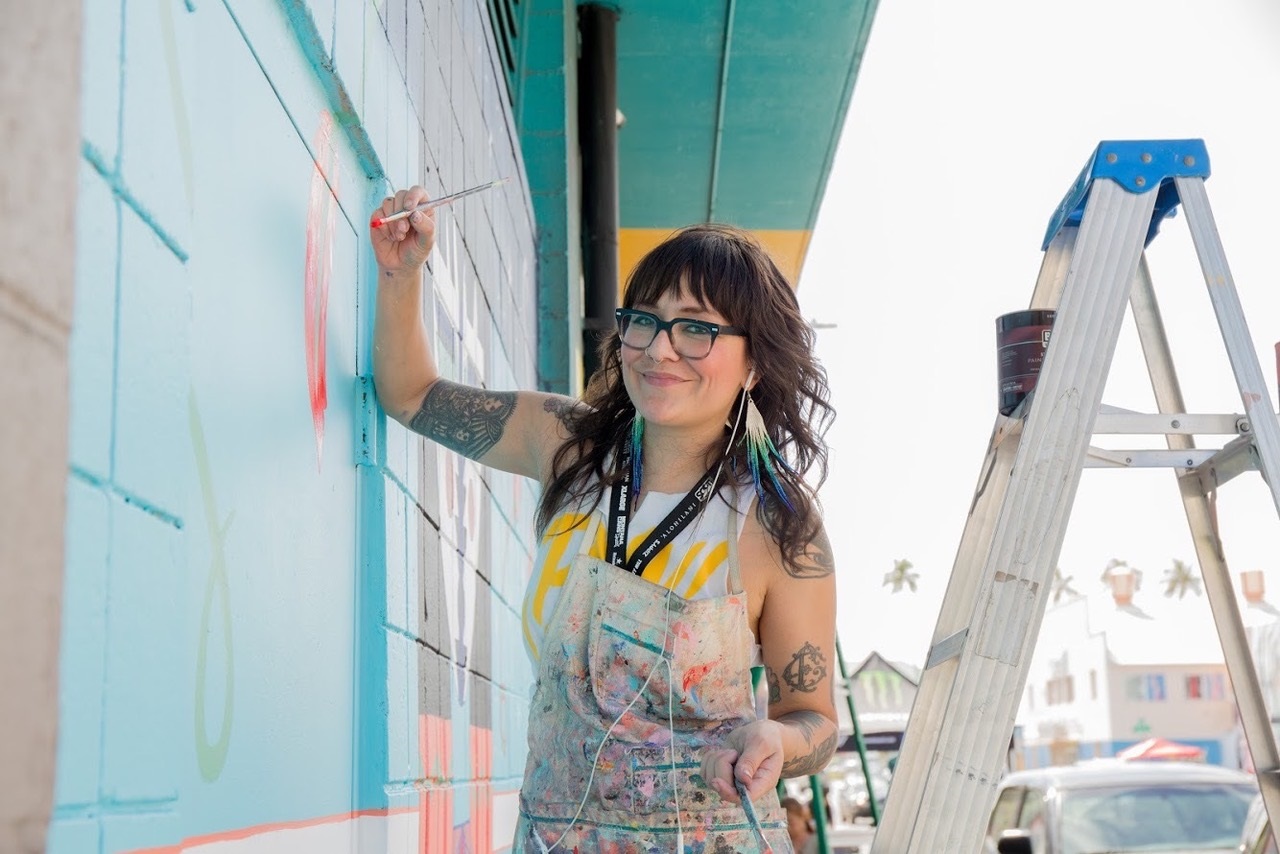
The mentorship program, spearheaded by Rodriguez, is designed to engage emerging Indigenous artists to develop installations at the Presidio that reflect their cultural and artistic identities.
“Through this collaboration, we aim to promote inclusivity, cultural exchange, and the vital role that art plays in shaping our relationship with the land,” Rodriguez said in a statement. “Together, we can create a powerful platform for Native American artists like Felicia to share their perspectives, challenge existing narratives, and inspire us all to be better stewards of the Earth.”
Gabaldon, from Santa Fe, currently resides in Oakland, California, where she’s resident artist at Faultline Artspace. Her art uses nostalgic illustrations to manifest the natural beauty of the American Southwest while she also re-examines it. Influenced by desert landscapes and her Choctaw Tribe and Spanish heritage, her art represents a reverence of self-discovery, culture, and history.
SUPPORT INDIGENOUS JOURNALISM. CONTRIBUTE TODAY.
“Moving to the Bay Area was very inspiring in terms of the art landscape in a big city,” Gabaldon said in a statement. “I started to gather inspiration from this space as well as New Mexico. Finding my voice allowed me to express myself culturally and Indigenously. I hope that when people see my art, they also feel welcome to express themselves.”
In “Iconic Visions,” she will create large-scale murals of images of Southwest creatures — coyotes, quails, and monarch butterflies. An opening event on Sunday, Aug. 13, will feature music from Rene y Familia and Audiopharmacy, DJ Sizzle Fantastic, and a talk from Gabaldon.
ART: Giant jacket sculpture makes cultural statement
A giant, festooned leather jacket by Ishi Glinsky, Tohono O’odham Nation, is stopping viewers in their tracks at the new exhibit, “Ecstatic: Selections from the Hammer Contemporary Collection at Los Angeles’ Hammer Museum.”
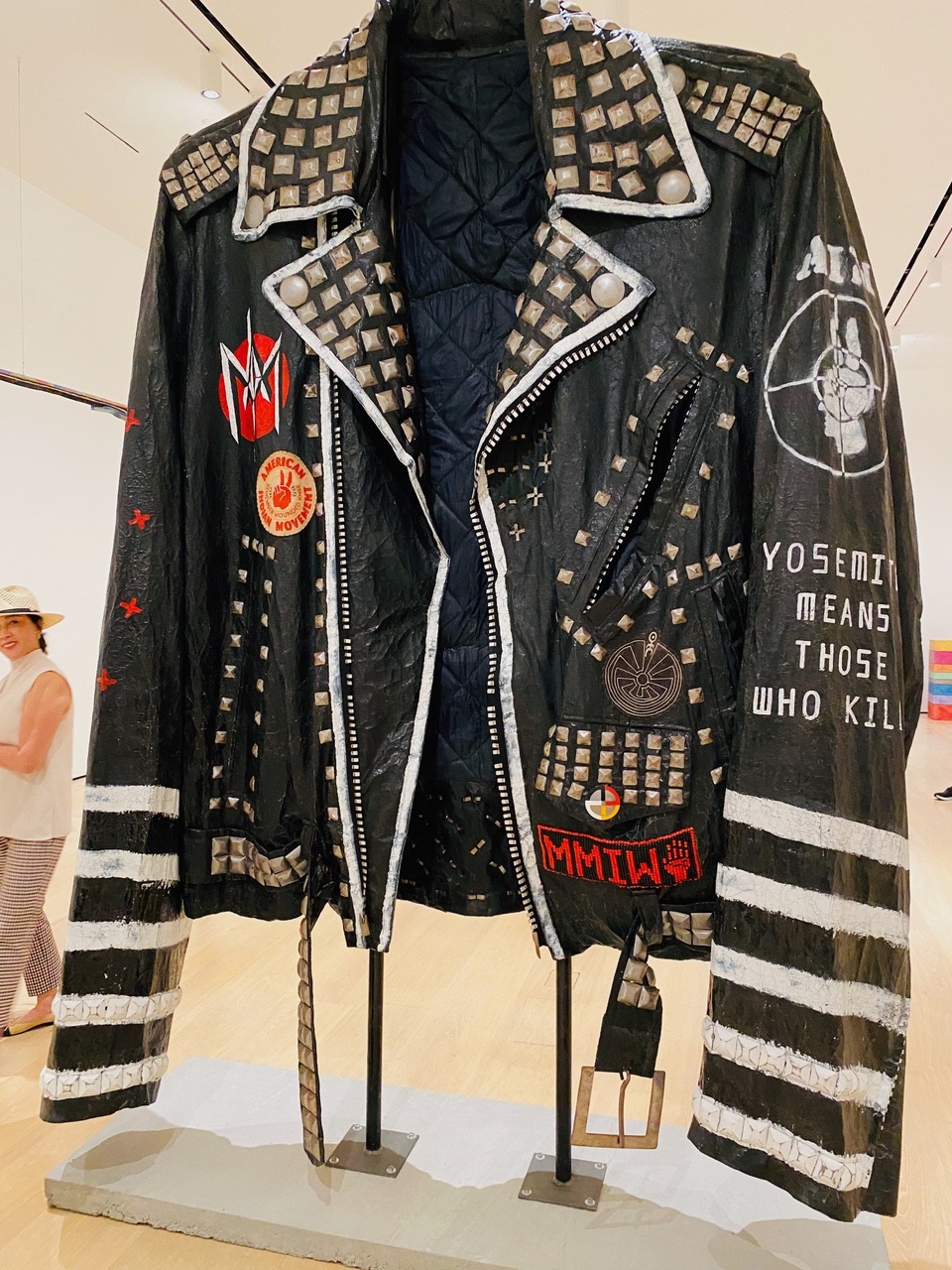
The 10-foot-tall jacket, “Coral vs. King Snake Jacket,” (2019) is made from canvas, industrial adhesives, wax, wood beads, aluminum, steel, nylon, enamel paint, and black pigment. It is adorned with chains and American Indian Movement patches, recreations of signage made during the Alcatraz occupation, studs, MMIW beading and other tough-guy touches.
Focused on sculpture, “Ecstatic” is organized around two distinct installations that emphasize the role of each medium. The other Indigenous artist included is Jimmie Durham with “Choose Any Three,” a carved totem/sign post.
The exhibit opened June 10 and runs through Aug. 27.
Acknowledging the ancestral lands of the Tongva, the Hammer collection makes a case for the central role that Indigenous art occupies within Los Angeles and the broader field of contemporary art.
Working in a variety of media, Glinsky investigates the traditional practices of his tribe, the Tohono O’odham Nation, along with other North American Indigenous communities to create his version of contemporary homages to sacred events and customs.
A strategy common to Glinsky’s production consists of creating outsize shifts in scale to amplify Indigenous stories, and memorialize them in the form of monuments to survival.
“Previously I’ve posted several images of this sculpture ‘Coral vs King Snake Jacket,’ mostly that of the front,” he said on Instagram post about the piece. “Without a doubt this is a substantial part of the experience. But, metaphorically there is another page of history to turn. Before sharing some predominant key points on the back of my piece I have to begin with the trajectory of this concept.”
The concept for the jacket began more than a decade ago, he said.
“The fact that we all are loitering on stolen land and specifically the land of the Tongva People, came to mind quickly,” he said. “The wording seen on the lower half of the jacket reads Tovaangar, the ground with which the work originally showed on and currently sits.”
It also gives a nod to his tribe, the Tohono O’odham, and his father.
“Proudly, I am able to bring a little bit of my father in the form of artwork on the central patchwork,” he said. “The image of the patchwork comes from a drawing my Dad made in high school. Attending a school that was mostly non-Native, he wanted to proudly display this lineage and heritage. As he drew the line work, my mom was present and helped work on transferring this image to a silk-screening process. After his passing, this would be one of the only connections I would have with him. This drawing would help me focus and drive me to work on my own artwork.”
Glinksy now lives and works in Los Angeles, California.
“Being a competitive person I wanted to be just as good and hopefully even better,” he said. “I’m still in awe. The patch was then distressed to look as if it had been danced in. There are several other key points, telling the full story of this sculpture takes time. I can only open the door today.”

Our stories are worth telling. Our stories are worth sharing. Our stories are worth your support. Contribute $5 or $10 today to help ICT carry out its critical mission. Sign up for ICT’s free newsletter.