

Sandra Hale Schulman
Special to ICT
The retro television series “Little House on the Prairie,” based on the 1932 book by Laura Ingalls Wilder about her childhood, was heavy on bonnet-wearing colonizers and filled with stereotypes and dehumanizing portrayals of nameless Natives and African Americans.
Historically, the Ingalls family saw fliers for “free land,” moved from Wisconsin and built their cabin — with stolen logs — in 1869 as illegal squatters in the pioneering town of Independence on the Osage Diminished Reserve in Kansas where most tribal members lived in longhouses. They did not know that the government was still negotiating to buy the land for white settlement. Ingalls wrote there were “no people. Only Indians lived there.”
A new Netflix adaptation of “Little House on the Prairie” aims to update and correct this one-sided history as the series centers on two families — the Ingalls and the Osage family, the Mitchell’s — who live nearby.
The show intentionally avoids the racist tropes of the past by centering Native storylines through authentic Indigenous casting.

The show can be seen as a precursor to “Killers of the Flower Moon,” which picks up the Osage story in the 1920s as the tribe is terrorized for their oil rights they retained with the land deal. Actors and advisors to the film have roles on the new series.
The main Native actors in the series are:
- Meegwun Fairbrother, Ojibwe, as the mixed blood Osage father, William Mitchell;
- Alyssa Wapanatâhk, Bigstone Cree, who portrays the mother, White Sun;
- Wren Zhawenim Gotts, Sokaogon Chippewa, is the daughter, Good Eagle;
- Xander Cole, Ojibwe, acts as White Sun’s brother, Little Puma;
- Talee Redcorn, Osage, as Governor Joe, who appeared in “Killers of the Flower Moon” and;
- Thosh Collins, Osage, as Louis, White Sun’s cousin
Redcorn served as a Osage Nation language expert, while Julie O’Keefe was the cultural consultant who also worked on “Killers of the Flower Moon.” O’Keefe credits Redcorn with helping to develop the Osage language program in the 1980s.
“He’s the cream of the crop,” O’Keefe said in a statement. “He worked with every single actor and actress — Meegwun, Alyssa, Wren — teaching Osage.”

“There’s some nostalgia with it,” Fairbrother told ICT. “But when I saw the project first come across my desk, I saw the red flags for sure, but then I read the script and I thought, oh, okay, they want to lean into it, I want to be a part of it.”
Fairbrother helped to shape William Mitchell’s appearance. He drew inspiration from a vintage photo of an Osage man who was the son of a chief. “His hair was slicked back into a small mohawk, but in the back he had spikes,” Fairbrother said. He and the creative team all agreed, “That’s the one.”
He says the team made sure every detail was correct in terms of costumes, jewelry, mannerisms, even down to how blankets were folded as they knew the Osage and historians would call them out on it otherwise. He worked for weeks on getting the language right.

William Mitchell is a different kind of character, he is not a wild savage and not the wise elder either. He’s a sensible family man, who fluently speaks Osage and English and understands the complexities of what both the Osage and the settlers are confronting.
“We’re talking about attention to history,” Fairbrother says. “We’re seeing this man being a mixed blood, Osage and settler background. That really appealed to me because normally I don’t get roles or auditions for historical pieces. I have pride about that and what we did, what we were able to do to present complex real human beings, real human family with love and trials and tribulations and successes and hardships.”
Mitchell’s wife White Sun is not afraid to talk back and challenge him over tribal issues and whether or not to allow their daughter to befriend young Laura Ingalls.
Fairbrother says he found in his research that Osage women “are very powerful, strong and full of pride for their culture and their ancestry. They’re on equal terms, [William] Mitchell listens to White Sun in pretty much everything that they do.”
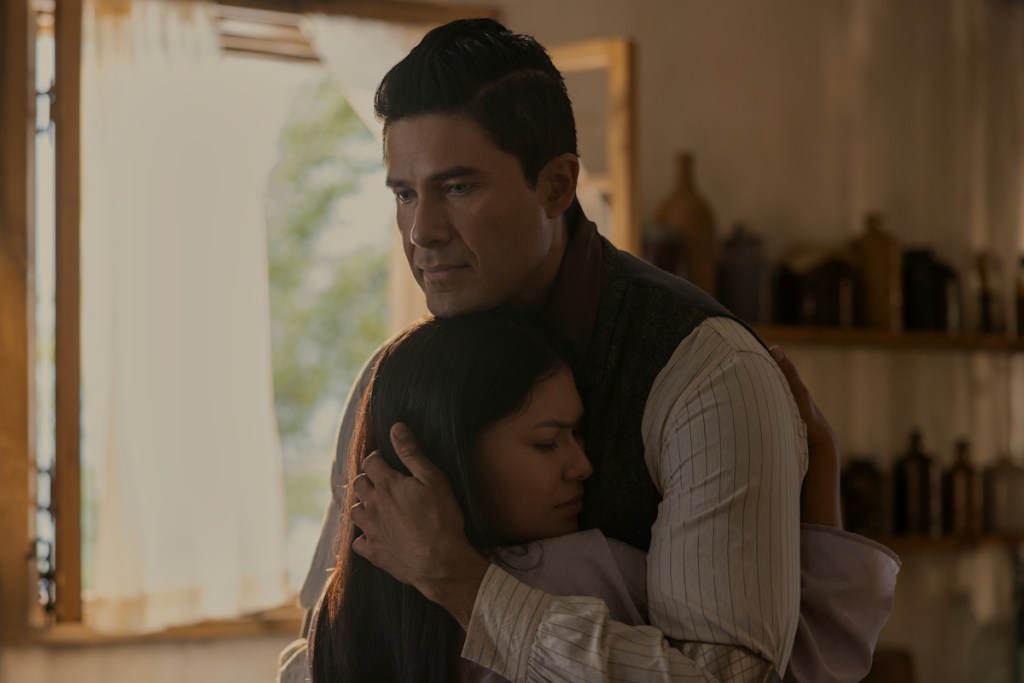
“These aren’t the Indians that you’re used to, they’re educated, they speak several different languages, they’re well read and then he’s a translator, he works in government. He works with the community,” Fairbrother said. “He’s that bridge between two worlds between the Osage and the oncoming settlers.”
In a particularly difficult scene, William Mitchell acts as translator in a pivotal meeting with the Osage and the government representatives demanding they sell the land and sign it over, then move to a reservation.
Fairbrother says he had to try and be realistic.
“They don’t have a choice, they know what will happen if they don’t, that’s what William Mitchell is advocating for. Culturally, historically, we are the land. We protect the land, we look after the land, this is our home. But if we don’t look to the future, then we might not have one, right? In terms of that negotiation, such a powerful moment in history for this nation and the Osage nation.
“In deciding to stay together, that one monumental change in the treaty that they would stay together as a nation and that they would retain their rights to the minerals and to the land and the resources. That has set them up for future generations and, they’re still today, one of the most successful nations in North America.”

Fairbrother says that each time they’ve come up against the atrocities, they manage to survive, thrive and keep going.
“I think it’s a family show at its heart because of the Ingalls’ and the Mitchell’s and the whole community. They need each other and they need their communities to be able to survive,” Fairbrother said. “So I think of it as a love story between the community and the land. They’ve got a storyline for every age group.”
At the end of the first season — the show has already been renewed for a second season — the Ingalls choose to move away from their little house on the stolen prairie before being forced out.
Do the Mitchell’s continue on in the next season? Fairbrother can’t say, but he suggests they will be connected to the show in different ways.
“There are storylines that we’re considering and talking about, we’ll have to wait and see,” he said.
All eight episodes of “Little House on the Prairie” are now streaming on Netflix.

