Joaqlin Estus
ICT
ANCHORAGE — As new policies and directions for a changing Arctic are being decided, Indigenous leaders at an Anchorage event have said, “nothing about us without us.”
Without them taking part in decision making, they fear the result will be costly yet poorly designed policies that don’t meet Arctic people’s needs. So said several speakers at the 3-day Arctic Encounter Symposium, which is hosted by a nonprofit of the same name.
Organizers anticipate about 1,000 participants, including Indigenous leaders, national and international policymakers, scientists, military officials, business executives, and advocacy groups. The agenda includes more than 50 talks and panel discussions on Arctic issues.
One change that’s looming in the Arctic is increasing maritime shipping on previously ice-blocked sea routes across the top of Russia and Canada.
Also, the melting ice and opening seas are making offshore exploration and development of rare minerals and oil and gas more feasible.
Such expansion will be hampered by the shortage or lack of ports, roads, water and sewer systems, and internet service in most Arctic communities. Some of the existing infrastructure is being undermined and destabilized by melting permafrost. Homes, schools, and runways are being destroyed by fierce storms and floods.
All this is occurring while the quasi-governmental Arctic Council, which is made up of eight Arctic nations, is on pause due to the war in Ukraine. The United States, Canada, Greenland, Iceland, Sweden, Finland, and Denmark continue to cooperate with each other and to a limited extent with Russia (on search and rescue, for instance).
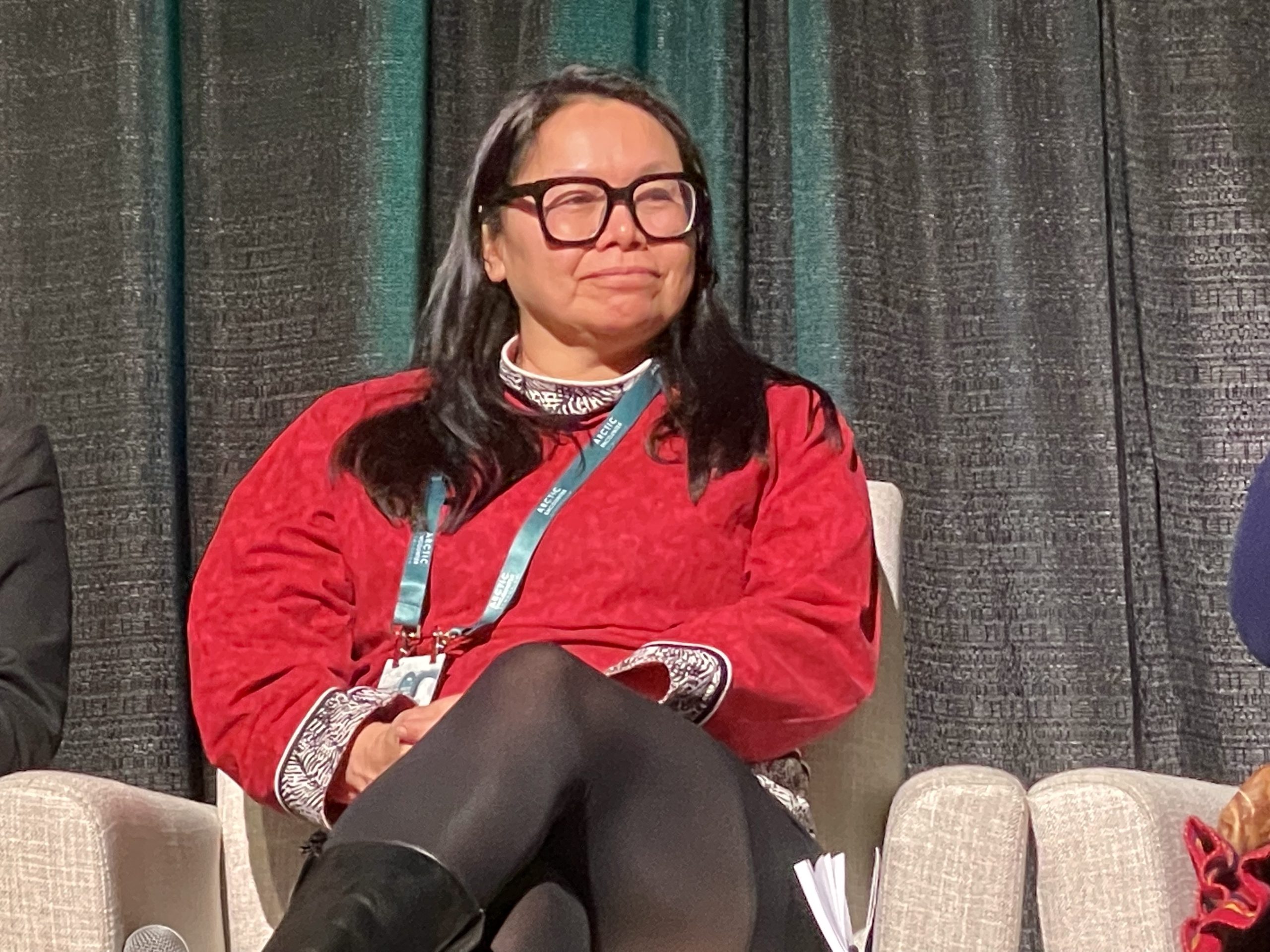
Chief Bill Erasmus, Dene Nation of the Northwest Territories in Canada, spoke during a March 29 panel of Indigenous leaders discussing the future of the Arctic.

Erasmus said problems to the south affect the Arctic. He told an audience of a few hundred people that decades-old tar sands oil development is leaking toxic waste water.
“(Pollutants) are coming down the river system. Not just Indigenous or Native people, but everyone; this is affecting everyone. And it goes all the way down the water system over a thousand miles into the Arctic ocean, which then affects everyone sitting up here … So we have to learn how, if we’re talking about development, how do we take care of the people? That’s the first big issue with us,” Erasmus said.
While the people of the Northwest Territories grapple with the aftermath of earlier operations, future development was on the mind of panelist Madeleine Redfern, Inuit. She is co-CEO of CanArctic Inuit Networks Inc., and a former mayor of Iqaluit, Nunavut.
Redfern said the people of the self-governing Nunavut Territory are concerned that money Canada is investing in infrastructure will not be used wisely.
“We need to be engaged; we need to be in the room; we need to be at the table. And we need our Indigenous communities and businesses and development corporations to also be able to get those government contracts and not see those investments being squandered. Because they’ve just been done badly. We’ve got decades of that experience where the original purpose of the investment doesn’t even meet the needs of our communities.”
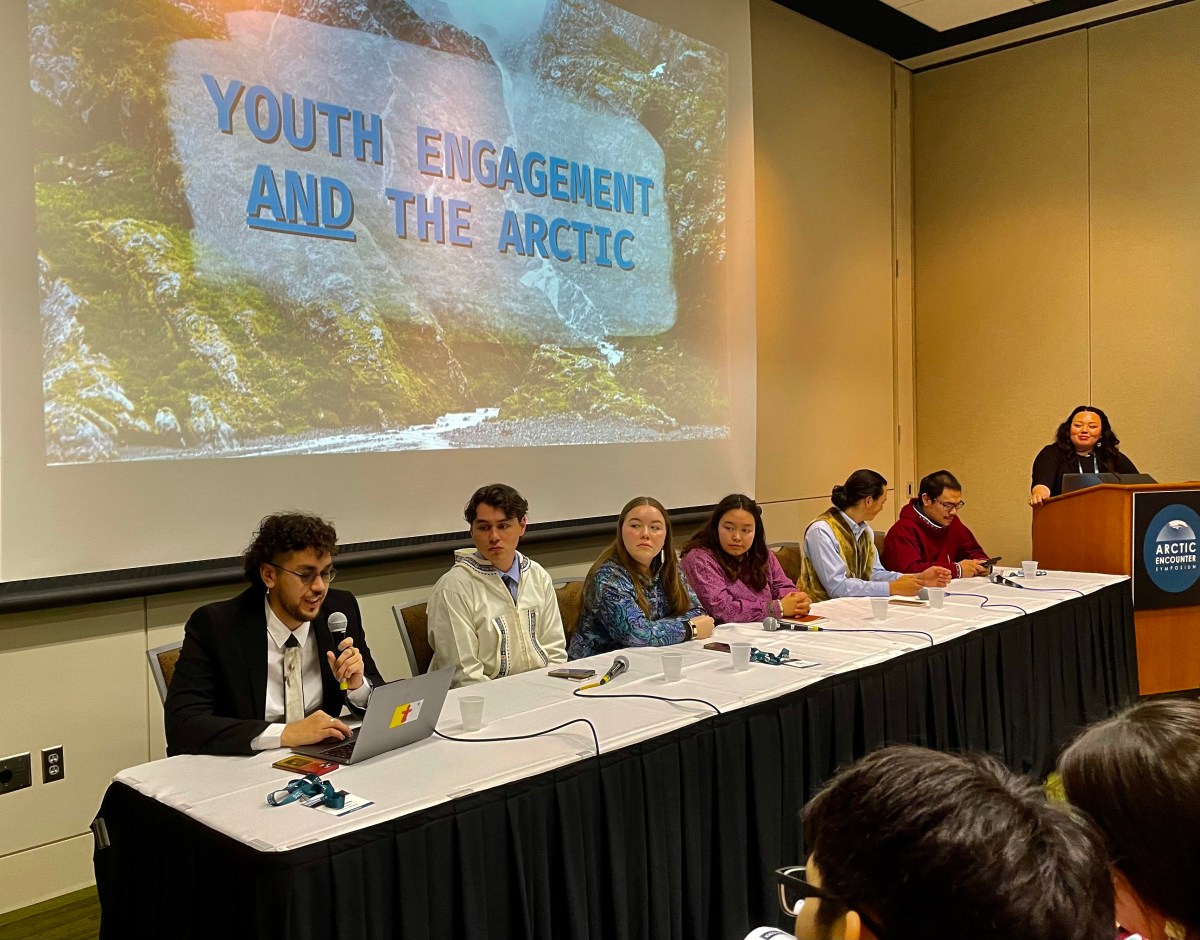
A similar message about having a seat at the table was conveyed during another session. This one, though, was about engaging young people in Arctic discussions.
Kikiktagruk Macy Rae Kenworthy, Inupiaq, was the panel moderator. She’s program staff for the Arctic Youth Ambassadors Program at the Alaska Conservation Foundation. She said it’s important for youth participation to become the norm in a wide range of discussions.

“Because you can’t have a discussion about an issue that’s truly diverse if you’re not representing all of the populations within that discussion. And youth, as we stand, are our own population. We have different experiences (than other generations),” Kenworthy said.
“That includes youth being involved in conversations, and not just on panels about youth engagement. We need to be on panels about resource development, education, tourism, all of these things … Let us talk about the issues, the real issues,” Kenworthy said.
Sam Schimmel, Siberian Yupik and Kenaitze, from Kenai in southcentral Alaska, is board chair for the Arctic Youth Network, a youth-founded and youth-led nonprofit organization. He’s also the founder of Operation Fish Drop, a food security program to address some of the food insecurities brought to bear by climate change.
He said young people in the Arctic often occupy two roles: They go to school and learn western ways of thinking, speaking and organizing, and they hunt, fish, subsist, and learn traditional cultural values.
“So for a lot of young people, you serve the role as kind of a translator, somebody who’s able to understand and know our traditional ways of knowing and express them in a way that’s understandable to western science, and then also express western science in a way that is better understood for our Indigenous leaders,” Schimmel said.
“Now, that doesn’t mean that we’re always the ones driving policy, but oftentimes we’re the ones connecting the bridge of our traditional communities to the western science realm,” he said
“Indigenous knowledge is built on tens of thousands of years of observations. So when we talk about Arctic policy and when we talk about the steps moving forward and how we deal with climate change,” policy makers need to draw upon the values, experience and traditions that have kept Indigenous people alive and thriving, Schimmel said.
Joshua Atghagvik Cannon, Siberian Yupik, of St. Lawrence Island and Nome in northwest Alaska, said youth feel passionately about the need for their participation. He’s an Arctic
Resilient Communities Youth Fellowship member at the Institute of the North, and a political science student at the University of Alaska Anchorage.
Cannon said to those people who sit on boards, “You have the opportunity to include us. I understand there’s a formality still to western ways of career paths and policy. I understand that.” He said he wouldn’t ask to have a 16-year-old sit on a board or for a full-time career position for a student.
“But getting more community outreach and engagement, asking for voices, asking for opinions in the right ways, working with community leaders who are within rural communities,” just spending time with youth are some ways to include their perspective, Cannon said.
Cannon asked the audience not to mistake his enthusiasm for finger-pointing.
“By you being in this room and listening to us, you are in no way being scolded when we are complaining right now. I wanted to make that clear…It is the infrastructure that has gotten us to the point where we have to even discuss how we can involve the youth more like that,” he said.

As for those who think youth are not ready to take part in big decisions, Eben Hopsen, Inupiaq, reminded the audience of a historical precedent. Hopsen is a photographer, filmmaker, fisher, hunter and whaler from the town of Utqiagvik on the North Slope of Alaska. Young Alaska Native people earlier represented their people in momentous, contentious issues he said.
“If you look back in the past, you know, 40, 50, 60 years ago when they were forming ANCSA (Alaska Native Claims Settlement Act) and ANILCA (Alaska National Interest Lands Conservation Act) and all the other historic things that they passed and that they built, those leaders didn’t know what they were really expecting to do. And if you look back in the past, you look at what they did … you can see what or see how they fought and then see how they helped these things,” Hopsen said.
Schimmel said a now elderly activist once encouraged him by jokingly telling him claims advocate and statewide leader “Willie’s (Hensley) hair wasn’t always gray. He wasn’t always that old.” Hensley, Inupiaq, was in his 20s in the mid-1960s when he wrote a college paper on the legal rights of Alaska Natives to their homelands, a document that helped fuel the land claims movement in Alaska.

ICT is a nonprofit news organization. Will you support our work? All of our content is free. There are no subscriptions or costs. And we have hired more Native journalists in the past year than any news organization ─ and with your help we will continue to grow and create career paths for our people. Support ICT for as little as $10. Sign up for ICT’s free newsletter.