

Help ICT make strides in 2024. Our goal is to raise $150,000 by the end of the year with generous contributions from funding partners and collaborators like you. We’re thankful for your support, and we’re thriving because of it. DONATE TODAY!
Renata Birkenbuel
ICT
MISSOULA, Mont. — An awakened audience, an endangered salmon metaphor, a grieving mother and a usable list for families in crisis encompass a recent stage reading of “Can’t Drink Salt Water,” which takes on the Missing and Murdered Indigenous Women epidemic.
Playwright Kendra Mylnechuk Potter, Lummi, hand-picked to write the original play for “underserved populations,” created a multi-layered narrative to serve real-life Indigenous family and friends at the Montana Repertory Theater.
But she effectively educates everyone along the way.
The Montana Repertory, an educational, professional theatercommissioned Potter, making her the first Montana-based Indigenous playwright for its First Reads series.
“This play reading is more than just a play reading,” said Lauren Small Rodriguez, Northern Cheyenne and Chicana. “It created a platform for education awareness for those … unsure. There were a lot of folks in the audience who were non-Native. This gave that opportunity to welcome them into our lived experience.”
Sex trafficking as the main plot raises awareness of all theater-goers who turned out for the powerful story that will transform into a full production sometime within the next year.
After learning that her birth mother was a victim of sex trafficking, Potter drafted her powerful storyline that validates Indigenous experiences. Potter struggled with how best to present such difficult material, but she remains open to presenting truth to power.
A nearly-packed house of about 200 listened intently as five actors, three of whom are Indigenous, read her latest incarnation of the script as part of typical theater workshopping.
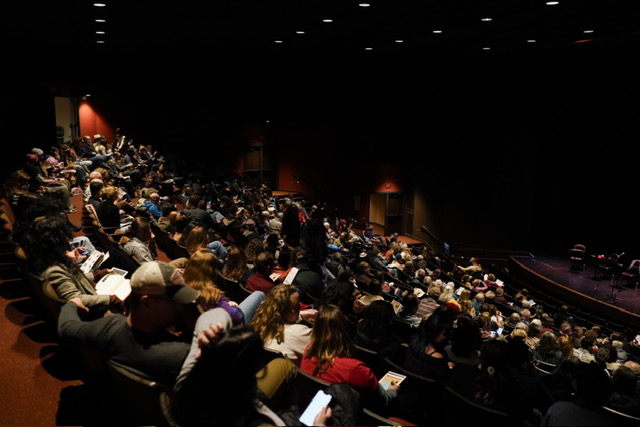
The two-act play follows one Indigenous mother’s heart-wrenching investigation and search for her missing daughter, Star, inextricably linked to Vic, another young woman who escaped a sex trafficking situation.
“Two girls, one got out and one did not,” said Potter.
In the story, a well-intentioned but tone deaf non-Indigenous couple opens a safe haven for women who have escaped. University of Montana theater student Shadie Wallett, playing Vic, interacts honestly with those in authority, often in brutal but funny teenage-like fashion that provides levity. She also plays Star, the friend who does not make it home.
“People are trying to steal Vic’s voice and Vic’s sense of autonomy, you know?,” said Wallett, 19, Northern Cheyenne and Crow. “She is reclaiming that and healing in a way that they know how.”
Vic the character rises to her ancestors’ strongest sense of empowerment when she rights injustices for herself, for Star and for Star’s grieving Mother.
“Something important about this play for everyone to know,” Wallett said later, “is that this is our life, this is our experience, almost daily.”
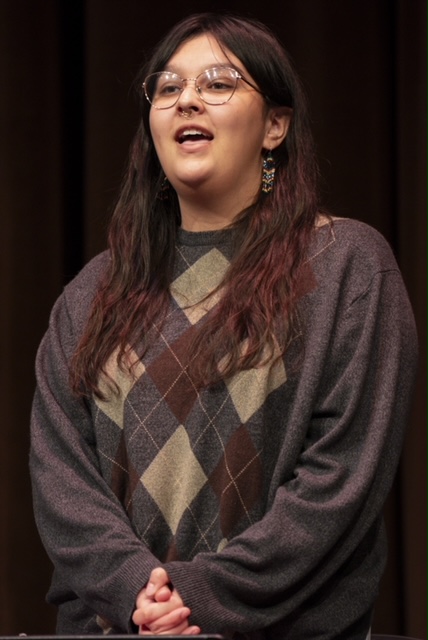
Detailed descriptions of the astounding, resilient life cycle of endangered salmon equips the audience with an effective metaphor for families searching for missing loved ones.
“It’s the grief and the mourning and the healing that people have to go through, and the innate sense that something is wrong,” added Wallett.
“The impending sense of doom that the grief that native people feel is not just grief about one person. It’s about grief for your entire people. I think it’s important for other people to understand that this is how we feel all the time.”
Afterward, Carissa Heavy Runner, Blackfeet and Dine and a real-life grieving mother, took to the stage alone, sharing her ongoing story of seeking justice for her daughter, Mika Westwolf, 22, who was killed in a hit-and-run on the Flathead Indian Reservation last March. The woman driver, Sunny White, who struck and killed her, remains free, but has been charged with vehicular homicide.
Initially, Heavy Runner and family quickly realized that law enforcement helped little in the investigation due to stereotypes of young people who may be drinking or addicted.
“It’s hard,” Heavy Runner told the audience. “And so we knew that in the beginning that we had to control our daughter’s narrative because regardless, she’s young, regardless.”
As a result, she has created a powerful movement, Mika Matters, a guide book for others seeking lost loved ones. The site updates supporters on the potential upcoming trial for White, whose children are named Aryan and Nation.

“This stuff, it’s hard to hear,” said Heavy Runner. “It’s sensitive, it’s traumatic, but it’s necessary. People need to hear it, it needs to be shared because the statistics are ridiculous right now for Native Americans.”
Heavy Runner first met Potter at the second annual Beartracks Celebration in Missoula, a bridge-naming event.
“I am thankful for Kendra’s bravery in creating and making this play come to life,” added Heavy Runner. “I know the issue of MMIP isn’t something easy to write about but I’m glad she did. She did an amazing job with her writing and her choice of actors that brought the staged reading to life successfully. For me, personally, it was like a flashback of my feelings as a grieving mother for the past 8 months coming to life right in front of me, if that makes sense.”
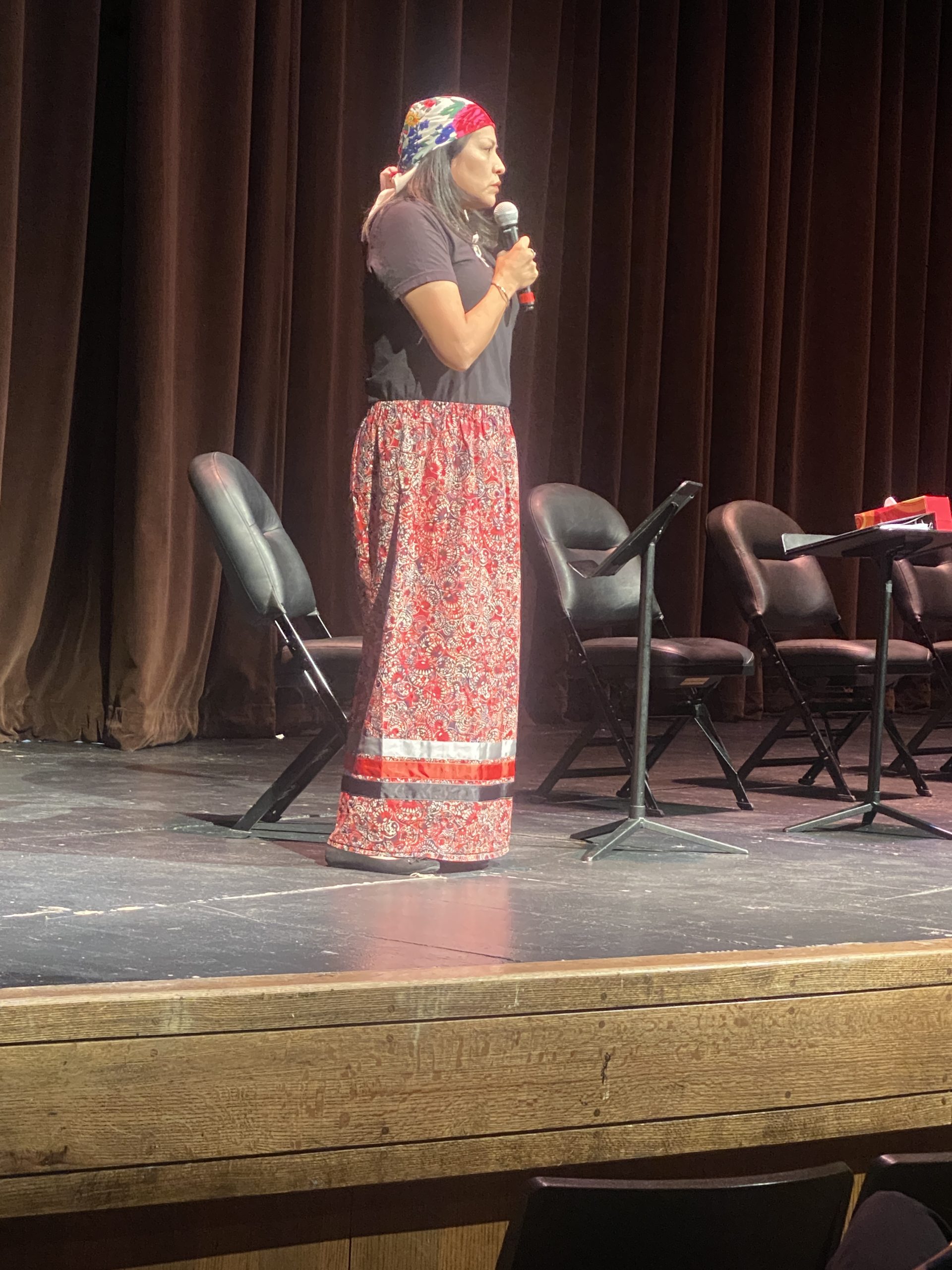
Tears flowed, not only from Heavy Runner’s eyes, but also from those watching and listening.
Wallett said it was especially courageous for Heavy Runner to speak in front of an audience that included non-Indigenous people.
The grief only grows in a world, Wallett said, “that’s basically out to get you. She’s amazing for the way she has coped and she’s made it into a movement for other indigenous kids … who matter so much.”
Surprisingly, during the staged reading, one character tells the audience to take out their cell phones and scan a QR code from the program. Up pops a practical list for what to do when searching for a missing loved one.
Rodriguez, founder of the Calling Our Spirits Forward nonprofit focused on indigenous health equity, partnered with Potter and the Montana Rep to bolster the allyship among Indigenous entities and to educate the general public about the complicated issues surrounding MMIW.
“The reason why I felt (the play) was so powerful is because it intersected lived experiences of Indigenous people living in both worlds,” said Rodriguez, “highlighting that colonial structure that perpetuates violence against our Indigenous women and girls and peoples, including men.”
Destini Love, Blackfeet and audience member, said she welcomed the call to action and overall acknowledgement of Indigenous women’s shared experiences.
“I appreciated that there was a sense of holding people accountable and not just a plea to action,” said Love, a parent herself. “But … just matter of fact pointing out of responsibility – especially, I think, to non-native members of the audience.”
Love likes that Wallett’s character speaks her mind instead of defaulting to reticence in the face of self-righteous helpers. The moment – spoiler alert – is a key turning point.
“There are some, what you might call more white savior characters in it,” Love added. “And I really appreciated the moment where Vic, the main character, basically stands up to them.”
Potter, who was adopted, previously filmed an autobiographical documentary, “Daughter of a Lost Bird,” about reuniting with her birth mother.
She informs “Can’t Drink Salt Water” from an insider’s view, but after workshopping the play in front of an all-white audience, she realized that non-Indigenous audiences need to learn the basics about MMIW.
“It’s been astonishing to me how many people – even dear friends of mine and people in my circles who are not native – are completely unaware of the issues,” said Potter.
“So I’m actively wanting to find a way for the story to be as inclusive or that as many people as possible can see themselves in this play and also feel inspired to do something about this epidemic.”
Promoting education awareness and challenging misconceptions remains a vital goal for Calling Our Spirits Forward, added Rodriguez.
“We need more people like Kendra that have the courage to take on sharing these hard and real issues with the world,” Heavy Runner said. “Finding different ways to captivate, educate, and connect to the greater public with the help of others means so much to me and the many other families that are in a similar situation. Together we are stronger and we must continue to be a loud voice for those that were lost to this epidemic.”
Actress Lily Gladstone, Blackfeet and Niimíipuu, is a member of the selection committee who selected Potter. Gladstone, of course, is best known for her recent star turn as an Osage woman in the high-profile film, “Killers of the Flower Moon.”
Perhaps Gladstone, a UM graduate, will be in the audience when “Can’t Drink Salt Water” transforms into a full performance.

Our stories are worth telling. Our stories are worth sharing. Our stories are worth your support. Contribute $5 or $10 today to help ICT carry out its critical mission. Sign up for ICT’s free newsletter.

