
You can help elevate meaningful stories from Indigenous nations when you support ICT during Arizona Gives Day! ICT is headquartered in Arizona, and covers the Indigenous world across North America. Help us reach our goal to raise $10,000 for reliable, compelling, Indigenous-led journalism in Arizona and beyond.
Pauly Denetclaw
ICT
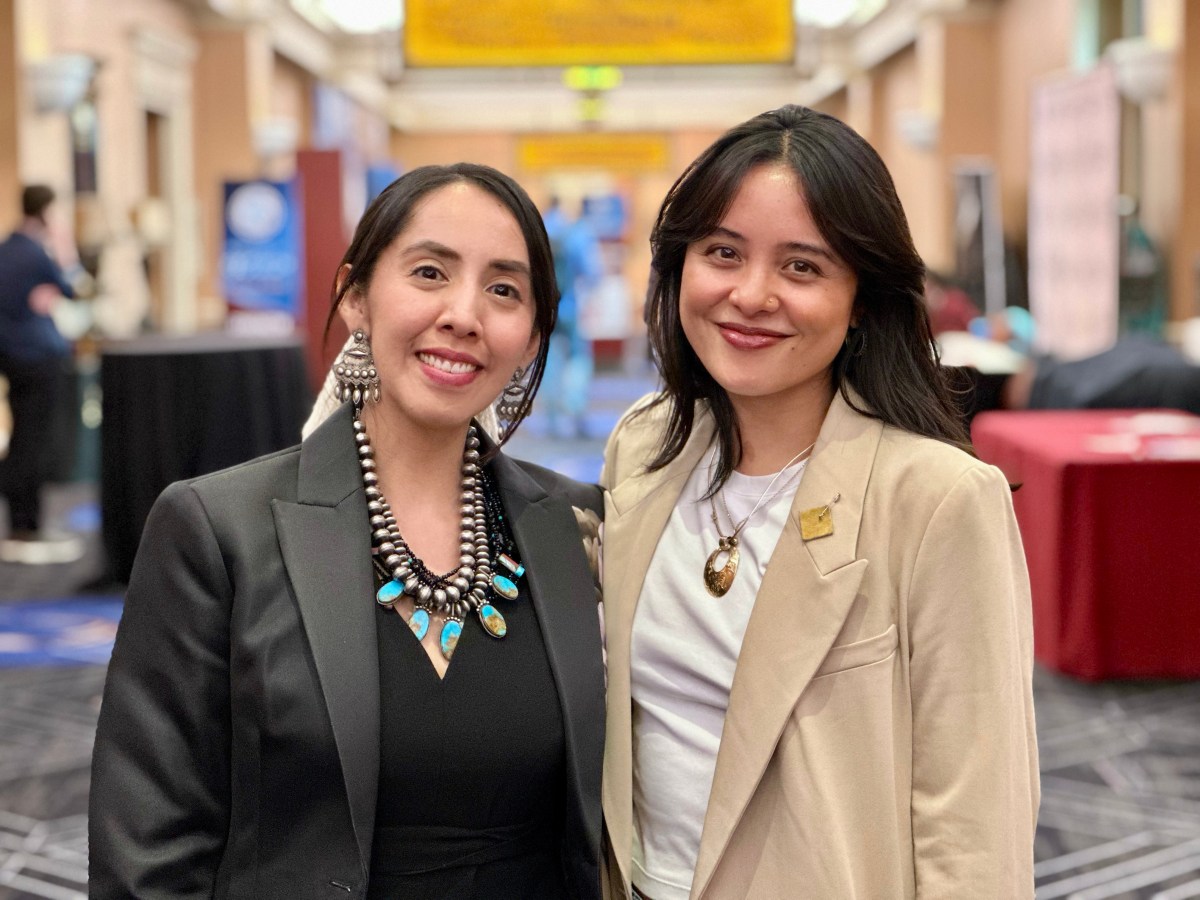
LAS VEGAS, Nev. — Laughs, conversations and the signature sound of Native jewelry filled the space during the 2024 Reservation Economic Summit in Las Vegas, Nevada. Attendees wore ribbon skirts, long braids, bolo ties or their most intricate beadwork. It’s an economic conference but one that is unique to Indigenous people.
Nicole Johnny’s tsiiyééł and Navajo jewelry fit right in. Unfortunately, that’s not always the case. Johnny works in the world of venture capital. An industry that is overwhelmingly White, and male.
This only becomes more prevalent the higher up in management one goes. Althea Wishloff, Gitxsan Nation, is the first Indigenous woman to be a general partner at a venture fund. Shocking but not surprising, considering that White employees hold 75 percent of investment partner positions.
A 2022 industry benchmark survey by Deloitte that provides demographics for U.S. venture capital firms didn’t even mention the statistics for Native American, Alaska Native or Native Hawaiian in their report. Instead folding them into the category for “people of color” or “women of color.” While there are no official numbers, Johnny and Wishloff combined know of 15 Indigenous women in venture capital in both the United States and Canada.
It doesn’t stop there, Indigenous entrepreneurs received only .004 percent of venture capital funding in 2021. The number of Indigenous women who have received funding would be even less than that.
“Nicole and I are the only Native women on our team,” Wishloff told ICT. “There are other women, but we’re the only Native women.”
Venture capital is a type of financing where one sells shares of a company to a venture capital firm for monetary investments in said company. The venture capital firm will then have a less than 50 percent stake in the company. The best way to describe the process is to think of “Shark Tank,” an American business reality TV show.
“If I’m going from point A to point B. I can walk. I can take a bike. I could take a car. I could take a plane,” Wishloff said. “Venture capital often acts as an accelerant because you have more money at your disposal to experiment in different things, and learn what works, and what doesn’t. It doesn’t mean you couldn’t achieve the exact same outcome, but maybe it would take 20 years versus five.”
Wishloff and Johnny both work at Raven Indigenous Capital Partners, the only venture capital firm in North America solely dedicated to funding Indigenous-owned businesses. The company’s portfolio ranges from the beauty industry to green energy providers.
Skoden Venture, another Indigenous-owned venture capital company, funds entrepreneurs who are Indigenous, Black, Brown and/or women.
One of Raven Indigenous Capital Partners’ more well-known entrepreneurs is Jennifer Harper who owns Cheekbone Beauty and in 2020 created a more sustainable lipstick line called SUSTAIN, which seeks to reduce the amount of makeup packaging that ends up in landfills.
“We’ve been able to do a lot of things that we wouldn’t have been able to do without the dollars,” Harper told ICT. “We would have never been able to build the kind of brand we’ve built, with this idea of turning our products to be truly sustainable, and really own the formulations and decide on different kinds of componentry, and packaging. And have a lab or a chemist.”
Cheekbone Beauty has received $1.8 million in venture capital funding with a goal to become a global beauty brand that centers sustainability.
“I really believe our people have the power to build huge, big brands and to be bold,” Harper said. “If you have something that’s really special, you have this unique position in a market, you’re filling a white space, so to speak, go for it and find a partner, or the dollars wherever you need to in order to grow.”
The mission of Raven Indigenous Capital Partners is to invest in Indigenous entrepreneurs to strengthen Indigenous economies and ultimately, have a long-lasting positive impact on the ecosystem.
“When you’re looking at deals, when you’re looking at companies, ask the founders and ask yourself, is this a company that brings good medicine to our world?” Johnny said. “Does it bring good medicine to our communities and to our people? Is it good to exist in the way it is? I always like to keep that framework in mind as I’m looking and meeting entrepreneurs and looking at deals.”
For example, Cheekbone Beauty has given over $150,000 to organizations that support Indigenous youth and their mission is to create sustainable, vegan makeup products.
Raven is based on the Anishinaabe Seven Sacred Teachings—love, respect, bravery, honesty, wisdom, humility, and truth. This Indigenous worldview also leads into the seventh generation principle, that decisions made today must take into account the seven generations yet to come.
“While we have both Native and non-Native folks on the team, we hope to be seen as somebody that Native entrepreneurs can see themselves in,” Wishloff said. “It’s really important to have another Indigenous person who might have similar lived experience or understand the challenges of navigating as a Native-owned or Indigenous-owned business. We look to hold both commercial and impact, with equal honor and respect.”
This type of focus and understanding is important in venture capital. As some 77 percent of venture capital goes to companies with White founders and just 1 percent goes to Black founders. According to Crunchbase, out of the $330 billion in venture capital just .004 percent went to Indigenous founders.
“We know those percentages are abysmal, especially, if we think about Native women or Native people generally,” Wishloff said.
One of the few Indigenous women to get venture capital is Harper. She can think of two other Indigenous business women who have also gotten venture capital.
American Indian, Alaska Native, and Native Hawaiian, make up 3 percent of the U.S. population. In Canada, the percentage of First Nation is 5 percent. Meaning the venture capital industry has a long way to go when it comes to funding parity for Native American-owned businesses in the states and First Nation-owned businesses in Canada.
“It’s shocking and appalling when we hear the stats of where venture capital goes,” Harper said. “Not very many of us get any money from the venture space. It’s time that, that for sure should change.”
In 2021, Betsy Fore became the first Native American woman to raise a Series A in venture capital funding. She is the co-founder of Tiny Organics. The early childhood nutrition company received an $11 million investment.
There are funding stages for venture capital. Pre-seed, seed funding and Series A are the type of investments Raven Indigenous Capital Partners make. Pre-seed and seed funding are for businesses that are getting established and expanding.
Series A funding is for established, multi-million dollar businesses that will generate long term profit.
Raven Indigenous Capital Partners, known colloquially as Raven, has made 19 investments so far, according to Johnny and Wishloff. These investments range from $250,000 to $3 million. These investments are to help a small business grow rapidly, whether that’s by hiring employees, buying new equipment, launching a new commercial product, or to enter new markets. Raven’s investments last from five to seven years and come with business development resources and technical support.
“With traditional banking, a lot of the time, the collateral becomes an important part of the conversation,” Johnny said. “What can you offer as collateral? When businesses are looking for lines of credit, or for loans, and especially businesses that are located on or near reservations, you can’t collateralize that. But when you build a business and you can essentially sell the shares of the business, then, that no longer becomes a concern. You take away these traditional hurdles that traditional financing has.”
For its investments, Raven will become a 10 to 20 percent stakeholder in the companies it invests in.
Oftentimes, venture capital isn’t even seen as an option for Indigenous entrepreneurs.
“Some entrepreneurs have told me, ‘Oh, so you’re a VC fund. So, you’re a vulture capitalist.’ It’s reshaping that narrative, this idea of it as an extractive thing, as something that takes away,” Johnny said. “Rather it’s up to (us) to reshape the narrative of, ‘No, we’re coming to be a good relative to you in this space.’”
In general for Indigenous communities, there is a lot of mistrust around banks and other financial institutions. A 2014 study by the Social Security Administration found that American Indian and Alaska Native populations aged 50 and older had significantly less financial literacy than other groups.
“Because of the historical trauma with many financial institutions, the idea of sharing ownership in your business is a daunting fear to overcome,” Wishloff said.

ICT is a nonprofit news organization. Will you support our work? All of our content is free. There are no subscriptions or costs. And we have hired more Native journalists in the past year than any news organization ─ and with your help we will continue to grow and create career paths for our people. Support ICT for as little as $10. Sign up for ICT’s free newsletter.
