
Mark Thiessen
Associated Press
ANCHORAGE, Alaska — For years, when the tiny Alaska Native village of Rampart’s awful internet service would go down, the only way to reach the outside world was to await the small airplane that touched down daily with supplies and the occasional visitor.
“We had no way of getting ahold of anybody out of Rampart other than going to the airport and telling the pilot,” said tribal administrator Margaret Moses. The pilot would relay messages — including word of medical emergencies — after flying 100 miles to Fairbanks.
The Koyukon Athabascan village of about 50 people eventually upgraded to a satellite company, at a hefty price of $3,000 a month.
It’s one of scores of Alaska Native villages where spotty and expensive internet coverage is the norm — if it’s available at all. And such service can be the only lifeline for remote communities, many of which can be reached only by boat or plane.
Now, efforts to address inequities in a longstanding digital divide are underway across the nation’s largest state by land area, particularly in Alaska Native villages, with funding provided by the 2021 infrastructure bill and other federal programs as part of the Biden administration’s Internet for All initiative.
Overall, the bill provides $65 billion in funding to improve broadband access in the U.S. Every federally recognized tribe, including 229 in Alaska, can receive up to $500,000.
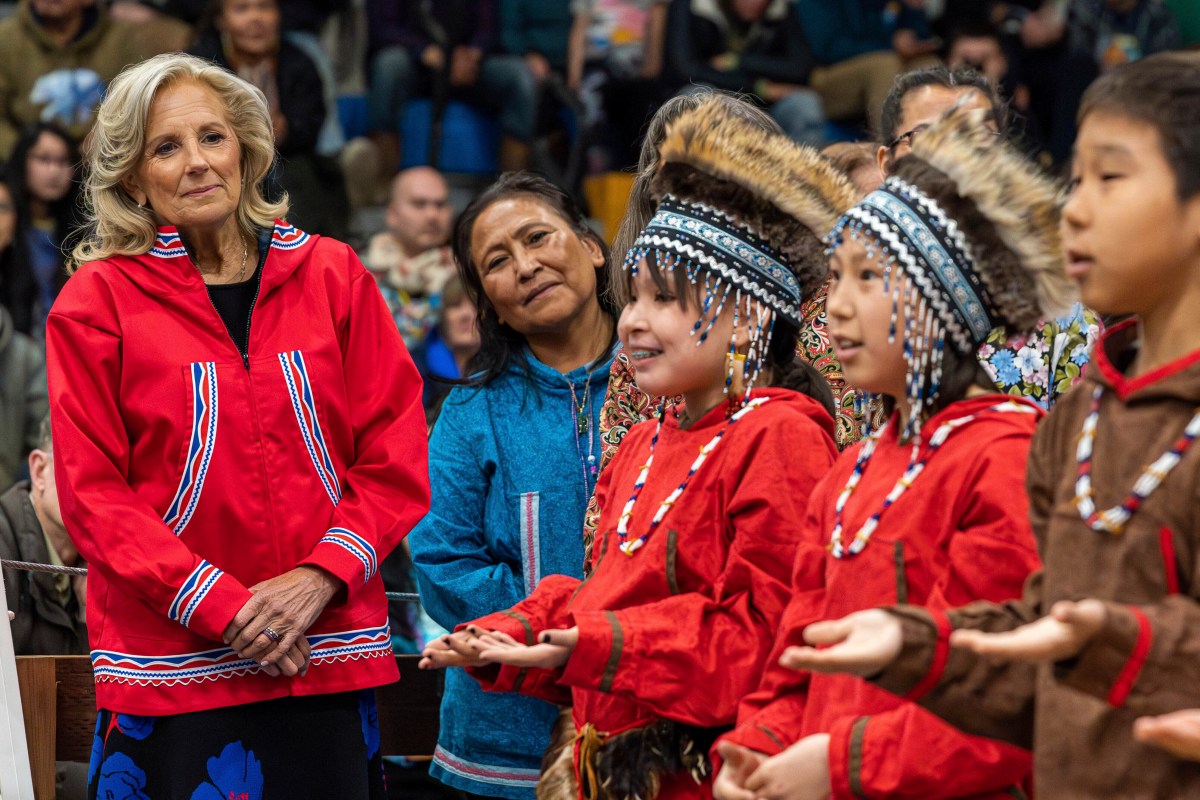
Jill Biden visited the southwest Alaska community of Bethel late Wednesday on a stopover to Japan to highlight progress being made under the program, including the award of $125 million last year for two broadband infrastructure projects in the area. In doing so, it was the the first visit by a first lady to Bethel, which is about 400 miles west of Anchorage and accessible only by air.
“With high-speed internet, you’ll have better access to critical health care, new educational tools, and remote job opportunities,” the Anchorage Daily News reported Biden told a crowd at the local high school.
“It will change lives. It will save lives,” said Biden, who was accompanied by Interior Secretary Deb Haaland, U.S. Rep. Mary Peltola, an Alaska Democrat, and Alaska first lady Rose Dunleavy.
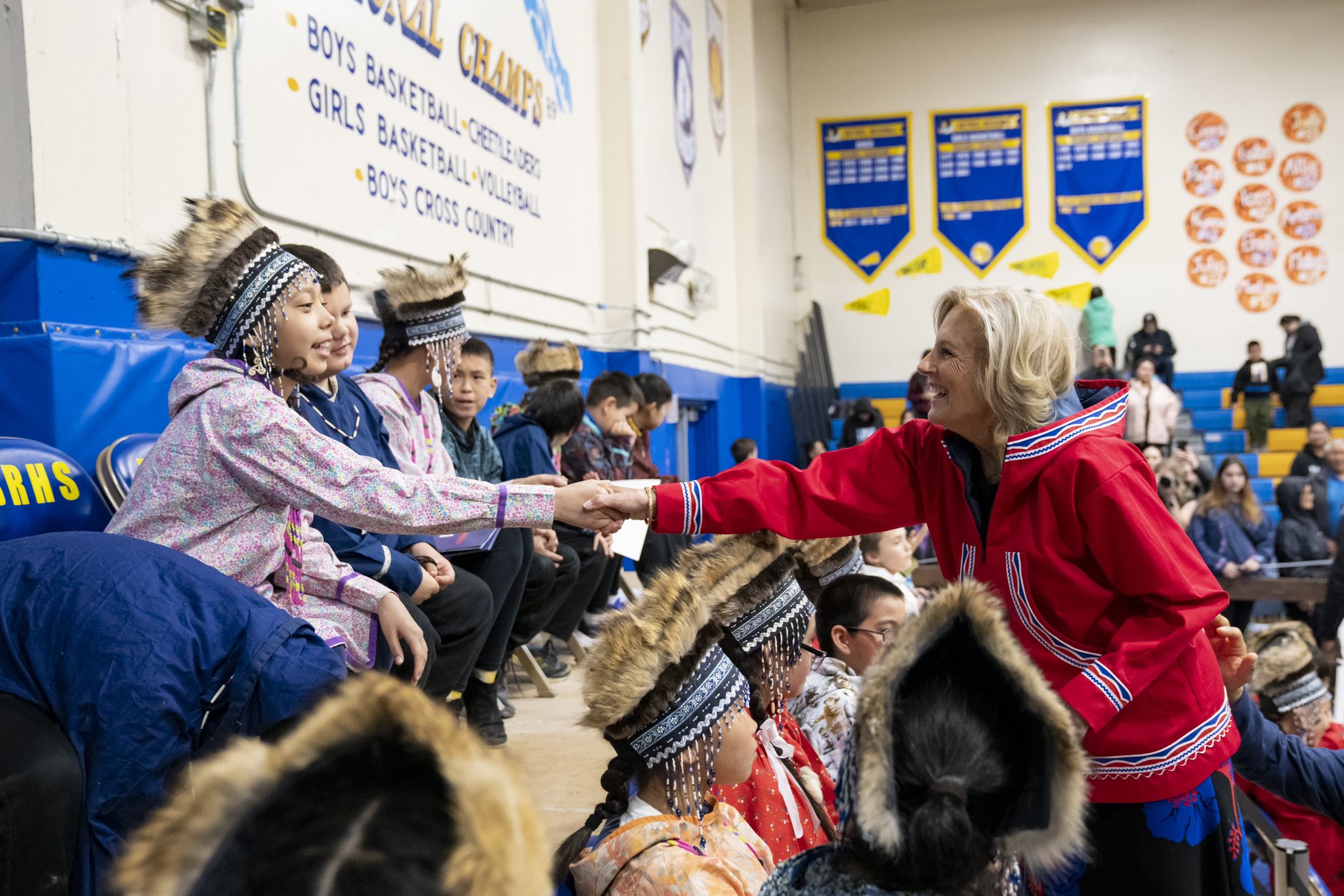
Dunleavy said the broadband investments in the Bethel area will help create jobs. She told the crowd: “Rural Alaska has always been on the wrong side of the digital divide until today.”
An additional $5 million in grants were awarded Wednesday, including $500,000 to the Hoonah Indian Association of southeast Alaska to help train people for jobs created by a tourism boom.
Nine other $500,000 grants were awarded to three tribes in California, helping increase the speed to 314 tribal households for the Soboba Band of Luiseno Indians; providing equipment and training to the Seminole Tribe of Florida; and upgrading 17 households with high speed internet service in the Match-E-Be-Nash-She-Wish Band of Pottawatomi Indians (Gun Lake) in Michigan.
Other grants went to tribes in Minnesota, Virginia, Washington and Wisconsin.
“What’s been hard in administering this program is the need is just so immense when you look at the totality of Indian Country as a whole and the lack of critical infrastructure that hasn’t been made available previously to most of these communities,” said Adam Geisler, a division chief with the administration’s National Telecommunications and Information Administration..
Three-quarters of the 574 federally recognized tribes in the U.S. applied for over $5.8 billion in funding when the Tribal Broadband Connectivity Program launched. However, the program is currently funded at just short of $3 billion, most if it from the infrastructure bill. So far, nearly $1.8 billion has been awarded to 157 tribal entities to improve broadband access.
In Alaska, 21 projects have received more than $386 million.
In the Yupik subsistence community of Akiak, 30 miles north of Bethel, tribal officials provided free broadband to the village’s 100 homes during the COVID-19 pandemic until grant money was exhausted.
The Akiak Native Community tribe wanted to use its $500,000 to at least subsidize that service. However, its grant was assigned to its Alaska Native regional corporation, which will have an internet provider eventually bring fiber broadband to Yukon-Kuskokwim Delta villages.
That’s left subsistence residents in Akiak, where a quarter of all families fall below the poverty line, to either pay $90 a month for their own satellite service or wait for fiber.
Kevin Hamer is general manager of the Yukon Delta Tribal Broadband Consortium, a nonprofit tribal organization made up of 18 tribal governments in the Yukon Kuskokwim Delta area, including Akiak. He believes there should be flexibility in the government funding to provide immediate, affordable broadband while tribal communities wait for fiber broadband, which could take years.
Tribal communities often have expensive and terrible internet service unless they can afford to pay for their own satellite service, including shelling out $600 for the equipment. Without satellite service, there is no video classrooms for children, telehealth with medical professionals, or telecommuting.
“You are excluded from all the benefits of the digital economy,” Hamer said.
Remarks as prepared for delivery by Jill Biden at an Investing in America event in Alaska
Thank you, Mary. You’ve dedicated your life to lifting up the voices we all need to hear. From Bethel to Washington D.C., you’ve never stopped fighting for all Alaskans.First Lady Dunleavy, I am honored to be here with you. Thank you for welcoming me back to your beautiful state and to Bethel.
Secretary Haaland, you work every day to protect our environment, support our families, and work with tribes across the country.
I’d also like to thank Mayor Henderson, Ana, Vivian, and Walter for the work you do to lift up communities in the Y-K Delta.
And congratulations to the Bethel High School seniors graduating this week!
Two years ago, I had the opportunity to visit the Alaska Native Tribal Health Consortium in Anchorage, where I met Valerie Davidson—the president of the consortium and a daughter of Bethel. And through Valerie and her team, I got to know this incredible state a bit better.
I saw how the connections here run deep—the bonds of family and friendship, of tribes and traditions. I saw how acutely you are connected to the natural world around you—from the migration of salmon to the cycles of the sun. And yet, I also learned about the challenges you face—and how communities in rural areas like this one often feel unseen and unappreciated for their unique contributions to our country.
I took those stories home with me. I told them to my husband, Joe. And he listened.
That’s why he and his administration worked with your representatives in Congress to invest over 100 million dollars in the Y-K Delta, and even more statewide, so you can bring affordable, faster, more reliable internet to Alaska. It’s a part of his Investing in America agenda and how he’s rebuilding our country from the bottom up and the middle out.
This is one of the largest tribal broadband expansions in the country. With high-speed internet, you’ll have better access to critical health care, new educational tools, and remote job opportunities. It will change lives. It will save lives.
And it will help make our world a little brighter, a little more beautiful.
Because it’s not just about what you get from this, it’s also about what you are able to give. To Alaska. To the United States. To the people around the globe. As much as you need broadband, we need your wisdom, your knowledge, your experiences. And because of this project you will be able to share them.
The funding is going directly to Bethel Native Corporation because you know what your communities need.
And I love the name that you’ve chosen for it.
An Airraq isn’t the story itself. It’s a tool that helps us tell it. A simple string that becomes a thing of beauty with the creativity and joy and hope we bring to it. The connections of this community are already deep. But with Airraq, you will be able to bring them to life in new ways.
During my last visit to this great state, Valerie gave me a Yupik name—the name of her grandmother. It meant so much to me. And she told me of something her grandmother used to say: “When you lead with love, you never stand alone.”
I feel so much love in this community today. Love for Bethel and the people who make it home—for the language and heritage that has shaped you— for the generations who stand behind you and live on in your hearts— for the young people who are dreaming a brighter future for us all.
And you are not alone in this work. Joe, Secretary Haaland, and I—along with the rest of the Biden-Harris administration—stand beside you, today, tomorrow, and always.
Quyana. Thank you.

