
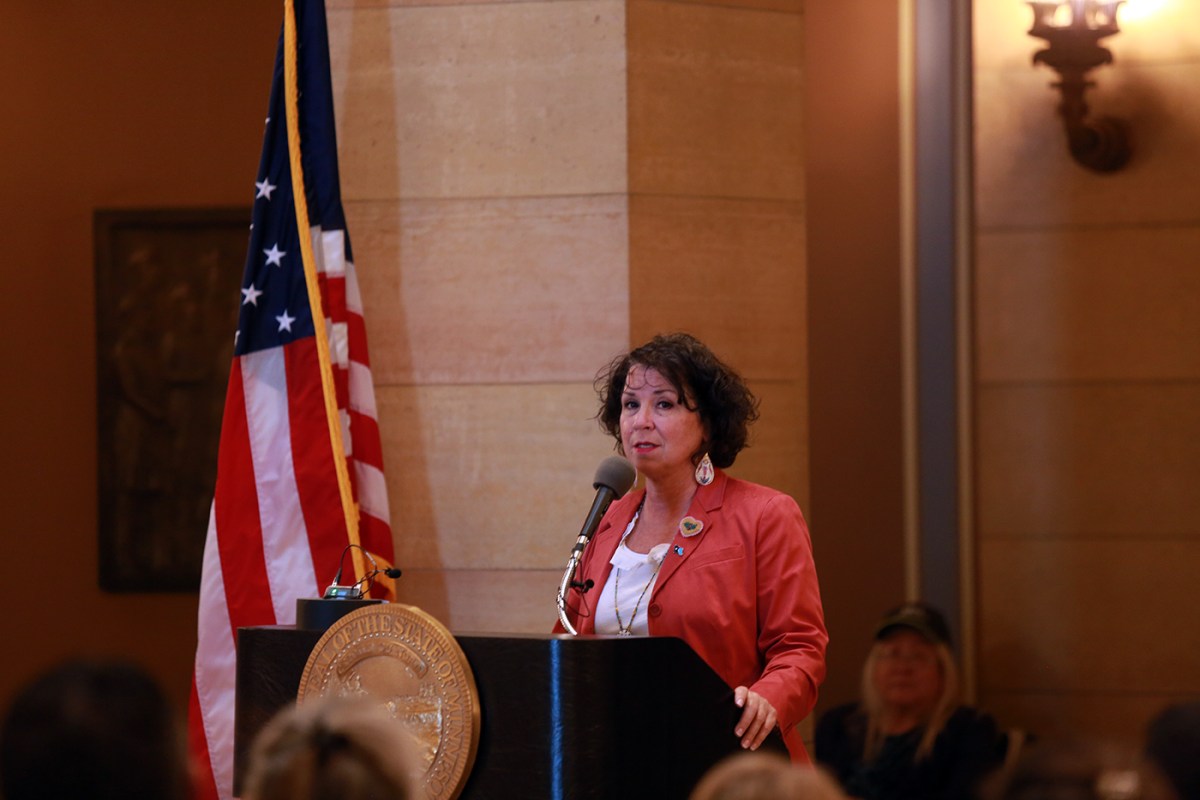
This story is part of a partnership between Bethel University’s journalism program and ICT.
Merrina O’Malley
Special to ICT
Minnesota State Sen. Mary Kunesh was walking to her car after giving a speech at a college in Ely, Minn., when she was approached by two tall, white men in camouflage. She was alone and nervous, especially in a place where the sex trafficking of Native women was the highest in the state.
To her surprise, the men were genuinely interested in what she had said during her presentation after hearing the stories of injustices faced by Indigenous people for centuries. They were currently training to be law enforcement officers and said there was nothing being taught to them about this issue. No one was talking about it either. Today, thanks to the work of Kunesh and other allies, racial training is a required part of public safety training.
Kunesh, a citizen of the Standing Rock Sioux Tribe, learned from her family of leaders the importance of taking action and standing up for her rights. After becoming a legislator eight years ago, she has worked on removing the hand that has silenced countless Native Americans and made her mark as the first Indigenous woman to serve in the Minnesota Senate. Her most recognized work has been with the Missing and Murdered Indigenous Women Task Force, which was created in 2018. Since then, she has continued to stand with the Native community with landback bills and voting initiatives.
In her younger years, Kunesh’s grandpa taught her to value and fight for her place as a Lakota woman. She came from a strong network of inspiring figures like her mother, great aunt Josephine Gates and the leaders she knew through Standing Rock.
“Russell Means, [Dennis] Banks, all of those guys were bringing the trials and tribulations of being Indigenous to the public,” she said.
As someone with a background in teaching, Kunesh has made it a goal to educate people about Native people’s experience. Robert Pilot, the host of Native Roots Radio, believes in her mission and has featured her in more than 300 episodes. On the show, Kunesh speaks about the latest in legislation and culture.
“I am impressed by [Kunesh’s] tenacity,” he said. “She stays on top of things and does not get rattled.”
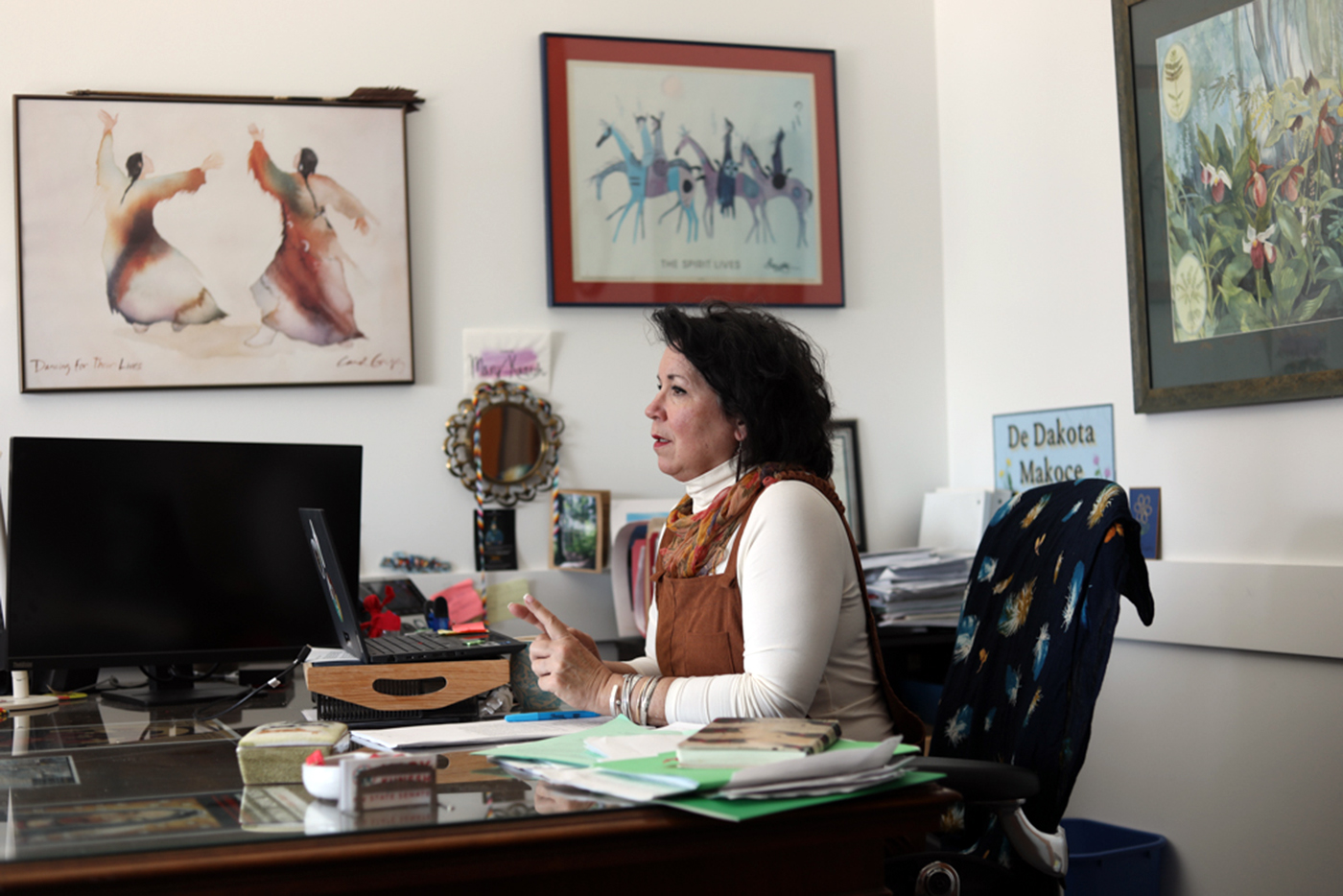
A personal connection
At a young age, Sen. Kunesh was exposed to stories of missing and murdered Indigenous people.
“I had an awareness of the violence against Native people for a long time,” she said. Her father, a pro bono lawyer who worked for tribes in northern Minnesota, would often take her along on his trips across Minnesota, where she learned more about the hardships faced by tribes.
One story hit close to home, a relative named Elsie Kelly who went missing a generation ago. She is just one of many who were not properly investigated by law enforcement agencies.
The statistics were not on their side either. If an Indigenous body was recovered, it would often be improperly recorded or not recorded at all. In some places, Indians from Asia were lumped in with American Indians, and deaths were often written off as suicides with no further investigation, according to Kunesh.
Many missing and murdered Indigenous relatives were never officially recorded in the Department of Justice’s database. With a lack of officiated data, the only thing propelling any sort of investigation into this centuries-long phenomenon were personal stories from those who had lost their loved ones.
In the summer of 2017, Kunesh heard the story of Savanna LaFontaine-Greywind, a Spirit Lake Nation woman. Until her body was found, the media provided minimal coverage despite concern amongst the people who knew her. She was 22 and pregnant at the time she disappeared.
“[This lack of media coverage] was just so typical of what happens with Indigenous violence, especially [with] women,” said Kunesh.
Later that same year, she began putting together the MMIW task force and a report that would be released in December 2020 highlighting the injustices and historical trauma faced by Native women.
It wasn’t an easy start. Without statistics and data to show the widespread problem, she had to rely on the stories of people within her community, and gaining their trust took time and patience.
“There’s just such a historic distrust in any type of government or authority,” she said. “In doing this we would be dredging up a lot of painful history.”
As the deadline for the hearing approached, Kunesh reached a dead end. She got connected with a leader of the American Indian Community Housing Organization, who suggested that the women write their stories down on postcards. A few days later, a stack about 4 inches thick was driven 150 miles down to the Capitol from Duluth.
“They went over to the Capitol and handed them out and people were amazed by [the stories], and they came to me and said, ‘What is this?’” said Kunesh. “That’s how we got the very first hearing.”
Members of tribes from across Minnesota stood up and testified, telling stories of their missing and murdered daughters and relatives, many of which had not been heard before.
“Their stories were so genuine and so heartbreaking,” Kunesh said.
After many long hours, the MMIW task force and legislation were passed with a 100 percent bipartisan vote after an omnibus supplemental budget deal in 2018. The first MMIW office in the nation was signed into law by Gov. Tim Walz in 2021. According to Ana Negrete, an MMIW community planner, Kunesh continues to visit and support the office to this day.
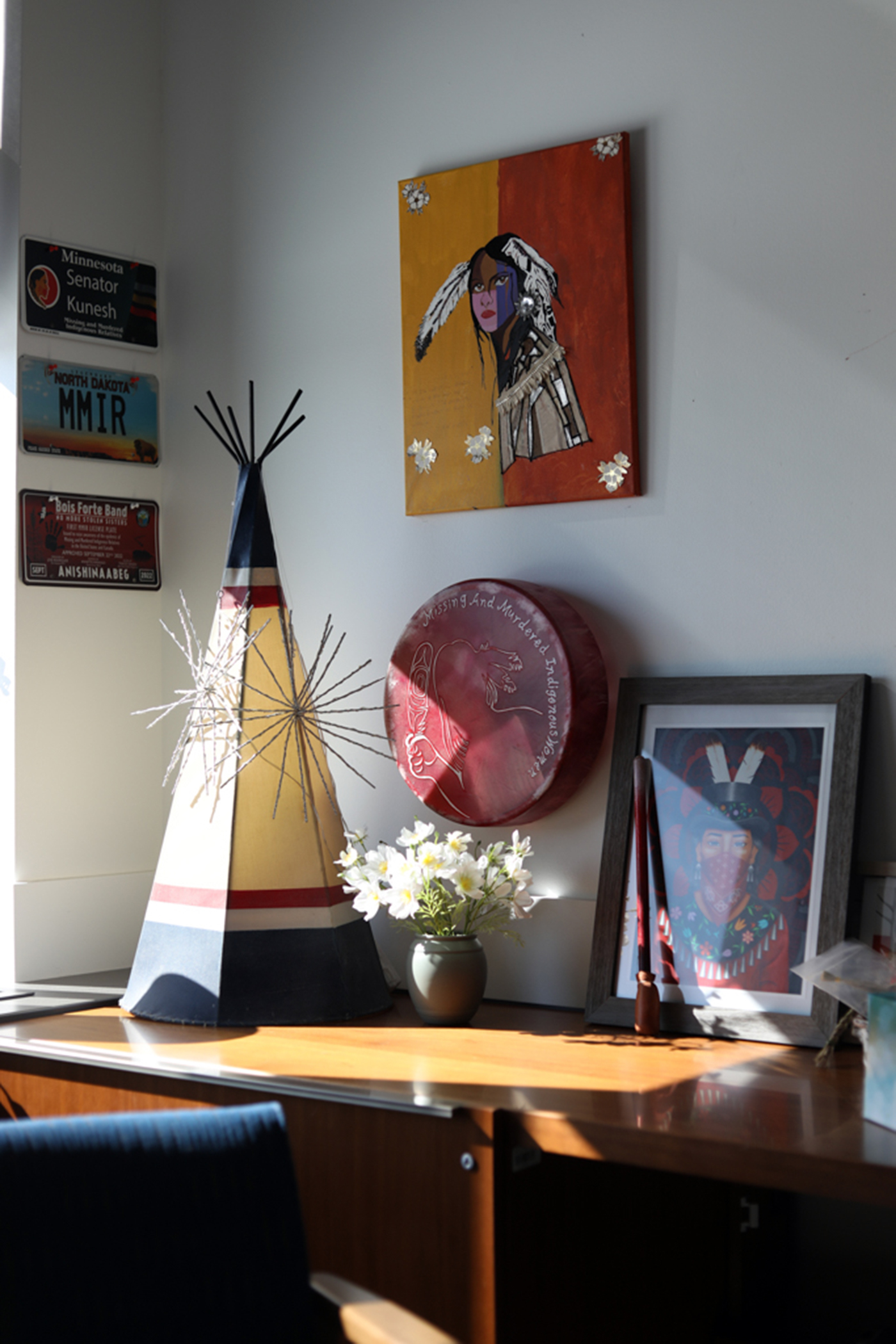
Framed by 11 tribal flags during her speech at the May 6 American Indian Day on the Hill in Saint Paul, Kunesh celebrated progress. She spoke of legislation that positively impacts Indigenous people and of the hope she has for the future as she works to get land back for tribes. Her next mission? Red Lake.
Sam Strong, the secretary of the Red Lake Nation, spoke highly of Sen. Kunesh after her speech. He said she has done lots of work in carrying the land back bill meant to return the entire Red Lake back to tribal jurisdiction. As of now, the Department of Natural Resources owns the lower part of the lake.
“She is unafraid to do the right thing,” Strong said. “She is fearless.”

Merrina O’Malley is a student at Bethel University graduating in May with degrees in English Writing and Spanish. During her time at Bethel, she has had the pleasure of working on social justice stories while abroad in India and writing for Press Publications.
This story was part of a partnership between Bethel University’s journalism program and ICT editors Kevin Abourezk, Dianna Hunt and Dalton Walker.

