
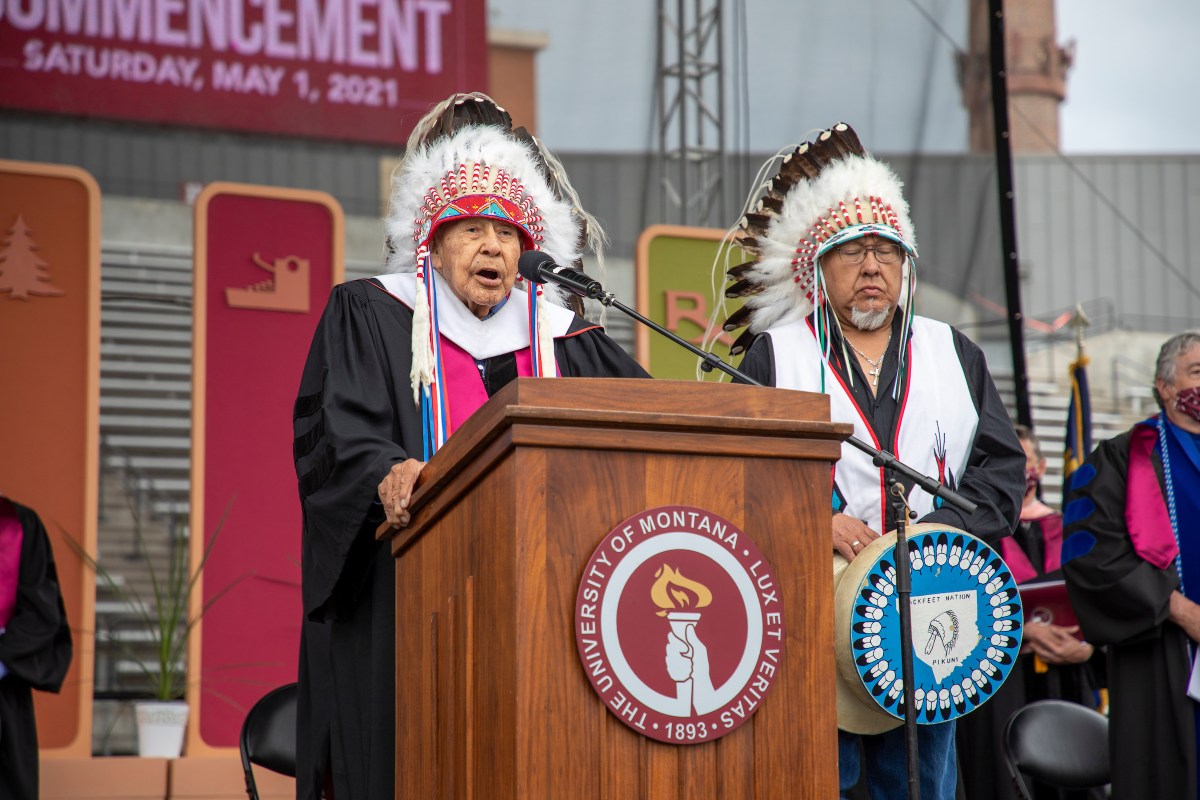
It has been about a year and a half since Earl Old Person, the Blackfeet Chief, passed away at age 92 from cancer. The tribal leader, politician, and language holder left behind a lifetime legacy that beckoned for recognition from Montana leaders.
Montana lawmakers seemed to have recognized Old Person’s legacy. Although it took some work, the Legislature passed a bill to rename a section of Montana Highway 89 on the Blackfeet reservation after the late Blackfeet Chief Earl Old Person. The bill is currently on the Governor’s desk waiting for a signature, which would make the name change legally official.
Sen. Susan Webber, Democrat and a Blackfeet citizen, sponsored the bill and said she believes the Governor will sign the bill. She said the motivation behind bringing the bill forward came from the community Old Person served.
“It’s an honor to be asked by your tribe to do something for them and so that implies that, you know, 17,000-plus members of the Blackfeet tribe had requested that,” Webber said.
SUPPORT INDIGENOUS JOURNALISM. CONTRIBUTE TODAY.
First introduced in January, Webber believed that this would be a quick bill to get passed through, however it got tabled in the Senate Highways and Transportation Committee.
“It was a struggle getting it out and, and it shouldn’t have been,” Webber said. “It should have been a slam dunk. It should have been easy, and I thought when I started it out, ‘Oh, it’s just gonna sail through.’ That wasn’t the case.”
Members of the listening committee spoke during the first reading of the bill and said that renaming Highways was reserved only for fallen soldiers and police officers. Sen. Barry Usher, Republican, called for the motion to table the bill. Usher, who is also a former state Representative, said it has been customary to name highways after fallen military personnel and law enforcement officers.
“In the house transportation we had a lot of these bills and in the house we came to the conclusion that we would only pass if someone died in the line of duty in the military or law enforcement and that’s because we ended up with 10s, maybe 20 or more of these,” said Usher in committee. “There are many, many, many other ways to significantly recognize the great service to our state and our country for people.”
Despite the rough entrance of the bill, Webber said it was blasted onto the Senate floor to be voted on in a last chance effort to keep it alive. The motion passed, where the senate pushed it through with a 36-14 vote.
The Montana American Indian Caucus presented a letter of support which stated that this bill would help honor the late chief at the House Transportation committee hearing after it was referred from the Senate floor.
“Chief Old Person was also a staunch Republican politically but most importantly, stood up for Native American Rights creating precedent for all Indian Country,” stated in the caucus letter. “This committee can recognize one of our most historic Montanans and Native American Chiefs.”
Old Person represented the Blackfeet tribe in leadership for 70 years, sitting on the Blackfeet Tribal Business Council for the majority of that time. His work reached far and wide throughout his life and was infamously known for being able to not only exist, but succeed working in both reservation and off-reservation governments.
Sign up for ICT’s free newsletter.
Rep. Tyson Running Wolf, Democrat and a Blackfeet citizen, carried Webber’s bill onto the House floor this week when it was up for second reading. Running Wolf served alongside Old Person when they were on the Blackfeet Tribal Business Council.
“Chief Earl Old Person positioned himself as a go-between, linking his Native American community with the rest of the country and beyond,” Running Wolf said in his opening statement on the floor. “He urged his tribe to be more entrepreneurial and he pressured government officials and venture capitalists to invest in Blackfeet-owned businesses.”
The chief had a strong and consistent involvement with the country’s political leaders. Running Wolf said Old Person has met with every U.S president since Harry S. Truman through Barack Obama, making sure that all of Indian Country was recognized and had a voice.
Running Wolf closed the floor discussion with a quote from the late Chief.
“He would say, ‘Thank you all my relatives, I’m really happy to be here with you. Try really hard and do your best for the people you serve,” Running Wolf said.
Often described as kind and welcoming, Old Person touched the lives of many Montanas, some even in the state house.
Rep. Michele Binkley, Republican, also spoke to the House. She told the floor of a time when the chief had given her money to help her move down to Florida and years later she still remembered Old Person’s generosity.
“I just can’t say enough about him. I just really loved him,” Binkley said.
Old Person encouraged the pursuit of education for Native youth and understood the power of continuing to learn and further opportunities. The University of Montana awarded him with an Honorary Doctorate in Human Letters in 1994 due to his accomplishments in humanitarian efforts.
University Of Montana president, Seth Bodnar, said the university had a long-time relationship with Old Person. The chief was a part of the Rawhide Singers, a group from the Blackfeet tribe who came and honored each graduating class at UM through song.
“Just demonstrating the important role that Native American heritage and culture plays, not just in this university’s past, but, but in our present and the important role that it plays in our future,” Bodnar said. “Chief Old Person was an incredible leader. He was a role model for so many people including myself.”
Last year the University set up a $300,000 endowment in Old Person’s name that goes to the school’s annual Kyiyo powwow, an effort that would help the production of the event.
“I learned a great deal just in my time visiting with him and watching him interact with people. He truly cared for people and embodied the idea of a servant leader for so many,” Bodnar said.
The community of the Blackfeet tribe felt the loss of its Chief but also the loss of something else. The community had lost an iconic culture and language holder.
“When he was a teenager, he was an interpreter for the tribal council, which was made up of people who spoke the language,” said John Murray, the Tribal Historic Preservation Office director for Blackfeet. “They had connections back to, you know, the old life, of the Blackfoot way.”
Murray spoke about the interconnectedness the chief had with families in the community, saying that Old Person had ties either directly or indirectly to every family. Murray said that the chief lived through many significant moments in history concerning American Indians such as the passage of monumental laws including the Indian Civil Rights Act and the Indian Freedom Act. Old Person also sat as president of the National Congress of American Indians in 1969 and 1970.
“He was one of the icons of Indian Country leadership,” Murray said.
The two-mile segment of Highway 89 to be memorialized is located on the reservation west of Browning and stretches toward Browning High School, which was a strategic detail.
Sen. Webber said she asked the chief’s family where they wanted the road to be. The family responded and asked for the placement to be in front of the school.
“We want to basically show our native children and our guests that we have these outstanding people in our communities, that we have our outstanding people in the community and it’ll give them a sense of pride, It’ll give them a sense of ‘Yes, I can do this,’” Webber said.

This story is co-published by Montana Free Press and ICT, a news partnership that covers the Montana American Indian Caucus during the state’s 2023 legislative session. Funding is provided in part by the Headwaters Foundation.
