
This story was originally published by MPR News.
Melissa Olson
MPR News
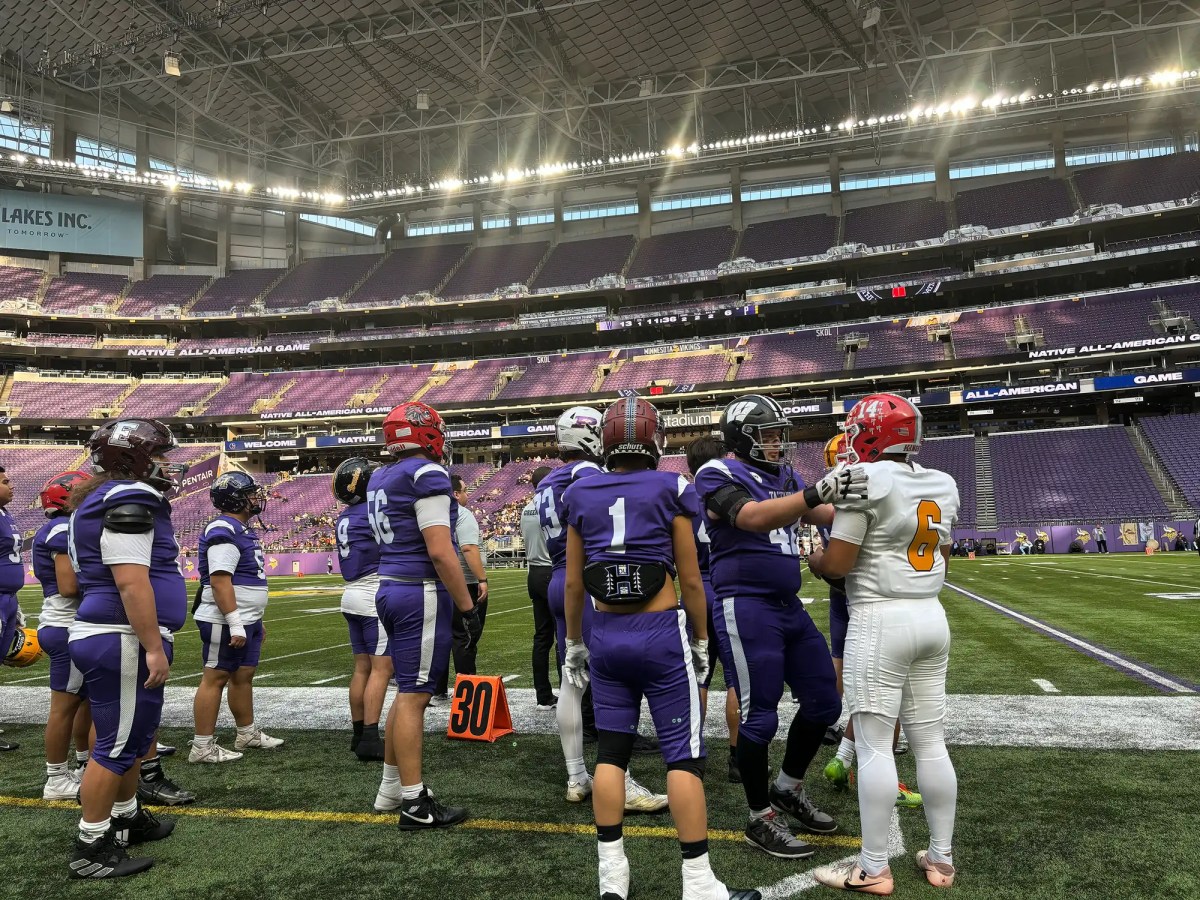
The sounds of jittery, out-of-breath shouts, sideline pep-talks and crunching pads echoed inside one of the biggest stages in American football on Sunday.
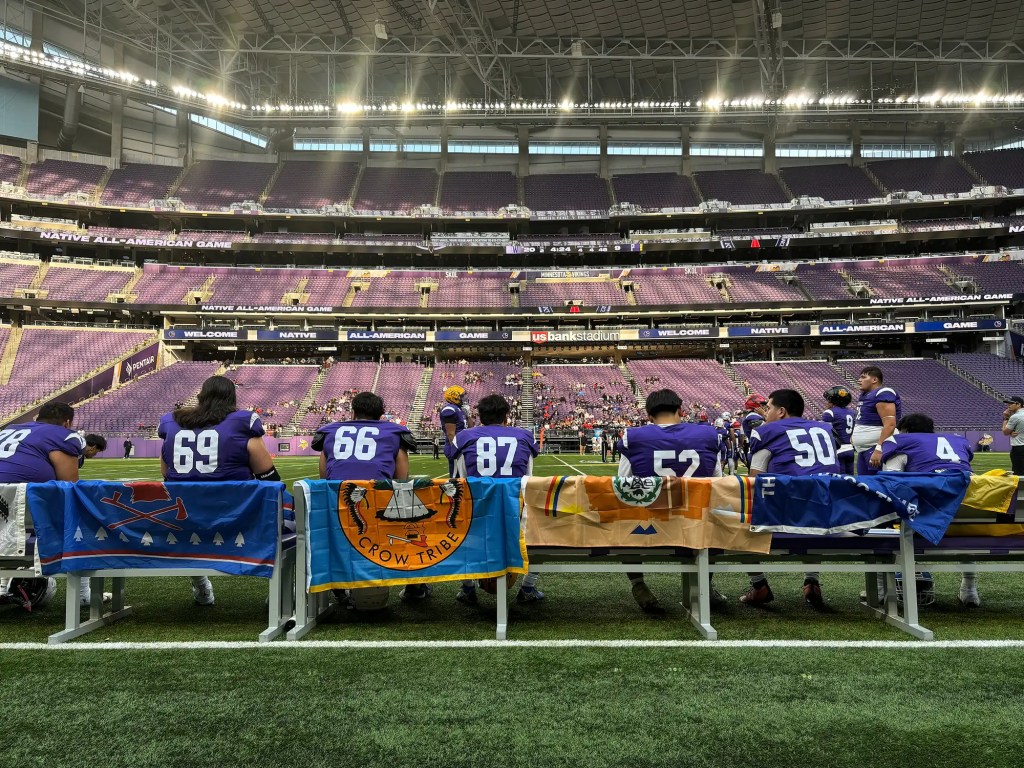
Seventy Native American high school athletes were living the dream: playing at U.S. Bank Stadium in Minneapolis as part of the fourth annual Native All-American football game.
Julian Senn, a high school senior, made the trip from Newberry, S.C. Other players arrived from faraway places too: 48 tribal nations from 21 U.S. states and Canada participated.
“I didn’t know none of these guys at first,” said Senn, a citizen of the Turtle Mountain Band of Chippewa. “We met on Zoom meetings. Now, being able to play with them is awesome. Being on a big stage right now, don’t feel real.”
The Native American Athletic Foundation hosted the event. Athletes like Senn had an opportunity to work with former college and professional athletes and coaches like Kent State head coach Pete Cordelli.
“We had a little bit of one-on-one time,” Cordelli said. “I look at this as a lifetime memory, but also, this is laboratory for leadership. These are young guys who are going to make an impact on many lives as they go forward, but it comes through leadership.”
The 70 players were divided into two teams: Team Ta’tanka and Team Wa’ya.
Derek Fine, Ahman Green, Levi Horn, and Chase Johnson are former NFL players who shared their knowledge on the gridiron.
Green, former running back for the Green Bay Packers and four-time Pro Bowl athlete, coached Team Ta’tanka. He tried to keep the playbook simple because the players didn’t have much time to practice.
“Not a big one, something that just lets you get out there and be a football player,” Green said. “They are learning all the stuff you learn as a professional — in anything. To learn how to adjust on the run.”
Levi Horn coached Team Wa’ya. It’s his first year with the Native American Athletic Foundation. He says the annual All-American game provides players with an opportunity to be seen by college recruiters.
“It’s a chance for them to get another piece of tape and go out and play somewhere else,” Horn said.
Horn spent his college career playing for the University of Montana and went on to play for the Chicago Bears for three years as an undrafted free agent. He also played briefly for the Minnesota Vikings.
Mike Andrews, founding member of Native American Athletic, says it’s a unique opportunity for Native youth, many of whom live in a rural part of the country.
“They don’t get the same access to recruiting databases and scouts,” he said. “So we really like to bring them into a city like Minneapolis and in a game like this and get some film. Hopefully, there’s a college scout that’s looking for a top-notch student athlete who happens to be Native.”
Correction (Dec. 15, 2025): An instance of Derek Fine’s name was spelled incorrectly. The story has been updated.
