Mark Wagner
Special to ICT
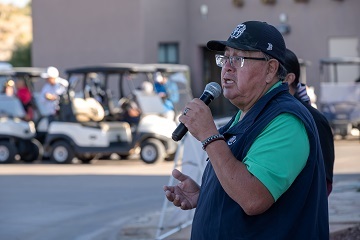
SANTA ANA PUEBLO, N.M. — Before the second round of The Native American Open golf tournament, Emmett “Shkeme” Garcia of the Santa Ana Pueblo led the crowd in a Keres blessing.
“On behalf of this current tribal chief and the humble people of the homeland of Tamaya,” he said, first in Keres and then in an English translation, “we pray you watch your words, be mindful of the homeland, remember you came carrying your ancestors and family and friends. Be safe, be strong and be blessed on this special day in this special place. Have a great day and go hard.”
Then Chairman Jay Garcia offered an acknowledgement of the Twin Warriors — Masewi and U’yuyehwee — who long ago showed the Tamaya the path to the upper world along the banks of the Rio Grande River.
With that, a slate of Indigenous golfers headed to their carts after final hugs and good luck wishes from family and friends. Game on.

In its third year, The Native American Open at Santa Ana Pueblo on Oct. 21-22 featured 160 golfers from 71 bands, nations or tribes, with 17 states and Canada represented. Sponsors included AMERIND insurance, WM, Taylor Made, and many other top-flight organizations.
And for the third year in a row, the club had to turn golfers away. That’s not surprising for the well-run competition, with prize money and bragging rights — and the publicity that might bring sponsorships — all in play.
The benefits did not go unnoticed by this year’s champions, Skyesong Alexis and Eric Frazier. But the all-Indigenous tournament is about more than the perks.
“It’s a good feeling to accomplish what I have so far, being the first Indigenous in Canada to do what I have done,” Alexis said. “And I’m proud that I have pushed through it all, to be playing at the level I’m playing at now, knowing I’m where I belong. “
Women’s Champion: Skyesong Alexis
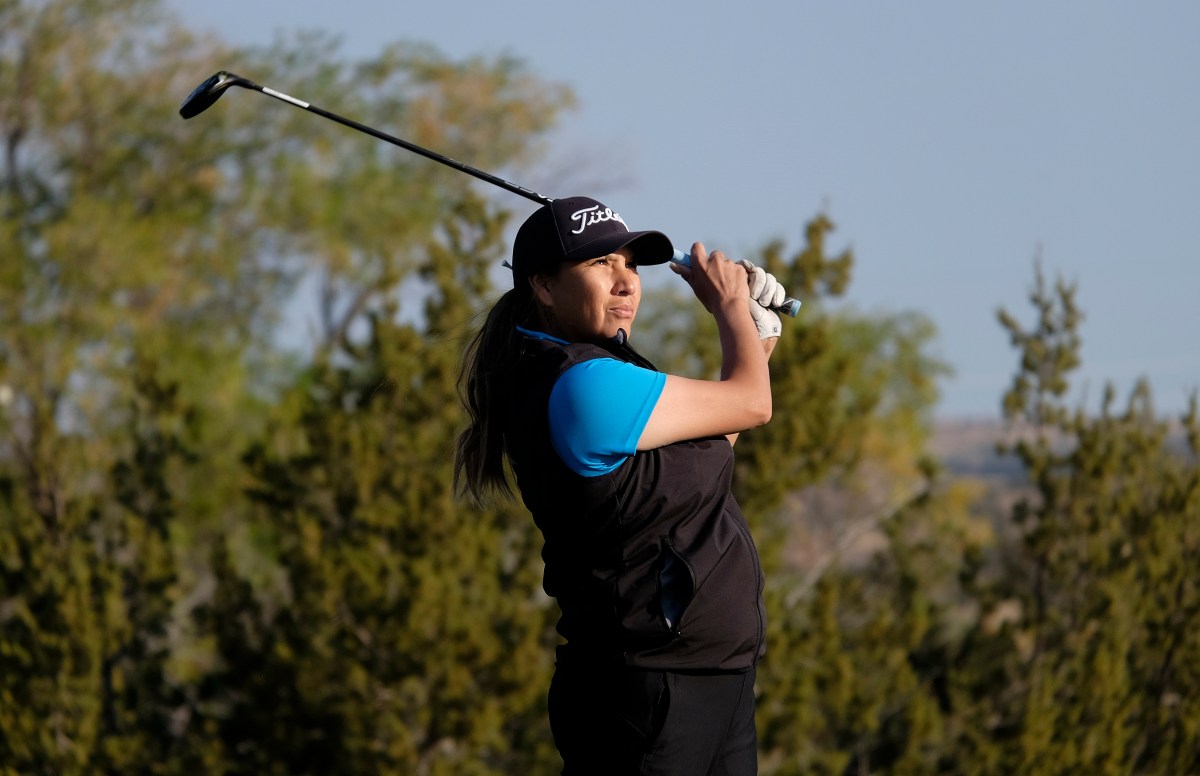
Alexis won the women’s championship flight with a score of 150, 15 strokes lower than her nearest rival. It was her second first-place finish in three months – she also placed first at the Indigenous Ontario Championship in August.
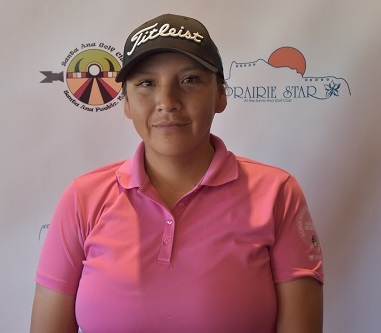
Alexis, from the Alexis Nakoda Sioux Nation in Alberta, Canada, began playing golf at 8 years old.
“I am self-taught,” she said. “I just watched Tiger Woods videos and Notah Begay on TV when I was a little girl. I would watch their swings, then go outside to swing the club. Tiger and Notah, with all their accomplishments, showed me anything is possible if you believe in yourself.”
Self-belief can be hard for Native golfers, she said.
“I faced a lot of challenges being Native,” Alexis told ICT. “I heard a lot of bullying comments along the way. But that didn’t stop me and just made me more motivated to keep showing up, because I belonged playing at that level in golf.”
In 2022, Alexis secured the backing of a sponsor — LiUNA Canada — and played on the Epson Professional Tour. She lived for a time in Florida and played alongside Gabby Lemieux, Shoshone-Paiute, and other top women. While she continues to seek sponsors for her professional career, this was a step toward her dream of playing on the Ladies Professional Golf Association tours.
Her biggest win?
“The Sun Life Open in 2019 as an amateur,” she said, with little hesitation.
Alexis, who played on Team Alberta in the Canadian nationals, gave up playing for a bit to have two children, daughter Kiya Alexis, 12, and son Cory Saddleback, 7. But she’s since returned.
She loved this year’s Native American Open for allowing her to play alongside such a strong field of contenders who are Indigenous, just like her.
“It’s good to see more young ones coming up,” she said.
What message does she have for the younger generation?
“To always chase your dreams,” she said. “Goals in life can be big or small. No matter what happens, know you are good enough. You belong, and there’s nothing in this world you can’t do. There’s always a way, if you just believe and push through and keep showing up. ‘Cause hard work pays off.”
Alexis didn’t just show up for the Native American Open this year. She won going away.
Men’s Champion: Eric Frazier
In the men’s championship flight, Frazier won by one stroke, needing an eagle in both rounds to gain the victory.
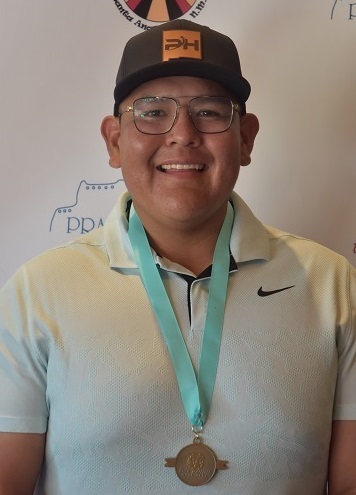
By the time ICT reached Frazier for comment, he was already on to the next tournament, the San Diego Open.
“I’ve played professional golf the last three years of my life,” he said. “I don’t want to walk away from it altogether. I enjoy every aspect of it.”
Frazier, Diné, grew up in Albuquerque playing at Paradise Hills on the city’s west side. He started at the age of six, taught by his dad and grandfather, who came to Albuquerque from Window Rock, Arizona. He’s a third-generation golfer, though he is quick to note the differences.
“My dad and grandfather, they would go hit balls in the middle of the desert,” he said. “They grew up in a time of golf when courses weren’t accessible. It’s a different time now.”
In addition to family, he counts Woods and Begay as primary inspirations.
“Those are the pinnacles of what I wanted to be,” he said.
At the same time, as every athlete knows, the element of time comes into play, and Frazier admits his thoughts have turned to the future, perhaps staying in the industry by enrolling in a golf operations or course management program. His last four years working in golf operations at Paradise Hills have laid the groundwork.
When the road fatigue of professional play gets too much, he would be able to stay in the golf world.
Related story:
—First Native pro golfer gains new recognition after 100 years
“I’m getting a little older,” the 27-year-old Frazier said. “As a professional athlete, I wake up early, go to the gym, practice and play. It’s every single minute of the day.”
He is not shy about the struggles of professional golf.
“There’s no money in it unless you win,” he said. “It’s an investment every week as far as expenses. If you don’t make the cut, you are losing money all day long.”
Still, golf has given him so much, he said.
“I’m talking about friends and people I’ve met,” he said. “It’s more or less like a commonality thing. Now some of my friends, getting older, are starting to take up the game, and at home I’m playing with old friends.”
What’s changed from Frazier’s father to his own life is accessibility.
“Golf is more accessible to our people now,” he said, noting that the tribes that now have a golf course are also developing recreational programs and creating a culture of teachers, players and professional golfers.
He said the tournaments his father played were word-of-mouth, raising money for scholarships and other causes. The Native American Open is strictly a competitive golf tournament run by the Santa Ana Pueblo, which boasts the first Pueblo PGA professional in Jason Montoya. It is also the home of the Notah Begay lll Foundation.
In its third year, The Open, as it is called, continues to bring golfers in from far and wide.
“I really liked that it was more than the New Mexico community,” Frazier said. “I met people from everywhere. The Open did a great job of marketing. There are several different communities from all over.”
What message does he have for the next generations?
“Never take it for granted,” he said. “Always find that passion for the game and stick with it. One way or another you’ll come back to it. . .. I would also want to add: Never forget where you come from. Always appreciate what golf has done for our community, whether that’s for themselves or their family or the community as a whole.”
Other winners
The championship flights were not the only games in town. Eight other flights included Indigenous golfers with varying levels of skills.
SUPPORT INDIGENOUS JOURNALISM. CONTRIBUTE TODAY.
The championship flight is straight-up stroke play for scratch golfers, with no handicaps calculated into the final score. The women’s and men’s open flights featured golfers with handicaps higher than 3, with the winners determined without the use of handicaps, known as a gross score. The net flight winners are determined with handicaps calculated into the final tally.
The senior flights are for golfers 50-64 years of age, and the super senior flights are for golfers 65 years and older.
The other winners at Santa Ana Pueblo were:
- Women’s Flight: Annette Sieben,Cochiti Pueblo, New Mexico
- Women’s Flight Net: Candelaria Lewis, Navajo, Arizona
- Men’s Flight: Landon Johnston, Lheidli T’enneh First Nation, Alberta, Canada
- Men’s Senior: Conrad King, Oneida, Wisconsin
- Men’s Super Senior: Delmar Jones, Gila River Indian Community, Arizona
- Men’s Flight Net: Rocky Tsosie, Navajo, New Mexico
- Men’s Senior Net: Clarence Peterson, Navajo, New Mexico
- Men’s Super Senior Net: Russell Weiss, Juaneño Band of Mission Indians, California
There was no junior flight, but a number of young players joined in the open competitions. Two juniors medalled in the open flights: Olivia Long, Coeur d’Alene and Navajo, who placed third in the women’s flight, and Zachary BlueEyes, Navajo, who placed third in the men’s flight.
Peyton “Beans” Factor, who is Chickasaw, Choctaw, Creek and Seminole, and Maddison Long played in the championship flight. Another young player, Tristan Toledo, Jemez Pueblo, placed 11th in the championship flight.
Looking ahead
The awards ceremony was held at a chock-full room at the Santa Ana Golf Club on Oct. 22, after the final rounds were played.
Garcia, the chairman, opened the ceremony flanked by a group that included PGA Director of Golf & General Manager Derek Gutierrez. longtime club employee Micah Jones, and golfer Montoya, who handed out medals and envelopes with cash winnings.
In another corner, 80-year-old golf enthusiast and recreational player Beaman Wisdom, Chickasaw, said hello to old friends and introduced people to some of the country’s finest Native golfers, folks such as Robert Komahcheet, Aiden Thomas, “Beans” Factor, Glynnis Price and Sadie Kelly.
The parents of young golfers like sisters Olivia and Maddison Long and Zachary BlueEyes pushed their champions forward for pictures and medals.
Wisdom noted that the competition was too strong for him, and he — in a friendly tone — suggested there be a flight for golfers older than 70. He also handed out fliers about a new club and plans to start a tournament in Oklahoma.
Golf is the fastest-growing sport among First Peoples, Garcia said. A new generation is catching on.
“The changes seen are attributed to accessibility,” Garcia said. “With more tribal golf courses available, our younger generation has more opportunities to play and practice than my generation and those before. Television and Internet coverage has helped.”
More info
For more information about The Native American Open golf tournament or the Santa Ana Golf Club, visit My New Mexico Golf or the tournament website.

Our stories are worth telling. Our stories are worth sharing. Our stories are worth your support. Contribute $5 or $10 today to help ICT carry out its critical mission. Sign up for ICT’s free newsletter.