
Kadin Mills
ICT
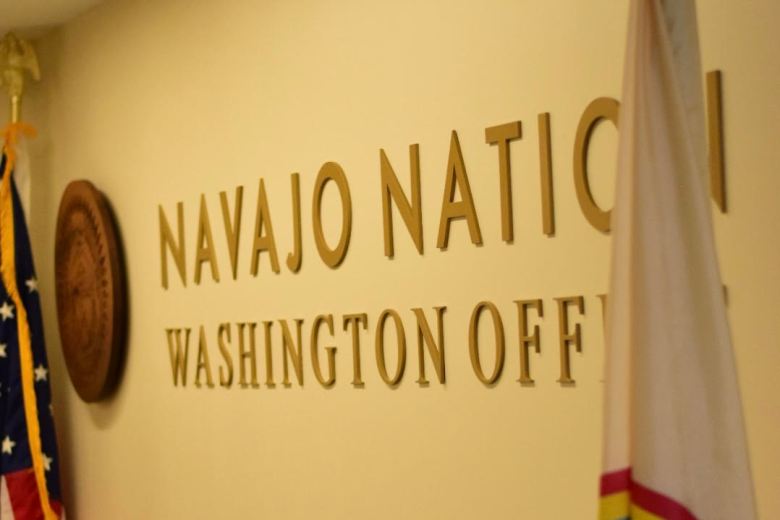
WASHINGTON — The Navajo Nation Washington Office collected stories of forced relocation earlier this week ahead of a planned tribal consultation with White House officials on Monday, Oct. 21. These testimonies, the office says, will help make the case to appoint a commissioner to the Office of Navajo Hopi Indian Relocation, an office that hasn’t had an appointment in 30 years.
On Oct. 14, 15 and 16, representatives of the Navajo Nation Washington Office visited eight chapter houses, of the 110 in total, across the Navajo Nation to hear accounts of more than 130 Navajo and Hopi people impacted by government relocation following the 1974 Navajo-Hopi Land Settlement Act.
The settlement attempted to address ownership of the 1882 reservation, home to both Hopi and Navajo citizens, as oil and other minerals were discovered under the surface. Congress authorized the Hopi Tribe to sue the Navajo Nation in 1958, and a federal judge held four years later that the tribes had equal and undivided rights to the land, with exception of some solely Hopi lands. The Hopi Nation petitioned Congress to partition joint use lands, leading to the Land Settlement in 1974.
A mediator drew the partition line, placing about 100 Hopi people on Navajo land and about 16,000 Navajo people on Hopi land. These individuals were forced to relocate. Congress also established the Office of Navajo Hopi Indian Relocation, a federal agency responsible for assessing relocation claims and appeals, administering trust land, and providing housing.
Since 1994, the office has lacked leadership in the form of a commissioner appointed by the president.
“We don’t know why presidents haven’t appointed a commissioner in that position. It doesn’t even require Senate confirmation,” said Justin Ahasteen, the executive director of the Navajo Nation Washington office. He is Hopi and an enrolled citizen of the Navajo Nation.
Ahasteen said the Office of Navajo Hopi Indian Relocation has failed to adequately support families who have been forced to move. He said the lack of leadership has left the office without the proper resources.
Congress is considering closing the office and Ahasteen says the Navajo Nation is fighting for their voice to be heard. They want the agency to address outstanding relocation claims, poor quality homes, as well as underdevelopment and poverty induced by a 43-year construction freeze on the western portion of the Navajo Nation. The pause, known as the “Bennett Freeze,” was lifted in 2009, but has not been adequately addressed, Ahasteen said.
He claims the Office of Navajo Hopi Indian Relocation has failed to have meaningful dialogue with the Navajo Nation regarding a commissioner appointment. He is confident consultation with the Biden Administration is a step in the right direction. “We’ve been asking for this for well over 40 years.”
Previous attempts at consultation with the federal government fell apart in 2018. The Navajo Nation is set to meet with the White House Office of Navajo Hopi Indian Relocation and the Office of Management and Budget on Oct. 21.

ICT is owned by IndiJ Public Media, a nonprofit news organization. Will you support our work? All of our content is free. There are no subscriptions or costs. And we have hired more Native journalists in the past year than any news organization ─ and with your help we will continue to grow and create career paths for our people. Support ICT for as little as $10. Sign up for ICT’s free newsletter.

