
This story was originally published by the Alaska Beacon
Corinne Smith
Alaska Beacon
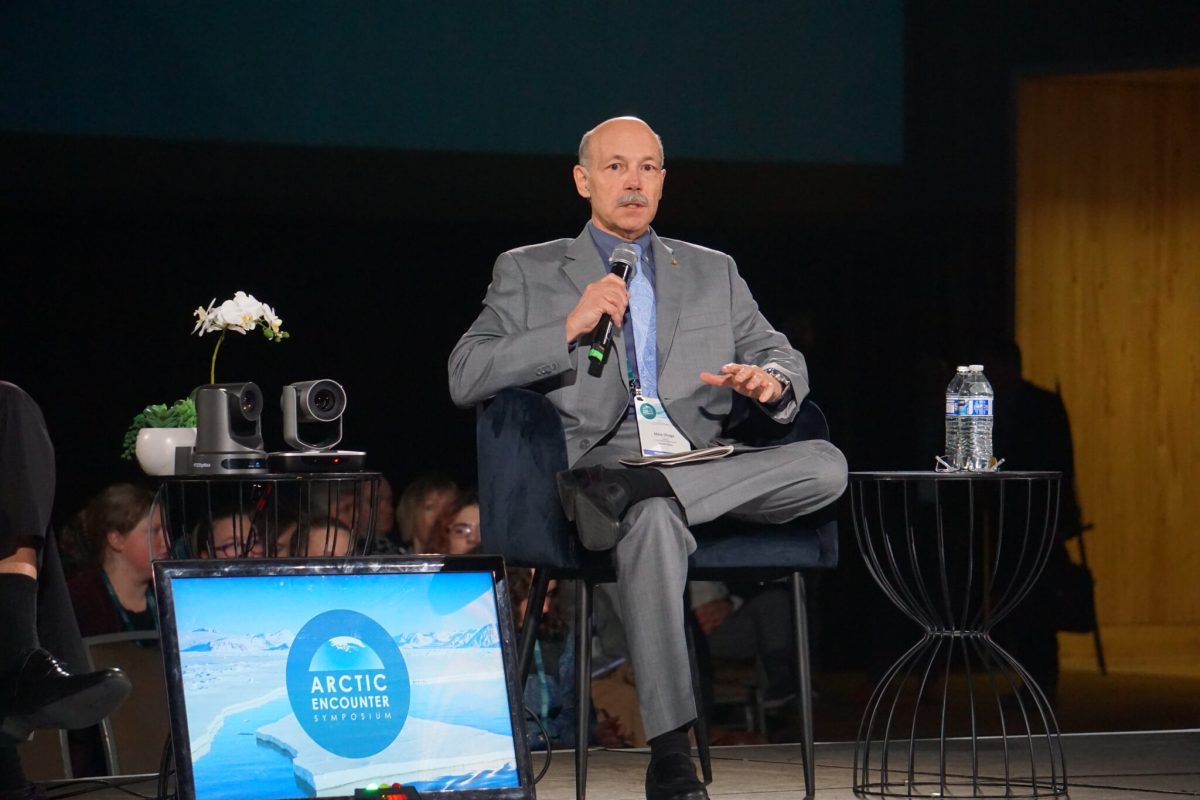
The former first U.S. ambassador-at-large to the Arctic, Mike Sfraga, has stepped into a new role as interim chancellor of the University of Alaska Fairbanks, and brings experience, focus, and a unique passion for the state’s leading research institution, which describes itself as “America’s Arctic university.”
In a phone interview in early August, Sfraga talked about his goals and challenges in the role, which is expected to last one year, as the University of Alaska continues a search for a permanent chancellor.
“Well, a number of things drew me to this role. One is, it’s my alma mater,” he said.
Sfraga graduated from UAF in 1997 from the first doctoral program in Northern studies and geography.
“I believe in its mission for the state,” Sfraga said. “I believe in its mission for the United States as America’s Arctic university, and I believe in its mission beyond our borders, as a global research institute focused mostly on the Arctic, but not solely.”
He went on to pursue a career with a focus on the North — from Alaska to Washington, D.C. — working in various academic, policy research and international diplomacy roles. Sfraga chaired the U.S. Arctic Research Commission, and founded the Polar Institute at the Wilson Center in Washington, D.C. Most recently, he served briefly as the first U.S. ambassador-at-large to the Arctic, appointed by former President Joe Biden.
“All of my previous positions have, in one way or another, included areas that UAF has expertise in, and so I’ve been able to tap into that expertise, especially during my time in D.C. and elsewhere,” he said.
Sfraga said continuing to grow student enrollment is a top priority. “The university has done a very good job over the past three to four years, increasing enrollment somewhere between 3 percent and 4 percent year over year,” he said. “That’s a strong trend line for the university. It shows us that we’re fulfilling our mission to our state across all programs. So that will be a priority to continue to help build upon our enrollment gains.”
Secondly, Sfraga said “it should be no secret” he’s focused on the Arctic, and UAF’s place for climate science, policy and research, and political and international relations. He said UAF has a role to play in our understanding of the Arctic.
“The Arctic has become an area of not just regional interest, but global interest, and this institution is poised very well to respond to a very, very strong demand signal for understanding the environment better, the domain better,” he said.
“That would be from our national security and homeland security perspective, but also changing oceans patterns and ocean acidification and fisheries — something so close and near and dear to all Alaskans, especially those who live a subsistence lifestyle,” Sfraga said, “all those things that we need to have a better understanding of as Alaskans, a better understanding of as a nation, and a better understanding in the global community.
“I will focus my time on places that I think I can help elevate those programs, enhance those programs, and further build upon those programs, because they are already world class.”
Sfraga answered questions about changing national political dynamics, and the Trump administration’s array of executive orders related to higher education, including immigration enforcement; banning “DEI,”, or diversity, equity and inclusion efforts; cutting research grants; and cracking down on student protest.
“We are in a very fluid environment. We need to be abreast of it. The team here is following these issues closely. We will deal with issues that come about as they come about,” he said. “I think it’s vital for us to reinforce the fact that we believe in academic freedom, serving all of our students, recognizing we have students from different backgrounds, from all over the state, all over the country, all over the world.”
In May, the University of Alaska system had seen more than $50 million in federal funding frozen, Pat Pitney, the university’s president, reported to the UA Board of Regents. This is part of a broader national freeze on certain categories of federal spending, including some money for research.
That included a $46 million grant for the Arctic Domain Awareness Center-ARCTIC Center for Excellence, focused on homeland security in the Arctic.
“We’re all waiting for further clarity on this. We know that, you know, members of Congress are working on various levels of funding scenarios for the different federal agencies. I’m hopeful that a majority of that funding will be put back into the budget,” he said.
He noted that the interview was being conducted during his first few days on the job.
“So we are working through the beginnings of scenarios, trying to understand what the implications could be …. We’ve watched this go on for the last several months, but I will be spending a great deal of time working with my colleagues here, along with President Pitney and the board of regents and the Alaska delegation (to Congress), to realize what the implications of these cuts could be to us, trying to mitigate those by communicating the value of research to our state and to our nation,” he said.
When asked about the University of Alaska regents’ action earlier this year to scrub reference to “DEI” or “affirmative action,” and its impact on student services, Sfraga said he was just days into the job but would be looking into it.
“The board of regents are in charge of our institution. They have oversight on that policy. So we’ll follow the board of regents policy, obviously, to answer your question about the ripple effects …. What I cannot give you yet is my read on all of the implications and everything we have done, because I’ve only been in the office a few days, and so that is on my list of issues that I will dig down on,” he said.
Some students, including some Alaska Native students, have criticized the move to change programs and support services, like the University of Alaska Anchorage reorganizing the Native Student Services program into the Indigenous and Rural Student Center. University officials have emphasized that these changes were separate from the regents’ anti-DEI language policy.
“My understanding is that we serve all students,” Sfraga said. “It’s also a commitment that we serve all students. I cannot speak to service levels, what they were and what they are now, I’ve not had any discussions that have referenced the decrease in service, just a reaffirmation that we serve all of our students.”
On the university’s role in Arctic affairs, Sfraga spoke about bringing his experience as a former ambassador to the Arctic to the region, and changing international geo-political dynamics.
“So part of my role would be to leverage my former position. We are ambassadors for life, even though we’re not currently in a particular organization, or a particular mission. And so I will look for areas where I can help our Arctic research directors, our research directors, our faculty, link to other universities and other entities throughout the circumpolar north,” he said.
“Our researchers already have longstanding, decades-long relationships. I’ll look for very strategic areas that I think I can help move their efforts forward. … So I’ll look to leverage a Washington, D.C., network in education and research — the same abroad, where we have some very strong partners and very strong opportunities.”
Sfraga said Alaskans should know there are many opportunities related to the Arctic.
“We’ve got a lot of challenges, but being at the nexus of domestic and foreign policy, whether it’s our homeland security, national security, energy security, we have some opportunity here in this new Arctic that we should work together and realize,” he said. He added that the Arctic matters in U.S. domestic policy, “and, I would argue, a big part of the United States foreign policy, because of our geographic advantage.”
“So as we think about this new Arctic, we need to seize this moment across our state and position ourselves very well for opportunities that will come our way, but they will be based on our ability to to actually move on those opportunities, and that’s going to take investment and smart planning.”

