
Nevin Kallepalli
Shasta Scout
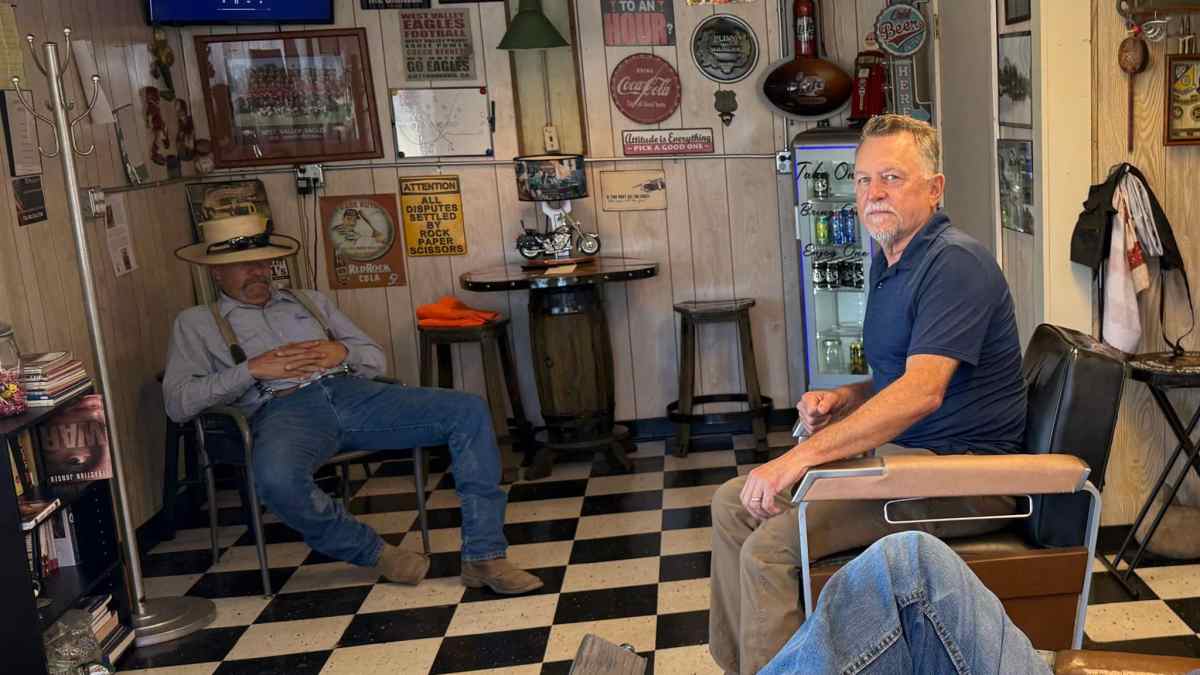
For years now, Woody Clendenen’s little barbershop on Main Street has doubled as an informal press briefing room for the Cottonwood Militia. While cutting customers’ hair, the cofounder of the Cottonwood Militia has also been known to give interviews to curious national reporters from the likes of Harper’s Magazine and CNN.
Despite national media attention, Clendenen and his partner Dan Scoville — the other founder of the local militia — still feel largely misunderstood by the Shasta County community where local press has rarely spoken to the group.
At the barber shop, a patron chimed in over the hum of Clendenen’s clippers flush against his nape. “Well, what was your opinion about the word ‘militia’?” he asked Shasta Scout while strapped into one of two barber chairs. “Did you think of your rednecks and your camo?”
“It’s been tarnished by the media for years,” Scoville added.
The negative connotation most Americans have when it comes to the term “militia,” according to Scoville and others in the barber shop that day, is related to intentional suppression of citizen self-reliance by the U.S. government. Nowadays, most Americans no longer grow their own food, tend to their own wounds or, according to Pew Research, live in a household with a firearm.
The Cottonwood Militia has guns and know how to use them, but leaders describe a mindset that is more defensive than offensive. “The militia stance on weapons is that the gun is the last line of defense,” Scoville explained.
Modern life is a far cry from the harsh conditions that required early white settlers to fend for themselves, as they slowly inched their way across the continent after landing in Plymouth Rock. Assembling a militia today, many members feel, continues to be not only a constitutional right but a patriotic duty.
Founders say the group is prepared for combat but is mostly focused on survival skills and disaster preparedness. They engage members in tutorials on how to communicate via radio and are prepared for a regional shut down to the power grid. They also provide basic medical training, along with arms training, and coordinate their communication via Signal chats when local wildfires or protests occur.
The Cottonwood Militia bylaws include a quote pulled from the U.S. military oath of enlistment, emphasizing that members “stand ready to defend our nation from all its enemies, be they foreign or domestic.”
Both founders spoke with reverence of the long tradition of militias throughout the 18th and 19th centuries, which, in Scoville’s words, “helped build America, because there was no military force, or not a very good one at first.”
It’s true that early militias were pivotal to building present-day America. But the complex history of early militias also includes paid involvement in the forced removal of the earliest inhabitants of this land. Across California, including what is now known as Shasta County, the mass killing of Native people was carried out in large part by volunteer militias commissioned by the California governor.
Clendenen acknowledges that militias may have been involved in some past violence against California’s Indigenous people, something he strongly opposes, but isn’t convinced they played a major role in destroying Native life. Regardless, he said, that history should have no bearing on the way today’s militias are viewed by the public.
“That has as much to do with us as the fact that there were white plantations that had slave owners and holding us as a modern society responsible for that. You know what I mean?” Clendenen said.
The militia and law enforcement
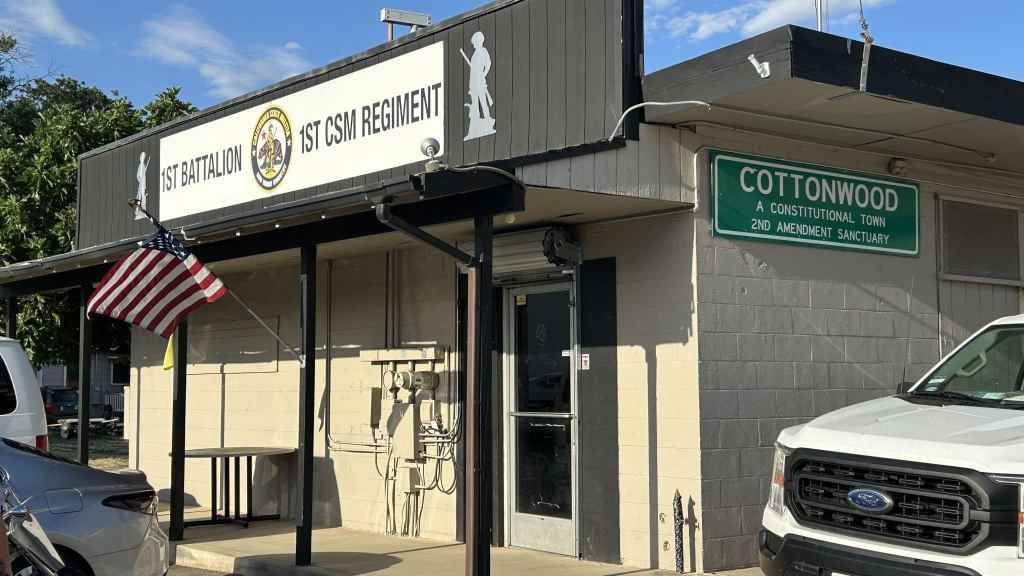
The Cottonwood Militia began in 2009 at a “barn meeting” for local residents of Cottonwood, California. Founders say the community had been experiencing an uptick in crime made worse by a delayed response time from the county sheriff, whose deputies could take hours to reach the small community on the outskirts of Shasta County.
In its early days, the local militia served as an enhanced neighborhood watch whose members subdued suspected criminals through citizens arrests while waiting for officers to reach the rural town of roughly 6,000. In time, according to militia founders, the group grew into an unofficial auxiliary of the official police force, with — they claim — the blessing of multiple municipal law enforcement agencies and officials, including the California Highway Patrol, the FBI, the Shasta County Sheriff, and certainly, some county supervisors.
“We’re not police officers or anything like that, but we do try to help our community,” Scoville explained, framing the group as a peace-keeping force that only intervenes when a crime is committed. They see their presence as support to deputized police officers, especially in situations that require crowd control.
Shasta County Sheriff spokesperson Michael Johnson confirmed that he met with the militia when he first assumed his role in 2024, as he would with any interest group, but did not elaborate on the nature of the department’s relationship with the militia beyond that. A lieutenant with CHP’s Northern Division probed Shasta Scout on what the news agency knew about the militia before suggesting that reporters contact the Redding-based CHP office where Shasta Scout was unable to reach a local lieutenant despite repeated attempts. As for the FBI, a representative from the local field office said the organization has “no comment” on the group and a public records request yielded no related records.
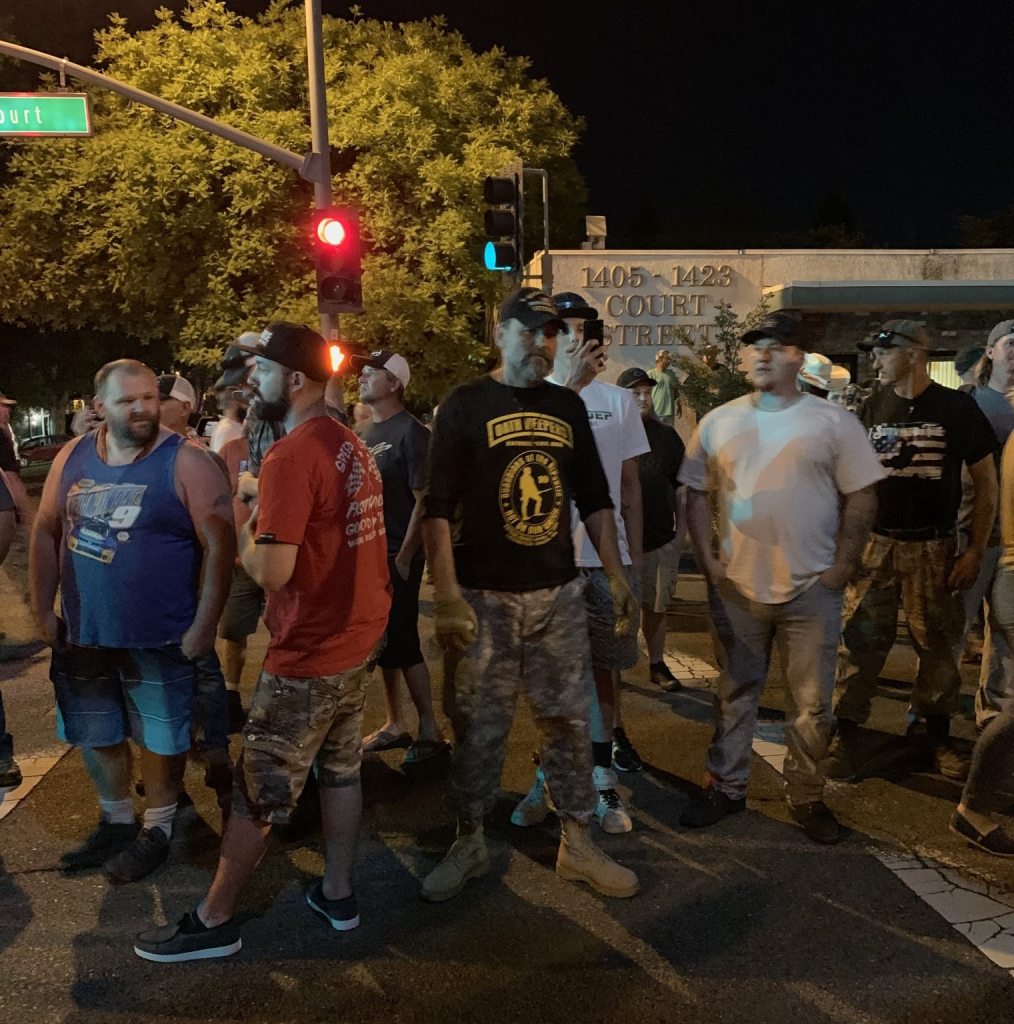
In Shasta, militia members with radios and ear pieces can be seen at local protests, from a 2020 courthouse demonstration connected to the Black Lives Matter movement to a recent one-person sit-in at a county board meeting. Most recently, militia members showed up to a No Kings Protest on June 14. Beforehand, the group discussed plans to surveil the upcoming demonstration in person while emphasizing their central commitment to freedom of speech and expression.
“We’re founded on being able to protest our government,” Clendenen reminded militia members who showed up to the regular weekly meeting, a subset of the larger group. They ranged vastly in age and gender, mirroring the racial makeup of Shasta County — that is, mostly but not exclusively white. Clendenen advised group members that their purpose isn’t to stop protests from happening but to make sure nothing “gets out of hand.”
From the founders’ viewpoints, only lawbreakers should feel unease when militia members show up to conduct citizen patrols, monitor public events or have conversations with those at homeless camps about missing goods. “We know all the outlaws and thieves in our area,” Clendenen said. “I mean, we get new ones every now and then, but we know them.”
Clendenen said the militia offers the unhoused one-way bus tickets to “anywhere but Cottonwood,” adding, “If we go down to look for some stolen stuff in some of the homeless camps — if you show up with 10 guys, and I’m the littlest one and the oldest, they’re very polite. We never have any problems.”
The statement illustrates how the militia treads the line of vigilanteism, relying on the strength of the larger group and their connections in the community to respond to perceived threats. In 2020, Carlos Zapata, a producer on the documentary series Red White and Blueprint who self-identified at the time as a member of the militia, warned that it wasn’t going to be peaceful much longer unless COVID restrictions were dropped.
During a 2020 George Floyd-era racial justice protest, individuals who identified as militia members showed up at what they said was at the behest of local law enforcement in response to rumored threats of violence — including a bus full of “antifa” agitators headed to Shasta — that turns out to have never existed. Militia members pushed protesters towards a line of police in riot gear that night. The night eventually ended peacefully.
In 2020 and 2021 several militia members made vague threats to a Shasta Scout reporter both in person and by phone, noting that they were being watched and should be careful what they do. In 2022, Clendenen compared journalists to Nazi war criminals saying “there’s a day coming when the media will have to pay.”
And in late 2024, after protestor Jenny O’Connell-Nowain was arrested for protesting at a public meeting, militia members lined up at the back of the chambers as the meeting resumed. When asked if a county official requested the militia presence that night, Clendenen took a beat, then answered cryptically.
“I’ll just say we found out about it,” he said.
In the grand scheme of public safety, Clendenen believes that militias and rightwing organizations more generally, have a cleaner track record than protesters on “the left” who he accused of burning “over 50 cities” in 2020. Reporting shows the vast majority of Black Lives Matter protests were nondestructive, with notable exceptions in Seattle, Portland and Minneapolis.
But Clendenen doesn’t trust media reports, which he accused of covering for the alleged crimes of protestors on the left. “Nobody can name a protest from the right where there are any cops attacked,” he said.
When asked about the reports of officers injured by demonstrators at the Capitol on January 6, Clendenen was skeptical. Police “might have got pushed around,” he said, “but there was not one person there with a gun.” Multiple investigations of the events of J6 have come to the opposite conclusion, finding that some protestors were armed not only with guns but also molotov cocktails.
Identifying who’s law enforcement
When some members of the Cottonwood Militia showed up to local BLM protests in tactical gear five years ago, it was hard to decipher civilians in tactical vests and gloves from what could have been a member of the National Guard or a DHS officer. Today, the porousness between vigilante and law enforcement has gone in the other direction, with the recent conduct of Immigrations and Customs Enforcement (ICE) marking the agency as “vigilantes” in the eyes of some California politicians.
Those blurred lines led California lawmakers to introduce both a state and national bill calling for agents to be required to clearly identify themselves. Senator Alex Padilla told Shasta Scout that it’s important for the safety of both law enforcement officers and community members.
“You don’t know how an individual or a community is going to respond when they’re not sure if it’s law enforcement or not,” Padilla told Shasta Scout.
As Clendenen carefully groomed the hairline of one customer at the barbershop, Shasta Scout asked if the militia would consider coordinating with ICE in future. He paused briefly. “We’d help if they asked,” he chuckled, adding that he can’t imagine ICE actually doing so.
He said that he’d heard that individuals in Texas were being given awards for their assistance with such work, a rumor that has yet to be corroborated. That mention prompted one customer to joke to Clendenen just before he left the barber shop, “It might be a good retirement gig for you!” as the little barbershop on Main Street filled with laughter.
Frontier democracy or lynch law?
The emblem of the privately organized California State Militia, the larger umbrella group under which the Cottonwood Militia is founded, is a minuteman. It’s the name given to colonial Americans who organized to fight the British. Like contemporary militia members, many minutemen had their own complicated relationship to state authority, having both fought for the crown in previous wars against the French, then against Britain in defense of what would become the United States.
After American independence, “militias participated in all the major wars in American history, beginning with the American Revolution,” Brendan Lindsay, a historian at Sacramento University, told Shasta Scout. Today, the Cottonwood Militia sees itself within that same tradition.
When California became a state in 1850, Lindsay explained, militias played a key role in American settlement, particularly at a time when the new state’s funds were scant. “There was no money to actually have a regularly organized California militia,” Lindsay said, mentioning that the California National Guard didn’t form until 1903. Instead, the Golden State legalized the activities of volunteer soldiers — with a caveat.
“But, big capital B-U-T, only if authorized by the governor,” Lindsay emphasized. As officially state-authorized groups, the volunteer militias of California’s past had a more formalized relationship with the government than the Cottonwood Militia has today.
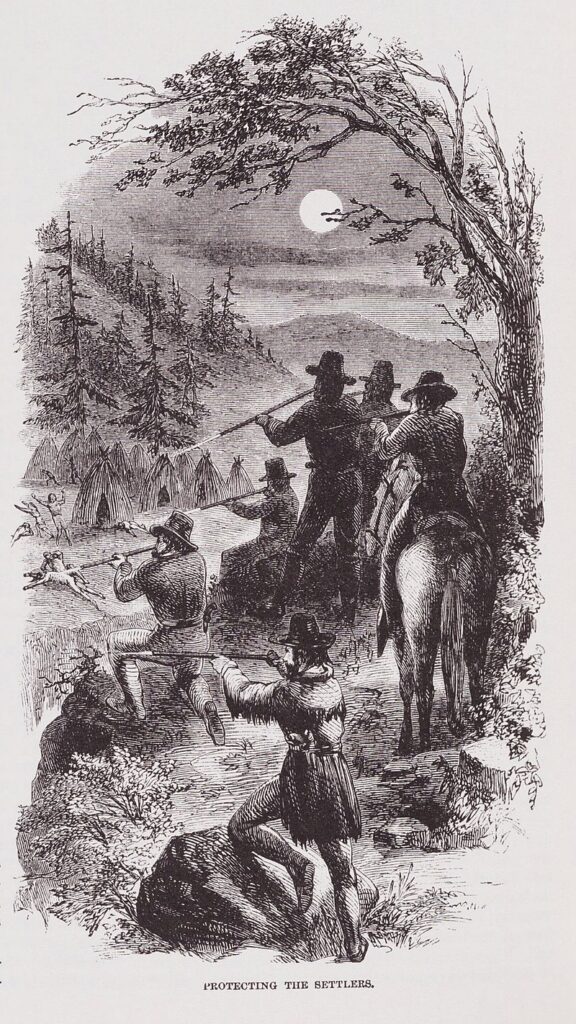
Part of that formalized relationship, as Lindsay has examined closely in his scholarship, was the militia’s role in perpetrating the genocide of California Indians. This kind of violence has a long legacy. As early as 1637, the New World’s first settler militias attacked Native communities shortly after crossing the Atlantic.
Exploitation of natural resources by settlers and gold miners provoked Native-led resistance — the targeting of outsiders encroaching on their land. In response, settlers appealed to the governor to deputize volunteer militiamen from their communities to embark on various “expeditions,” or more aptly, massacres, including the Shasta Expedition of 1854.
At the behest of white communities and backed by the early California government, these militias destroyed entire Native communities, submitted receipts to the state government, then received compensation.
It’s a dark chapter rarely discussed by modern militia groups which have seen a resurgence over the last 30 years. Flashpoints that reignited interest in armed self-defense began with the early 1990s standoffs in Waco and Ruby Ridge, the 1995 Oklahoma City Bombing, and the events of Sept. 11, 2001. More recently, both BLM and COVID-related protest movements have continued to reinforce the idea that self-sustenance, including self-defense, is core to American survival.
Clendenen told reporters that he wasn’t aware of militias’ historic involvement in Indigenous massacres, emphasizing that he’s “not for any of the atrocities that were committed against the Native Americans,” and adding that “both my grandmas were Cherokee.”
“I would guess that the government itself probably was responsible for more of the bad things that happened to the Natives than any militias,” he said.
Lindsay’s research — peer reviewed and based on the archived state receipts, newspaper reports and witness testimonies — indicates otherwise. But Clendenen expressed skepticism about academics, who he believes shouldn’t be immediately trusted at face value. “Historians are kind of like having an expert witness in a trial,” Clendenen said. “You know, you can get an expert witness on all sides.”
Interpreting the Second Amendment
From the early militias that formed the first chapters of the Ku Klux Klan to young Black Panthers in the inner cities of Oakland and Los Angeles, Americans have organized and armed themselves to both inflict and resist terror throughout the nation’s history.
Like all constitutional rights, the Second Amendment is nonpartisan, but the choice to purchase a firearm often reflects the political atmosphere of the moment. In the midst of social unrest of the 2020 pandemic lockdown, American firearm sales hit an all time high. And in response to dehumanizing rhetoric and policy changes under Trump 2.0, some communities of vulnerable transgender people have started to arm themselves and engage in combat training.
The individual right to bear arms is only one part of the Second Amendment, which also includes a provision for militias, stating that “a well regulated Militia, being necessary to the security of a free State, the right of the people to keep and bear Arms, shall not be infringed.”
How to define such a militia is the subject of debate between amateur and professional constitutionists alike. As Scoville noted, “Some liberal law organizations like the Southern Poverty Law Center that are far, far left, they say, oh, the militias became the National Guard.”
His comment is a reference to the Dick Act of 1903 that streamlined the nation’s citizen militias into two official categories: the “organized militia,” now known as the National Guard, and the “unorganized militia” or any mass of able bodied males aged 17–25. Under that legislation, only the government can call upon either group for response in times of insurrection and invasion.
Scoville disagrees that American militias can be defined so narrowly saying the Founding Fathers wouldn’t have put the power to activate militias into the hands of the government. “They would never let the federal government rule over the militia, because what they were afraid of most was the federal government,” he explained. Clendenen feels similarly, noting that he believes “the supreme law of the land is the Constitution and the Bill of Rights.”
In Scoville’s interpretation of the Constitution, the fundamental right to bear arms is inseparable from the right to organize a military-style platoon of armed community members who can decide unilaterally when to act. And in a time of war, Clendenen confirmed for reporters, the Cottonwood Militia would activate without the approval of a state or federal authority or any other authority higher than itself — except for maybe the sheriff, he hinted.
“Absolutely, we would heed the call [to battle even] if the president or governor didn’t ask us to,” Clendenen said.
Mary McCord, the executive director of Institute for Constitutional Advocacy and Protection at Georgetown, is an attorney who scrutinizes the legality of local militias like the Cottonwood regiment. Speaking by phone with Shasta Scout, she agreed with Clendenen and Scoville that the Constitution is the highest law of the land.
But all laws, both state and federal, “are valid,” McCord emphasized. “There’s no concept within our law where people get to decide which one they want to abide by and how they want to abide.” As long as, she said, state laws are not in conflict with the Constitution.
That’s an issue that’s decided by the Supreme Court and in fact, the Supreme Court has weighed in twice on the legal boundaries of the militia. “The Supreme Court has been clear since 1896,” McCord said, “in a case called Presser v. Illinois, that the Second Amendment does not protect private paramilitary organizations” from being outlawed by individual states.
Like all states, California does impose limitations on armed groups. State penal code defines a “private paramilitary” broadly as two or more persons who assemble “for the purpose of practicing with weapons,” and engage in “instruction or training in guerrilla warfare.” It also prohibits such organizations from engaging in combat training.
“If you’ve trained as a group, and you’re going to go out there to be the military force fighting against this, whatever, terrorist attack, then I would say there’s also likely a violation of [California’s] constitutional provision,” McCord concluded.
The Shasta County Sheriff’s Office did not answer Shasta Scout’s question about whether the Cottonwood Militia might be defined as an illegal paramilitary according to Penal Code § 11460, violations of which could lead to up to a year in prison, a $1,000 fine, or both.
Going back even farther to the language of the Second Amendment itself, McCord remarked that the “well regulated” part of a “well regulated militia” has always meant “regulated by the government — not just, oh, we have a commander, so we’re well regulated, right?”
Legal or not, thousands of people have cycled through Shasta County’s local militia workshops in the past decade, founders say, though Clendenen was unwilling to confirm the exact number of current members.
The number of active citizen militias across the country is also hard to quantify. Some groups are informal and hyperlocalized and others even operate criminally underground. There are well known white nationalist militias, but there are also militias that have no race or gender barriers.
As for the Cottonwood Militia, the organizational bylaws state that members shall defend the unalienable rights of all citizens regardless of “race, color, religion, sex, or natural origin”.
“Anybody can come into our group, if you believe in the Constitution,” Scoville said. “We don’t care if you’re purple. It doesn’t matter.”
Like the local group, many militias take it upon themselves to defend their families against both natural and political threats, some of which are undeniable, like climate disasters, and others more speculative and potentially tied to racial biases, such as foreign terrorist attacks and so-called “invasions” by undocumented immigrants.
Such fears do not appear out of thin air. In current times they are informed by communications from the federal government itself. Among them, memos about “Iranian sleeper cells” put out to the public without credible evidence of an impending attack, and depictions of noncitizens as a class of violent interlopers intent on destroying the country from within despite well-documented and outsized contributions to the economy.
Ever looming disaster
Earlier this summer, fire season was underway in Shasta County, with evacuation orders set for the Buckeye region north of Redding. During the weekly militia meeting — held directly across the way from Clendenen’s barber shop — alerts from the nonprofit Watch Duty app went off while members discussed wildfire response plans. If the flames had advanced south toward Cottonwood, they may have sprung into action amid the inferno: coordinating with each other via radio when power lines went down and providing food and water to families in containment zones and evacuating livestock.
The group is also focused on providing mundane essential needs shared by any small town in America’s heartland: a farmer’s market, homesteading courses on preserving food and foraging native plants, children’s day camps that relieve working and often single parents while sharing militia values.
As attendees filled the militia hall in the minutes before the June 20 meeting, a woman who runs the militia’s summer camp for girls recounted a delicious rabbit stew she and the girls had made from a recent hunt. Next to her sat a family of three adolescent children, their father and a wobbling German Shepherd puppy still learning how to use its oversized legs.
Clendenen led parts of the meeting. He has recently moved to Texas but commutes back to California for half of every week to care for his infant grandson who recently received a liver transplant, and cut hair part time at the barber shop he used to own. He’s officially retired from his role in the regiment, as militia rules require members to be California residents, but he remains deeply involved alongside Scoville and attends meetings during his days in Shasta.
Throughout the room, elderly couples, teenage couples and others from the Shasta community made polite small talk on a summer night. As Clendenen has often joked, militia meetings can feel more like a bingo night at a Catholic church. But public safety was top of mind, and not just the fire that kept triggering notifications on leaders’ cell phones.
Scoville prefaced the evening’s agenda by reiterating that the militia is committed to lawfulness and nonviolence, “so long as there remains a legitimate civil order in our society.” He then announced the resurrection of the militia’s citizen night patrol in Cottonwood and encouraged everyone to be observant of license plates and perpetrator descriptions should a crime occur. He recalled the story of a local nursery that had been robbed a few weeks prior — for the seventh time, he said — since the owner opened the business five years ago.
Scoville struck a careful tone, reminding members to wait for law enforcement before acting. In response, one expressed serious doubt about the competency of law enforcement. “They’re all just useful idiots with guns and badges. Maybe we should think of a way to stop the bad guys ourselves. I mean, I’m young enough to bust some heads!” he declared with a smile. Another woman uttered a quiet protest in response, reminding him of the militia’s official stance against vigilante violence.
Members seemed more agreeable when it came to a bigger existential threat. “We got this war going on in Israel and Iran,” Scoville told the group of about 25, just two days before President Trump issued a command destroying key parts of Iranian nuclear facilities. He mused aloud about how the bombing might provoke new threats on American soil.
“If they drop that bomb into that bunker, they’re not gonna have anything left, other than most likely terrorist acts. We must be prepared,” Scoville said.
The crowd buzzed about the possibility of an Iranian retaliation led by suicidal militants lurking in America’s shadows. “They don’t care if they get killed, they’re good,” one man suggested, describing what he believes to be the Iranian people’s attitude toward their own mortality. Another woman joked, “they got a lot of virgins!” referring to the trope of Islamic martyrs receiving 72 virgins in heaven.
Scoville interjected in a more serious tone. “I don’t think [the president] wants to drop this bomb, I think he doesn’t want any civilian lives to be killed,” he said.
But if he does, Scoville concluded, “I think it’s going to be best for our kids in the future.”
This story is part of “Aquí Estamos/Here We Stand,” a collaborative reporting project of American Community Media and community news outlets statewide.

