Kalle Benallie
ICT
Deandra Jones always asked her parents questions growing up. When they didn’t have the answer, she would become even more intrigued.
Jones, Diné, would frequently bring stray or injured animals to her house wanting to do something for them. Her passion for animals made her want to be a veterinarian but she switched to the path of research.
“I was very curious about the world. We spent a lot of time outside, like a lot of Navajo kids that grew up on the reservation,” the 35-year-old said.
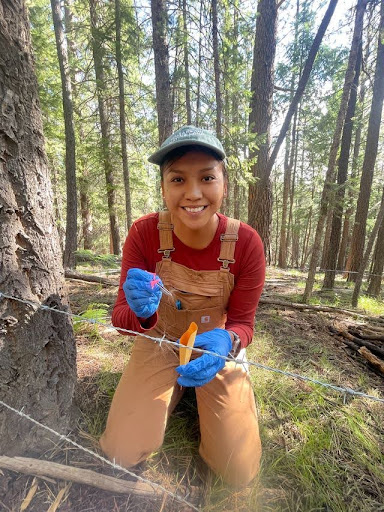
Jones is currently researching black bears on the Navajo Nation by collecting hair samples from bears living in the Chuska Mountains, a northeastern area of the Navajo Nation. She aspires to have a database that shows the movement of the bears by 2027.
It’s her five-year project as a Ph.D student at the University of Arizona in wildlife conservation and management.
In March, she received a $100,000 grant from the U.S. Fish and Wildlife Service that was signed by Navajo Nation President Buu Nygren.
So far Jones has set up 72 collection sites and has identified over 60 individual bears. She has a little over a year of research left to do and is finalizing the data.
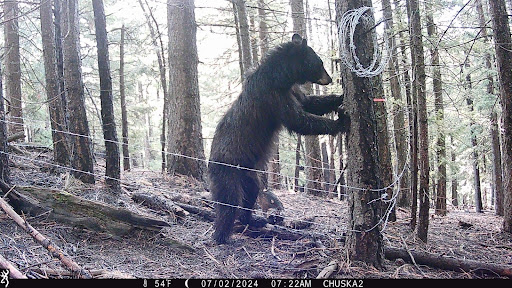
How she collects the data is by enticing bears with sardines, sweet-fishy smelling commercial liquids called Bear Lure and glazed doughnuts to an area that has barbed wire wrapped around trees. When the bears go to the area, they brush against the wire which leaves their hair for analysis.
Cameras are nearby to catch the action.
Before she started the project she asked, while in graduate school at the University of Arizona, the Navajo Nation Department of Fish and Wildlife what they needed. They gave her back a long list.
But Jones remembered hearing from them in 2011 that the black bear was one of the top priority wildlife species on Navajo lands from a workshop they conducted with Navajo participants.
There were three reasons gathered on why they didn’t have a lot of current information on black bears: lack of numbers on how many black bears there were in the Chuska Mountains, an increase in human-bear conflict or interactions on Navajo land and the cultural significance of black bears to many Navajo people.
“The goal for this research is to support both those cultural teachings about bears and just practical solutions on how to keep bears and people safe or how they can better coexist just for generations to come,” she said.
Solutions like lessening human-bear conflict by buying people trash cans that give bears less access and finding better ways to share information about where the interactions occur. It can determine the black bears movement which can help decide if hunting is allowed or analyze population growth or decline.
Ultimately, there can be a black bear management plan.
In 2022, Jones met Gloria Jones, former director of the Navajo Nation Fish and Wildlife and began going to communities to talk to people. Her intention was to go by it respectfully because her parents and grandparents taught her about wildlife, the land and how Navajo people shouldn’t directly interact with bears.
“We’re not supposed to feed them. We’re not supposed to touch them because they’re seen as relatives. We’re going to kind of give them that space,” Jones said.
It took time for her to explain why she wanted to do the project and her parents suggested they do a ceremony.
“We could get a prayer done, a protection prayer and that’s going to help you protect your mind, protect your body, protect your spirit because you’re going into this work and you have to be intentional about it. You have to go in with a good mindset,” Jones said.
They also suggested for her to offer corn pollen and a prayer if she ever saw a bear in the forest or came across its tracks.
“The corn pollen is what carries our prayers, the words that we tell them and it’s kind of our way of saying: we see you, we honor you,” she said.
Jones offers corn pollen after collecting samples as well.
The Diné Hataałii Association, an organization dedicated to the protection and preservation of Diné traditional ceremonies have helped to guide Jones on what she can or can’t share.
Through her time researching, Jones said she sees how important Indigenous-led research is compared to bringing people from outside the community how they take the information and leave.
“Indigenous-led research is different because we understand the language. We understand the land and it’s that local knowledge and those relationships. And then we carry these cultural protocols and respect for them. We’re also accountable to our communities,” she said.
Something Jones learned was how to approach community members for the cultural significance portion of her research. She would first ask them to do an interview and would get apprehensive responses. Her parents told her how it sounded like a formal inquiry.
Jones then changed her approach.
“I want them to tell me their stories, kind of like storytelling, like we do in the winter. I want to have a conversation with them. I want to learn about their experiences with bears,” she said.
Stories about the bears won’t be shared publicly. Data from the interviews and the community surveys about human bear conflict will be going back to the Navajo Nation.
“I learned something new every day. That’s the thing. It’s being along this journey that has definitely taught me a lot about myself and kind of the work that I do and how I express that and how I talk to people too,” Jones said.
Jones would like to have the research be an example for Indigenous youth or for future Indigenous scientists to see culture and science can co-exist in research.
“If we have more of this kind of information for these future scientists, for these future generations maybe that path for them can be a little easier. Maybe that path for them isn’t as much of a struggle as kind of what we had to go through those challenges,” she said.
Jones added that this research may become the foundation for researching “taboo” animals like the coyote, owl or snake.
“I feel like those are more don’t bother them kind of thing. I hope that they could come up with different ways that we can better be more respectful and better do research with our relatives, these animal beings, on Navajo or just with any other Native tribe or First Nations,” she said.