

Amelia Schafer
ICT + Rapid City Journal
PIERRE, S.D. – A new law enforcement training held in South Dakota allows tribal law enforcement recruits to stay close to home while carrying out their training rather than traveling down to Artesia, New Mexico, for 13 weeks of training.
Federal law allows for tribal law enforcement officers to attend either the Indian Police Academy in Artesia or a state-accredited training program. Tribes have the option of selecting where they’ll send officers, which is generally to Artesia, said Hank Prim, the South Dakota law enforcement training administrator.
And while the state’s law enforcement academy has always been open to recruits from tribal law enforcement agencies, the Criminal Justice in Indian Country Course was previously still only offered in New Mexico. With support from the Bureau of Indian Affairs, this course will be offered in Pierre following the basic training officers are currently undergoing.
“The Bureau of Indian Affairs proactively reached out to us and offered to host that training class,” Prim said. “The stars are aligned to do it.”
For those with families, the opportunity to remain in South Dakota during training is crucial.
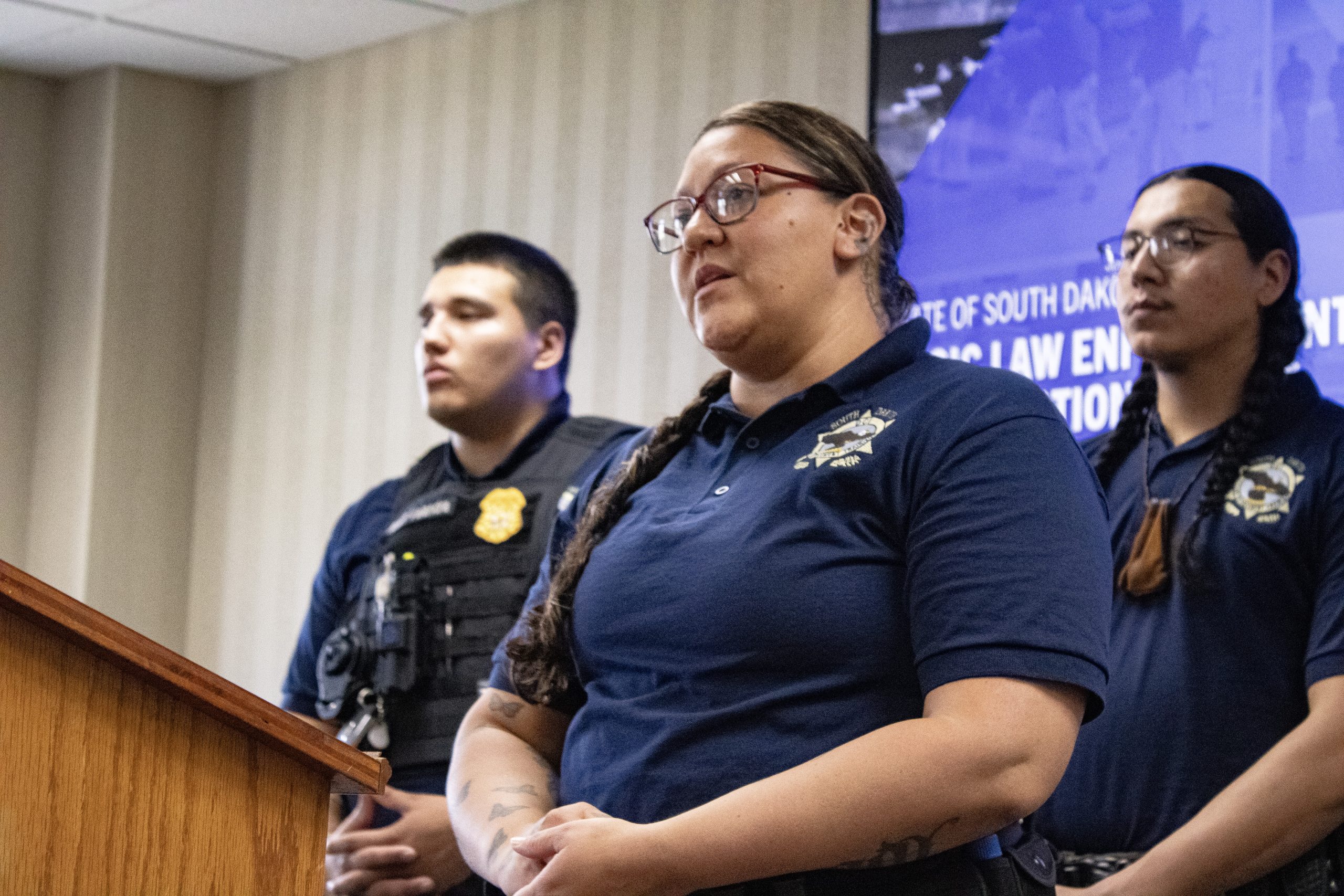
Michelle Casiano-Keeble, Sisseton Wahpeton Oyate, is a mother of three currently participating in the program. She was sent by the Sisseton Wahpeton Oyate to Pierre, rather than Artesia, for her training.
Artesia is over 18 hours away from Casiano-Keeble’s community and family. Pierre, only about three and a half hours is a much better deal.
“Being a mother of three [this] has definitely helped me be there for my kids and still do what I want to do and pursue my dream of being a law enforcement officer,” Casiano-Keeble said. “We’ve been going out on different adventures every weekend and trying new things.”
Casiano-Keeble had a history of working in law enforcement before moving over to tribal law enforcement. She was previously certified in North Dakota and worked with the Richland County Sheriff’s Department. Later, she worked for the Roberts County Sheriff’s Department on the Sisseton Wahpeton Reservation and later served as a school resource officer in the Enemy Swim Day School in South Dakota.
Working as a school resource officer let Casiano-Keeble build relationships with tribal youth and strengthened her desire to join tribal law enforcement to lend a helping hand in her community and serve as a role model for her own kids and other tribal youth.
“Being a female in law enforcement, I’ve gotten a lot of support in that aspect,” Casiano-Keeble said. “My family is cheering me on every step of the way and want to see me succeed.”
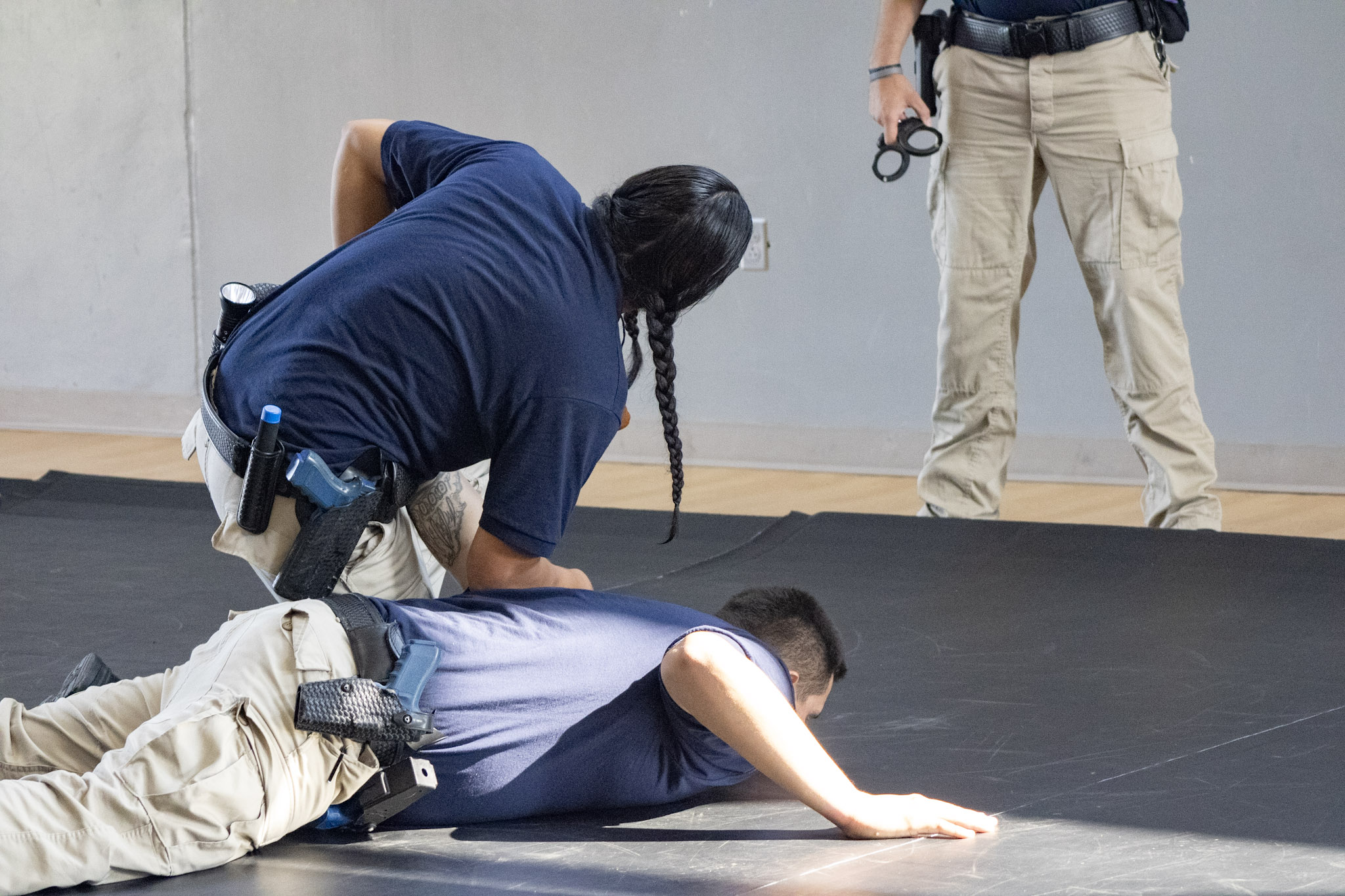
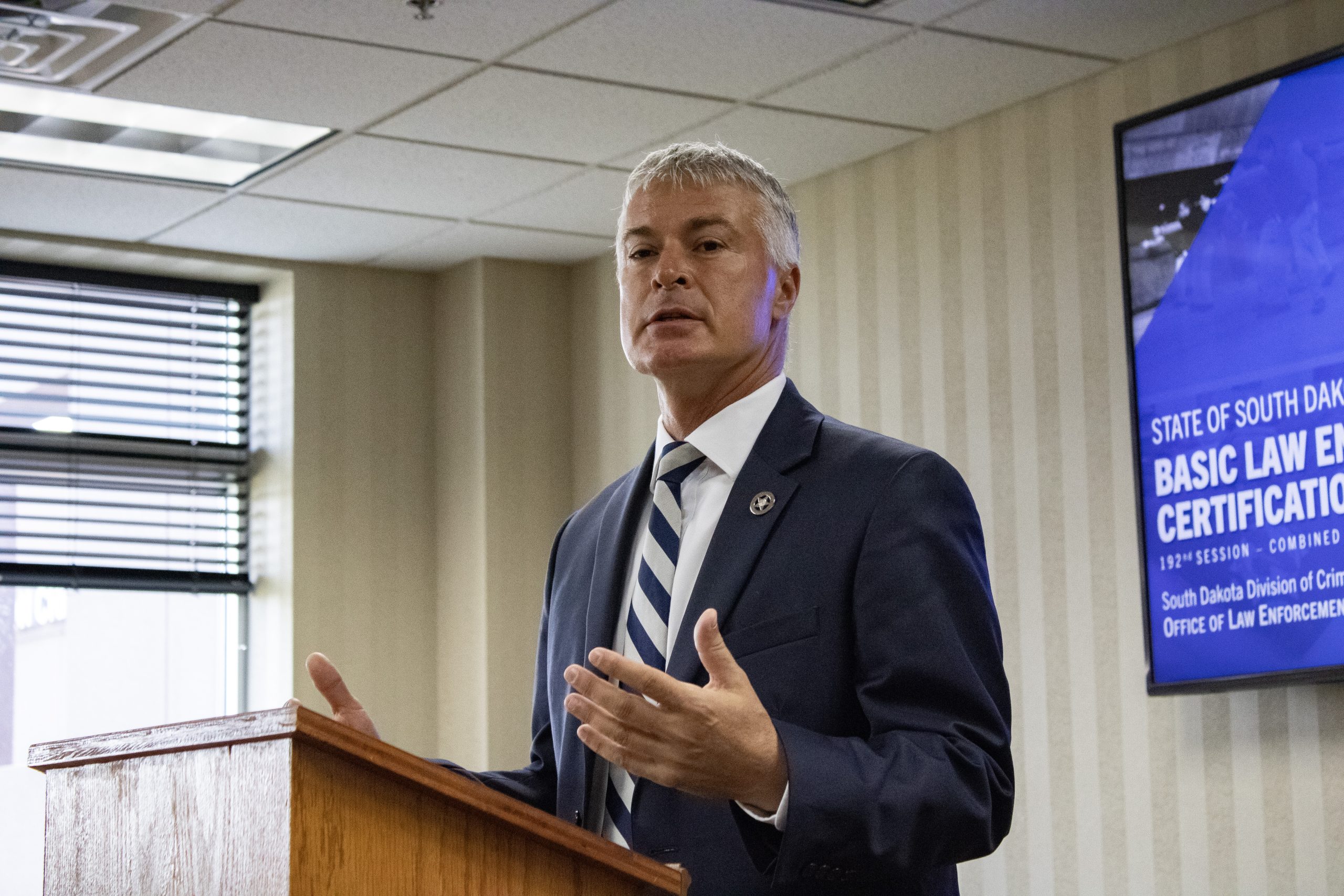
Aside from the Criminal Justice in Indian Country Course, not much had to change to accommodate tribal law enforcement training, South Dakota Attorney General Marty Jackley said. Officers still undergo a three-phase training program over the course of 13 to 14 weeks. The first phase, non-emergency training, is already complete. Currently, officers are working on emergency training and finally investigative training.
“This partnership was founded in our shared mission and that is to promote public safety throughout South Dakota,” U.S. Attorney Allison Ramsdell said in Pierre on Monday.
All nine tribal flags are hung in the George S. Mickelson Criminal Justice Center in Pierre, where the 13-week training is taking place, a sign of partnership, Jackley said.
“When you look at the training here in South Dakota, [it’s] a partnership between federal, state, local and tribal,” Jackley said. “To make this class happen it took everyone’s support. It took the [police] chiefs, the sheriffs, the adjunct professors, the U.S. Attorney’s Office, our federal partners, our tribal partners to be able to fit in an additional class.”
Jackley praised the new initiative during a press conference in Pierre on Monday, citing Gov. Kristi Noem’s support and his long-held desire for local training.
“The governor put a priority on having a class dedicated to tribal officers and we appreciate that,” Jackley said. “She was the first one that not only supported it, she asked me if we’d be willing to do it.”
The training’s announcement came on the heels of Noem’s tirade of allegations of cartel activity on tribal land. In fact, Noem was banished by the Standing Rock Sioux Tribe on the same day she announced the training, April 11. By mid-May, all nine tribal councils had voted to banish her from their lands.
Noem’s tirades linked limits of tribal law enforcement to increased drug activity and alleged cartel presence. She first claimed cartels were operating on tribal land on January 31 while visiting the nation’s southern border.
Despite the governor’s strained relationship with tribal nations, three tribal law enforcement agencies sent officers to the state training program – the Sisseton Wahpeton Oyate, Oglala Sioux Tribe and Cheyenne River Sioux Tribe.
In total, 11 tribal officers attended the training, which began June 3. Another 13 recruits came in from non-tribal state law enforcement agencies, including the Martin Police Department, which is within the Pine Ridge Reservation.
The Oglala Sioux Tribe has long struggled with a shortage of law enforcement personnel. In 2022 the tribe sued the U.S. government for violating treaty rights guaranteeing that the government protect tribal citizens.
Several officers came from the Oglala Sioux Tribe Department of Public Safety to receive their training.
“We need more officers in our tribe,” said Akia Winters, an officer from the Oglala Sioux Tribe. “My family and friends are pretty proud of me for what I’m doing because it’s a step in the right direction.”
Winters joined tribal law enforcement in April and said he’s taking things one step at a time. Winters, like Casiano-Keeble, said he appreciated the opportunity to remain close to his children and wife while training.
Officers are anticipated to graduate from the training on September 3.

This story is co-published by the Rapid City Journal and ICT, a news partnership that covers Indigenous communities in the South Dakota area.
Our stories are worth telling. Our stories are worth sharing. Our stories are worth your support. Contribute today to help ICT carry out its critical mission. Sign up for ICT’s free newsletter.

