Mark Trahant
ICT
EDMOND, OKLAHOMA – History is often divided into sections. We think about “American history” or “Native American history” or even “journalism history.” But those divisions all share the same history. So how do we weave more of our stories into a single fabric?
Last month that happened when the Oklahoma Journalism Hall of Fame honored Suzan Shown Harjo, Cheyenne & Hodulgee Muscogee, with a Lifetime Achievement Award. She was born in El Reno, some 40 miles from the University of Central Oklahoma where the hall is located.
The hall honors more than 500 Oklahoma journalists, including Will Rogers, Cherokee Nation, and Alexander Posey, Muscogee.
Harjo’s Lifetime honor is a recognition that there remains a lot of ground to cover, recognizing the breadth of the Native American journalists who have shaped their craft and the region.
“With WBAI-FM, Pacifica Network’s free speech flagship in NYC (1967-74), she directed one-third of the airtime and co-produced “Seeing Red,” the first national Native issues show,” Harjo’s citation read. “In Washington, DC, she was News Director, American Indian Press Association; Executive Director, National Congress of American Indians; political appointee, Carter Administration; and legislative liaison, Native American Rights Fund. Widely published and anthologized, she has written for all versions of Indian Country Today and served on boards from Native American Journalists Association to Howard Simons Fund for American Indian Journalists. A Founding Trustee of the Smithsonian’s National Museum of the American Indian, she was Editor/Curator, Nation by Nation (Treaties) book (2014) and exhibition (2014-2027). President of The Morning Star Institute (1984), she holds Honorary Doctorates (Institute on American Indian Arts, 2011, and Princeton University, 2023) and received the Presidential Medal of Freedom (2014).”

What’s missing from that chronology is the impact on the media relating to the name change for Washington’s football team. Law students study Harjo et al v Pro-football. So It should be the same in journalism schools, too, adding to that story-behind-the-story, not just the legal angles but the social, political, and financial pressures that were ultimately successful.
Then there is a lot to weave into a story that began about a half-hour away from the hall’s location.
Harjo is from El Reno, Oklahoma, and this was a homecoming that required her to leave. “I would never have been recognized for anything if I had stayed in Oklahoma,” she said. The era was defined by blatant racist attitudes about Native American people and communities. But that didn’t match her experiences living in other parts of the world, including Italy, where her father served in the U.S. Army. There she experienced what it was like to live in a bubble of acceptance. “Everyone I encountered in every place I went seemed to stress my independence and, and possibilities, and there were a lot of things I excelled in. So that was really good.”
Harjo said her parents and grandparents stressed writing and telling stories. “They all shaped me for print journalism. They shaped me for radio. They shaped me for anything because they were saying, ‘if you can write, you can do anything. If you can’t write, you can’t do anything.’”
The craft led Harjo to New York City and radio. WBAI was at the center of national debates about the Vietnam war and the Richard Nixon administration. When the Pentagon Papers were published, the station produced dramatic readings of the documents. And Harjo was working at the station on October 20, 1973, when Nixon ordered Attorney General Elliot Richardson to fire Archibald Cox. Richardson refused and resigned on the spot. Nixon then ordered his deputy, Wiliam Ruckelshaus, to fire Cox. He refused and resigned too. Finally Solicitor General Robert Bork agreed and did as Nixon ordered.
“I just happened to be on the board. Everyone left, including our news director (who didn’t find out that he wasn’t covering the big news of the year until he turned on the radio in Long Island and came back,” Harjo told me a few years ago. “So I handled that. I was the senior person in the station, so I handled the Saturday Night Massacre and the main thing I did was to open it up and said we’re having an open mic session with taxi drivers, politicians, actors and artists lining the city block waiting to vent.”
Harjo’s own program, “Seeing Red,” co-produced with her husband, Frank Ray Harjo, was a major platform for discourse on American Indian policy and politics. She interviewed the leaders for the Trail of Broken Treaties in 1972, including Robert Burnette and Hank Adams (who had put together an Indian Rights Manifesto.) That led to her coverage of the takeover of the Bureau of Indian Affairs (a reporter who was “very pregnant” at the time).
Harjo was able to enter the building even though it had been surrounded by police with radio recording equipment. “We went in as press and as our lives were, we were in part press. We were, you know, in part reporters, in part producers, in part just other Native people.”
The atmosphere was a war zone. “All over the BIA building people were preparing for a battle and not knowing if there would be an attack,” she said. “And then people were getting a little crazy inside.” There were electric traps, and molotov cocktails, and at one point Russell Means, Oglala Lakota, picked up a megaphone and said they were going to blow the building. Oren Lyons, Onondaga, countered with an order to stop that nonsense.
Not long after Harjo moved to Washington to succeed Richard LaCourse, Yakama Nation, as the news director for the American Indian Press Association where she covered Capitol Hill and policy.
It was in Washington where she led a decades-long successful campaign to change the pro football team’s name – as well as organizing around the idea of a national museum for American Indians. That project began in 1967. More than two decades later Congress enacted a law and by 2004 the actual location was selected on the Capitol Mall. A decade later the museum opened to what was thought to be the largest gathering of American Indians, Alaska Natives and Native Hawaiians ever. “It’s very good work and it’s much like gardening. You’re not doing it all the time and you just plant things here and there and you can go away from them because they’re going to grow themselves in some cases, and then sometimes they need your attention … because if you do nothing, if you’re just patient, sit back, nothing will happen.”
Harjo was never patient about racism, especially racism in sports. She was still in high school in the 1960s when she heard Clyde Warrior, Ponca, talk about why the Little Red mascot had to be removed from the University of Oklahoma. She joined a coalition of students, faculty who pressured the university to drop that mascot. It was difficult when people would talk about these issues, she says. “‘Braves, what’s wrong with that? Warriors, what’s wrong?’ Well, it’s the dumb way your fans behave for one, it’s all the Tomahawk chopping, it’s the war painting, the woo, woo, wooing, the fake dyed turkey feathers and chicken feather headdresses, the so-called Indian clothes, the so-called Indian dances. It’s all of that. And it’s putting up people you say, you revere, you say, you honor, you’re exposing them to mockery.”
The Little Red mockery ended in 1970 student and faculty demonstrations plus a sit-in at the chancellor’s office. But it wasn’t the end, it was only the beginning of the debate. Other universities followed suit and dropped offensive mascots, including Stanford, Dartmouth and Syracuse. The University of Utah swapped out its “R-word” for the Utes. (The three bands of Utes sanctioned the arrangement via a Memorandum of Understanding.)
And that’s where Harjo’s efforts began to change the name of Washington’s NFL pro-football team. More than a decade ago, then owner Dan Snyder, insisted that the name would never change. “It’s that simple,” he said. “NEVER – you can use caps.”
No nevermind. Because as the Washington Post’s Eugene Robinson wrote: “The name was always racist.” He said he and the fans did not recognize this fact for decades. “I like to believe that if I had paused to reflect about the name back then, if I had realized it was the same as calling the team, say, the “Washington Darkies” or the “Washington Chinamen,” I’d have felt the requisite outrage. But I didn’t stop to think — until roughly two decades ago, when my Post colleague Courtland Milloy started writingpassionately about the issue. The scales fell from my eyes.”
When the Washington team finally did change its name in July 2020 there was irony in the name being just the Washington Football Team. That was the vanilla envelope covering over the more serious discussions about what to call the team (before it became the Commanders).
Harjo said credit for the removal of the “slur and stereotypical logo belongs to all those Native families (including mine and that of Amanda Blackhorse, my sister target number one), who bore the brunt of and carry the scars from the epithets, beatings, death threats and other emotional and physical brutalities resulting from all the “Native” sports names and images that cause harm and injury to actual Native people.It does not belong to a change of heart by the team’s energy or to those who are bandwagoning and in line to cash in on our hard-fought and hard-won success. We’ve ended most of these obscenities but still have over 1,000 to go, but the fall of this king of the mountain of trash will help others to give up their ghosts of racism even faster, so, Aho, Mr. Snyder and thank you, Mvto, Mr. Fred Smith.”
On November 24, 2014, President Barack Obama awarded Harjo the Medal of Freedom, the highest civilian honor, for her life’s work.
At the ceremony, she was reflective. “Patience is something you just have to learn over a long period of time,” she said. “There’s not a single thing I’ve done except write poetry that has been just myself. Everything else, whether it’s making federal Indian law or making an institution or changing society, changing history, rewriting history, all of those things are grand collaborations, and they just take a mighty effort. And unless you have the people and the energy and the will and the people who really have a passion for doing a certain thing, nothing will happen. But if you have all of those things, everything’s going to happen. And if you just stick it out long enough, you prevail.”
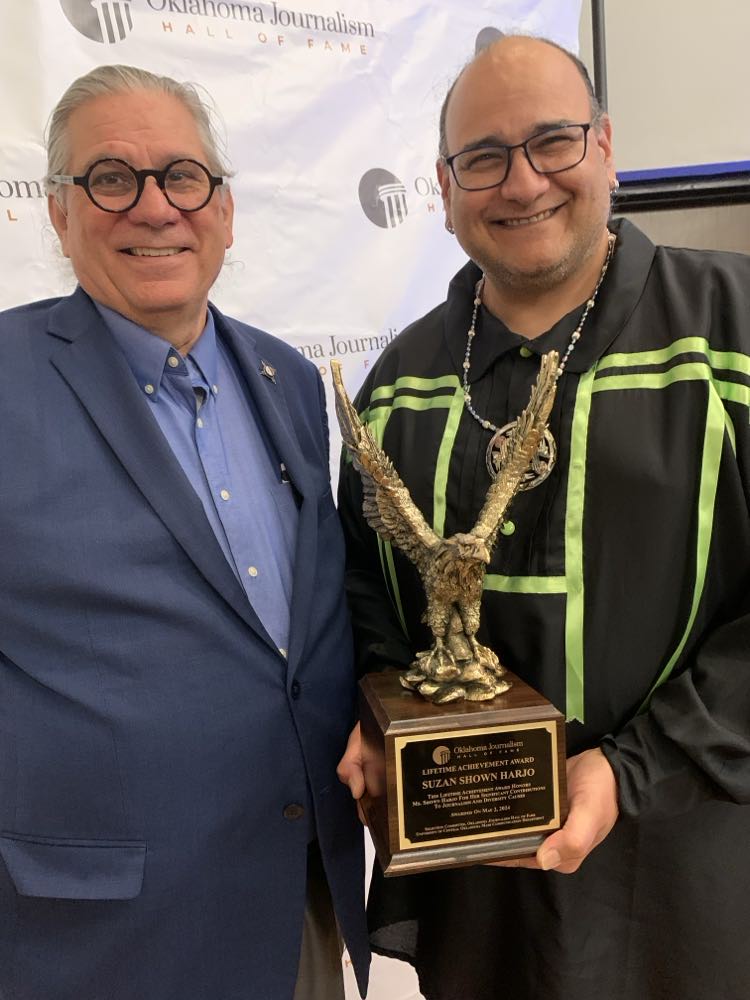
Recently Harjo and I talked about her Oklahoma Hall of Fame induction and the idea of inclusion – there are so many others who should be recognized for their contributions to journalism, not just Native journalism. One name we talked about was Gary Fife, Muscogee, who died earlier this year. Fife interned at the American Indian Press Association when Harjo was news director. He worked in Alaska, and ended his career back home in Oklahoma, with Muscogee Nation Media, both in the newspaper and on the radio.
There are so many stories yet to be told. But if you just stick it out long enough, you prevail.

Our stories are worth telling. Our stories are worth sharing. Our stories are worth your support. Contribute $5 or $10 today to help ICT carry out its critical mission. Sign up for ICT’s free newsletter.
This story was updated with a correction for the location.