

Sandra Hale Schulman
Special to ICT
A surreal, dark story based on Indigenous tales and imagery plays out in an 11-minute video for rock band Metallica, thanks to a quick encounter between the video’s animators and an Indigenous member of the band.
The recently released video single called “Inamorata,” from the new album “72 Seasons,” shows a Native man stranded in the desert as vultures and snakes descend. He begins hallucinating and wakes up repeatedly in new realities until he reaches a final destination.

The video was written and directed by Jess Cope. It was storyboarded by Mozart Gabriel Abeyta, Taos Pueblo, and illustrated by his wife, Helly March. Abeyta is the son of acclaimed artist Tony Abeyta, Navajo, and Patricia Michaels, Taos Pueblo, who was on Project Runway and recently designed the feather dress worn by Tantoo Cardinal on the Cannes red carpet for the premiere of “Killers of the Flower Moon.”
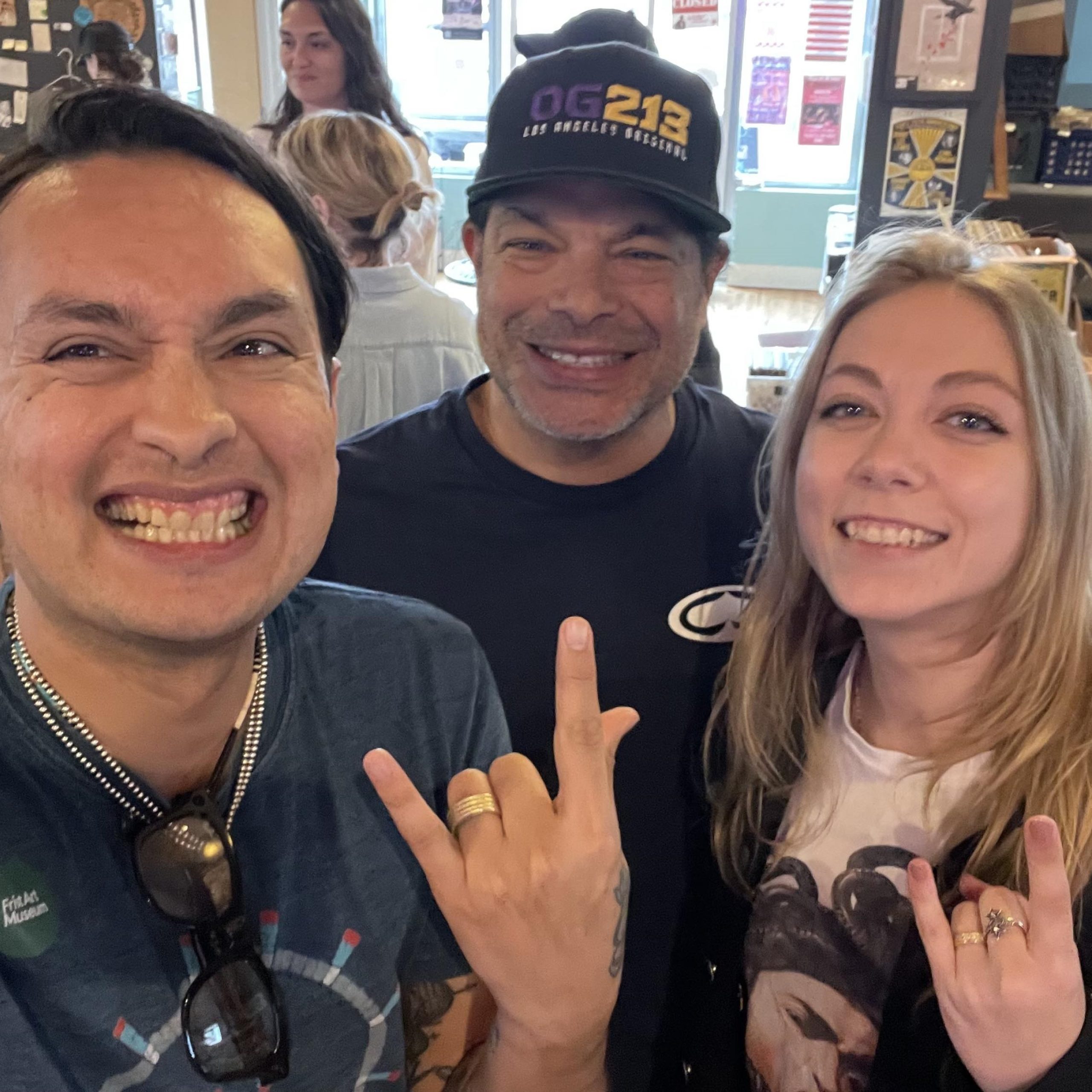
The film emerged from a photo opportunity at a Nashville nightclub with Metallica band member Robert Trujillo, who is also Taos Pueblo and Mexican.
“Just instantly this happened,” Abeyta said.
A chance encounter
Born in Santa Fé, New Mexico, Abeyta has worked in theater in New York, attended Vancouver Film School and was a Sundance Institute Fellowship Writer. He worked in Nashville for two years producing music videos.
About four years ago, he went to Barcelona, Spain to get a master’s degree in stop-motion animation, and ended up staying because he formed a band. He said he played music every day and night for four years before deciding to return to Nashville.
He missed the music industry and networking with the film community.
“Now, I’m a full-time musician and I do animation and film on the side,” Abeyta told ICT.
He recently married March, who is from Ukraine, and decided to take her to Grimey’s, a music club in Nashville that was featuring New Faces Night, which Metallica bassist Trujillo attended.
“My wife wanted a picture with him to send to her dad because her dad’s in the front lines in Ukraine,” he said. “Every day she wakes up, her dad sends her a heart emoji just to make sure that she knows he’s alive. It makes you realize how grateful you are about anything good in life. It was funny cause that’s the first time that I had brought Helly to Nashville.”
They went up to get a photo and made small talk.
“We said, ‘Hi, how’s it going?’ to Trujillo and he says, ‘Where are you from?’ And I tell him I’m from Taos, and he’s like, ‘Oh, wait, I’m from Taos,’” Abeyta said. “That’s crazy. I had no idea. We exchange numbers and then he says, ‘What do you guys do?’ I said, I do stop-motion animation and color-grading and filmmaking and music videos. And then I showed him the art that Helly makes, and he was just blown away.”
“He said, ‘That’s it. I need you for the new Metallica music video,’” Abeyta said.
Crossover worlds
Trujillo told the couple they needed an 11-minute animation done in just three weeks. That’s the equivalent of a short film, about three times longer than a typical 3- or 4-minute music video.
Trujillo said he would call the couple that night and set it up. It turned out Trujillo and March had another connection as she knew the director they were going to be working with on the music video, Jess Cope.
“We get the phone call that night from Robert, we talked for two hours, and he’s the nicest, friendliest dude,” Abeyta said. “We hooked up with Jess in the UK and our whole production team was about 22 people around the whole world … She said, ‘I’m going to give you guys a script and do your best to figure out the storyboard on it.’ I’ve done this for a long time and so we came up with a huge storyboard shot list.”
SUPPORT INDIGENOUS JOURNALISM. CONTRIBUTE TODAY.
March drew and illustrated the lead character, a combination between a Taos man and Trujillo. Then she drew everything else. Abeyta became the director making up the shots and changing the angles of the character, who keeps waking up from the dream worlds.
“Jess was so lovely to work with because she really loved having us,” Abeyta said. “She asked more about the Indigenous culture of Pueblos, so I was able to provide a lot more of that. They incorporated some of that imagery. She gave us a secret of the story, but she wants to keep it up for interpretation for viewers.”
In the video, there is a mysterious connection between the main character and a fox, and a potion he drinks.
“It was such an amazing experience, and Robert would call every single one of us a lot,” Abeyta said. “He was so respectful, and he loves creativity. You can feel that he loves making things happen. He seemed to be the producer on this video, and he was making it very clear that this was the most important video of the new album, this is one of the most important Metallica songs. It was exciting to be able to hear it before it got released. The whole band wrote us a letter and said they were so grateful, and they really loved it, it was one of their favorite videos out of the whole entire album.”
Abeyta said he is excited to work in the crossover worlds of film and music.
“I’m glad we’re going into this world of making short films and music videos,” he said. “I think it’s our job as filmmakers, and especially Indigenous storytellers. We should be moving past music videos that just make you look cool and stylish.”
“I was happy to do this, especially growing up in the ‘90s,” he said. “You go into the Pueblo houses and people would be jamming out on their battery powered little radio players to Metallica.”
As for his famous designer mom, Abeyta feels he is following her in the tradition of Taos Pueblo storytelling.
“I’m so proud of my mom on that Cannes dress,” he said. “She’s one of my biggest heroes in the world. I’ve grown up being at every fashion show since I was a kid and seeing her blossom.
“With the Pueblo you have to be a little bit more contemporary about telling your stories, and you have to be more surreal about it, because the spirits, they allow you to have a circle where you have to keep it into the Pueblo and then you have an outer circle. It allows you to share the stories because that’s our job as storytellers; it’s not against our beliefs to be storytellers.”

Our stories are worth telling. Our stories are worth sharing. Our stories are worth your support. Contribute $5 or $10 today to help ICT carry out its critical mission. Sign up for ICT’s free newsletter.

