

Editor’s Note: This story is part of the ICT’s powwow guide set to release April 2024. Include your powwow or a powwow near you by filling out this form.
Kalle Benallie
ICT
Athena Cloud, for more than a decade, has been teaching young girls and women on backup singing, or women’s Zhaabowe, which means she or he sings an accompaniment of women. The Red Lake Nation citizen estimates she has taught about 50 women through different cultural camps in communities and schools.
“It’s all about exposing the youth and community to different cultural customs and traditional ways of life that not everyone has access to if we were at home, at a reservation, for example,” she said.
Backup singers usually stand behind sitting drum singers during a powwow. Male singers are often the main group of singers.
In her perspective, women’s backup singing is a way to reclaim the culture and to spotlight minority women, especially Native women, in modern society.
“Taking back that power that we have and showing that power to everyone in that being through the power of singing,” Cloud, 27, said.
She grew up on her homelands in Ponemah, Minnesota and said back then they had a drum and dance troupe. They asked if anyone would like to learn the flag song. Cloud was the only one who wanted to learn.
Her parents would drop her off at a local song maker’s house and there she learned how to sing the song.
“What I do have and what I learned throughout the years is what I share now. Fast forward to modern times where communities are all about cultural revitalization.” she said.
Cloud also grew up singing in a youth drum group with her brothers and cousins, who have a group called P-Town Boyz. She has since traveled and sung with other groups like Stoney Park and Midnite Express.
Some of her students have shared with Cloud that they were too nervous or scared to sing in fear of being judged by others. In order to overcome that feeling, Cloud said she tries to uplift the women’s or girl’s voices and to recognize the power in singing.
“Once the drum starts, you’re singing for all those that can’t sing and for our ancestors that went through everything that they did. Knowing that here we are, we’re still alive, we’re still here. Let’s use our voice and let’s be proud of it,” she said.
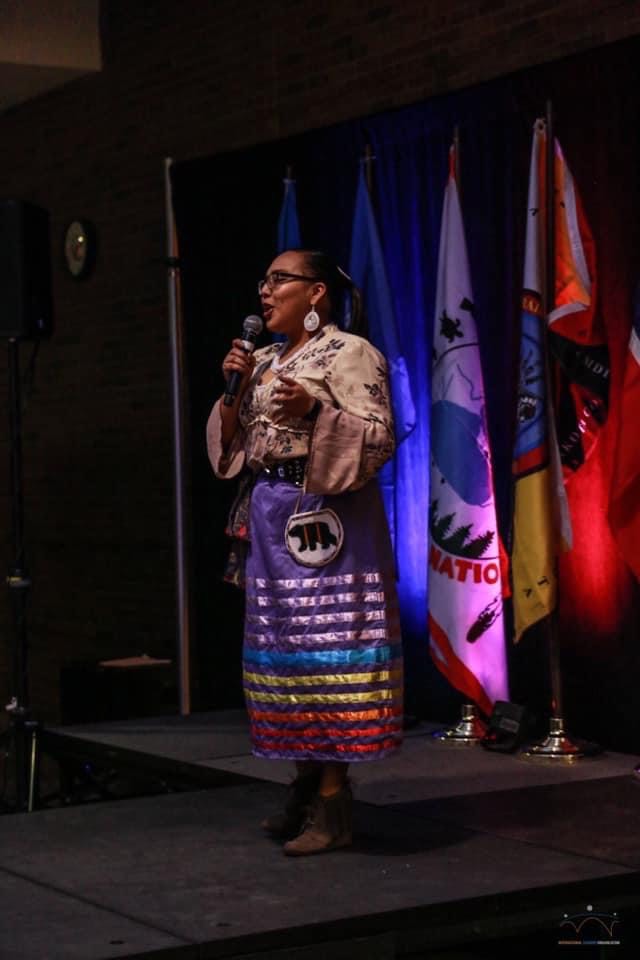
Cloud has also taught powwow Zumba since 2013. She said it’s to bring cultural activities to youth that weren’t available to her growing up. She tries to encourage the Ojibwe saying Minobimaadiziwin meaning “ to live a good life,” which balances the mental, emotional, physical and spiritual part of a person.
“(It’s) one of the ways I wanted to address the health disparities within our community and keep it culturally relevant was to promote movement through powwow dance,” she said.
Cloud not only does backup singing at powwows either, she dances too.
“I’ve been dancing since I learned how to walk,” she said.
She even sometimes sings right after she dances. It requires her to push through the tiredness and push enough breath out to get a sound that goes well with the group.
“You would think that when you’re backup singing, you’re just singing but you actually can burn quite a bit of calories, especially during the summer time, it being so hot out in Turtle Island,” Cloud said.

One similarity she finds between backup singing and dancing is the sense of accomplishment after facing the nervousness and anxiety that comes with performing for an audience.
Ultimately, Cloud strives to not only promote representation in society but also to showcase the pride of different cultures in the Indigenous community when they all come together at powwows.
“You don’t really have to worry about things outside of what’s happening at the powwow or what’s happening outside of that song, that dance move or that style of song. When you’re at a powwow and dancing or singing, you’re able to be more present in the time and not worry about paying bills or whatever mainstream, first world problems that we may have,” she said.

Our stories are worth telling. Our stories are worth sharing. Our stories are worth your support. Contribute $5 or $10 today to help ICT carry out its critical mission. Sign up for ICT’s free newsletter.