
Joaqlin Estus
ICT
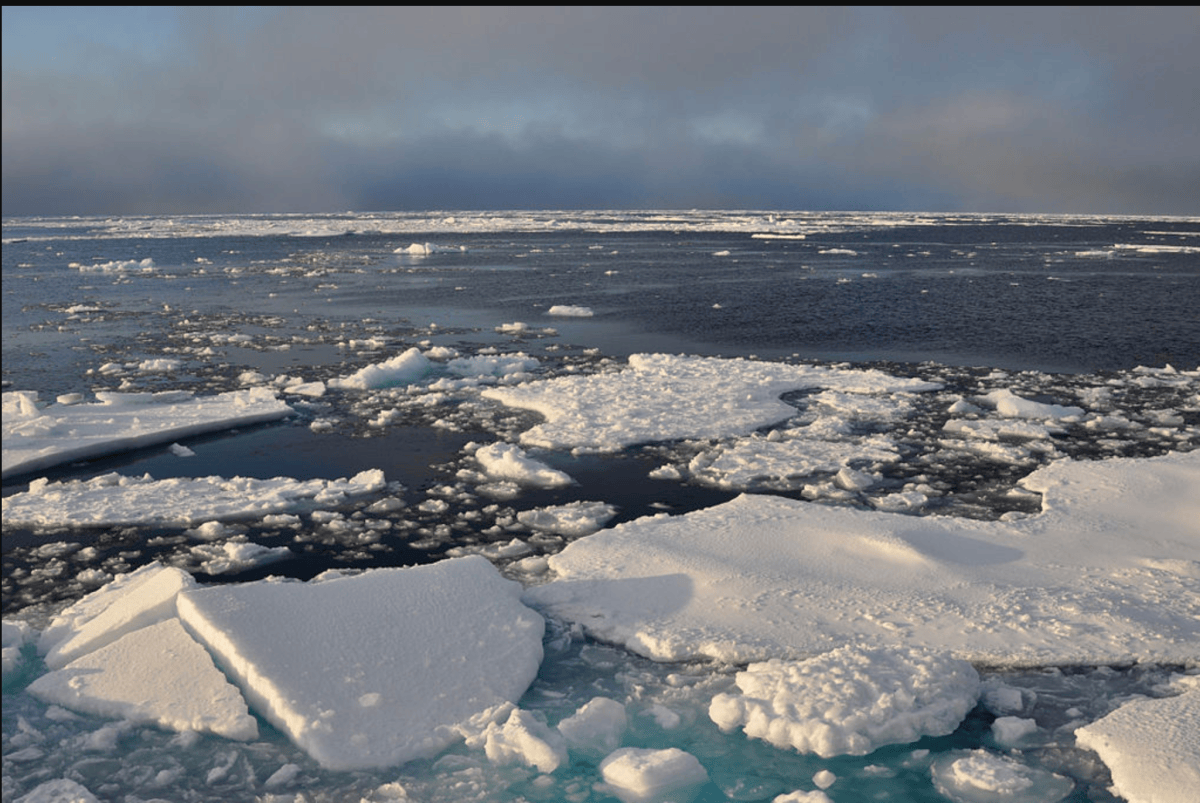
Scientists are known for speaking with dry precision rather than for dramatic effect. Still, “immediate,” “extreme,” “unprecedented,” and “consequential” are some of the words scientists are using to describe climate change in the Arctic.
The sense of urgency stems from the fact that northern regions are warming at twice the rate as other parts of the planet, if not even more quickly.
The changes in the Arctic show what’s coming to the rest of the planet. And Alaska can serve as a model for improving interactions among traditional knowledge bearers, scientists, and policy makers.
Those are some of the conclusions of the 2022 Report Card on the Arctic issued by the National Oceanic and Atmospheric Administration (NOAA) Arctic Program Tuesday at the American Geophysical Union fall meeting in Chicago.
The report card includes articles by more than 120 authors from 11 countries.
Jackie Qataliña Schaeffer, Inupiaq, is director of Climate Initiatives for the Alaska Native Tribal Health Consortium, and co-principal investigator for the Study of Environmental Arctic Change Human Wellness Team. She’s also one of the co-authors of the 2022 Arctic Report Card essay on how rapid environmental Arctic change is affecting people.
She told ICT that what’s happening in the Arctic is important to everyone because, “as the Arctic experiences these changes, it’s going to ripple across the globe, because you have to consider the Arctic as the cooling system for the planet.
“So if you’re in the desert and your air conditioner goes out and it’s 120 degrees, it only takes a matter of time before your body responds to that. So we have to look at this through that same lens, through a universal lens that looks at the planet as a whole. So it doesn’t matter if you’re in New York City, if you’re not witnessing it, or even if you may be witnessing it and not understanding it, the impacts will eventually touch you personally,” Schaeffer said.
Under Secretary of Commerce for Oceans and Atmosphere and NOAA Administrator Rick Spinrad, told reporters that after spending some time in Alaska recently, “my biggest takeaway from that trip is that the wolf is in the house.”
“By that, I mean the climate impacts we’re seeing in Alaska – melting permafrost that’s warping roads, melting ice that’s forcing entire Indigenous communities to relocate, warming waters that are forcing fish to migrate and are having ripple effects for the entire Alaska seafood industry, fire seasons that last far longer than they ever have – that’s just a snapshot of what parts of the Lower 48 might expect in the very near future,” Spinrad said.
He said more science in polar regions, and more modeling predictions are needed to “get a better sense of how we can build a climate-ready nation that encompasses all 50 states.”

Some examples of climate change in the Arctic: A tropical storm hit western Alaska a few months ago. Farther north, temperatures reached 40 degrees in Utqiagvik in early December. That’s 37 degrees above the average high for that time of year. Some 31 communities are facing imminent threats from flooding and erosion, with a dozen planning to relocate.
“Local responses to these stresses are hampered by the nation’s highest prices for food and fuel and widespread poverty across rural Alaska,” the report states, “in areas where 60 to 80 percent of households depend on wildlife for food, harvesting several hundred pounds of fish and game per person.”
The report said traditional ways of life in rural Alaska are already facing economic, social and cultural changes, and now “are further threatened by climate change impacts on diminishing food security, deteriorating water and sewage systems, increasing risk of accidents, and greater expenditures to construct and maintain infrastructure.”
“Our homes, livelihoods and physical safety are threatened by the rapid melting ice thawing permafrost, increasing heat, wildfires, and other changes tracked by the Arctic report card,” Schaeffer told reporters.
The Consortium is facilitating collaboration of diverse experts to combine and share their understanding with multiple audiences, Indigenous people and experts. “We are mindful that addressing unprecedented Arctic environmental changes requires hearing one another, aligning our values and collaborating across knowledge systems, disciplines, and sectors of society,“ Schaeffer said.
As one example of how traditional knowledge bearers, scientists and decision makers can work together, Spinrad said, “One of NOAA’s operations is the National Weather Service and we have developed a product called Sea Ice for Walrus Outlook.”
He said the project came about from working with tribes and “has met a particular need that is a direct consequence of climate change to ensure that the subsistence hunters have better information about the optimal route out on the ice as the ice is changing for the walrus hunt.”
The project he said, “really could not have been developed without the benefit of that dialogue and the benefit of modern science that has gone into improving sea ice forecasts.”
Schaeffer said the Consortium worked with more than 40 Indigenous, scientific and decision making colleagues in a Study of Environmental Arctic Change (SEARCH) to come up with a description of how people are experiencing the changes and consequences.
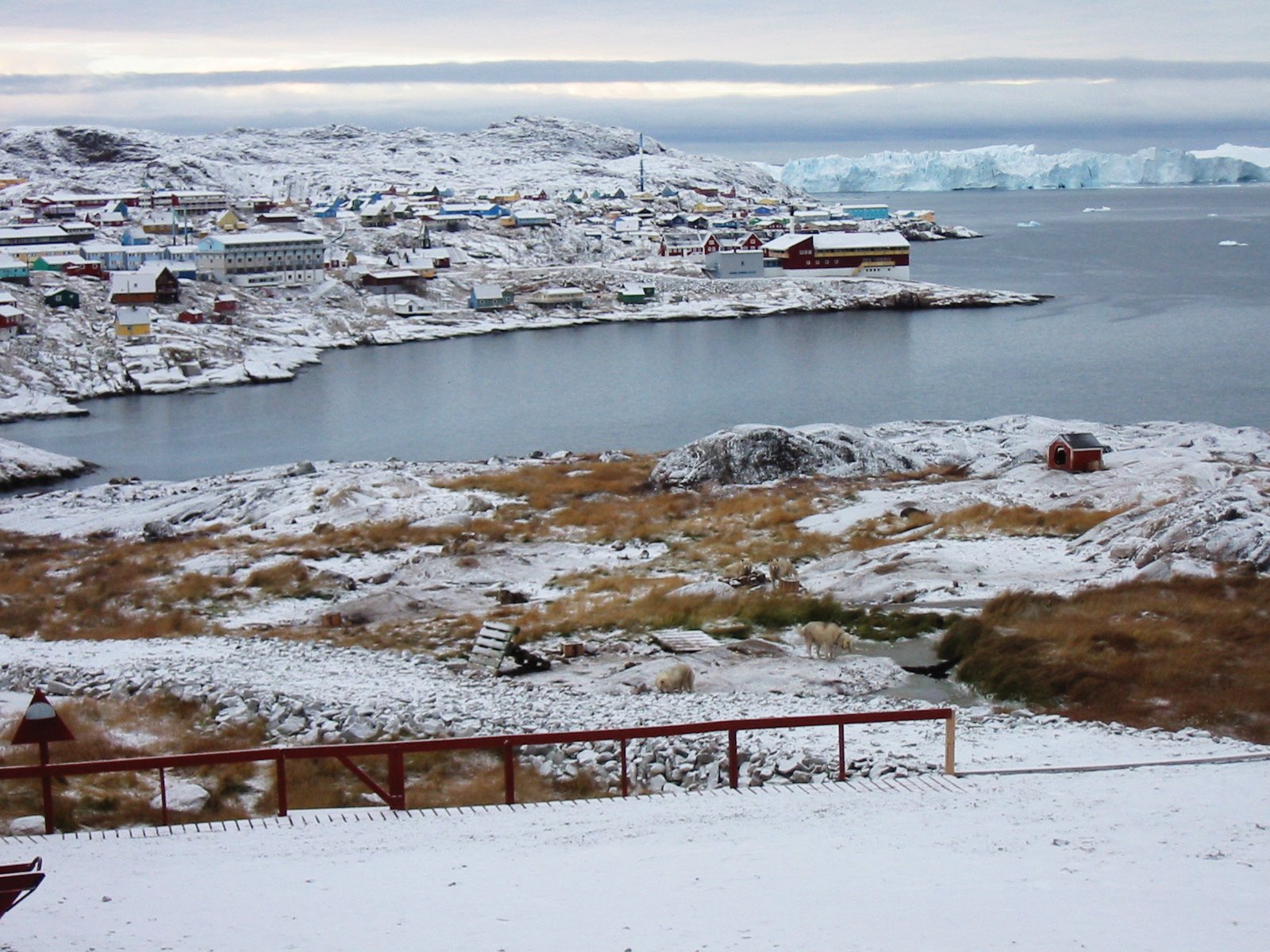
She said Arctic Indigenous people interact intimately with nature and their safety depends on knowing how to operate on land and sea. “The distribution, quality, thickness, and timing of ice on the ocean lakes and rivers drive nearly every aspect of life in the Arctic, from boating to whaling, to seal hunting to the safety of fishing and foraging.”
“Living and innovating in Arctic environments over millennia, Indigenous Peoples have evolved holistic knowledge providing resilience and sustainability.
Schaeffer quoted one of the participants in the SEARCH collaborations. Retired University of Alaska professor Paul Ongtooguk, Inupiaq, said, “we lived in places with such efficiency and grace that later people who have come to our homelands have considered them to be empty of human beings. And they’ve called this a wilderness because they didn’t see us in this place. They could not imagine that a people could live so well in a land that it would appear untouched by them. And we live with that dilemma today.”
Some vital signs, indicators of Arctic climate change
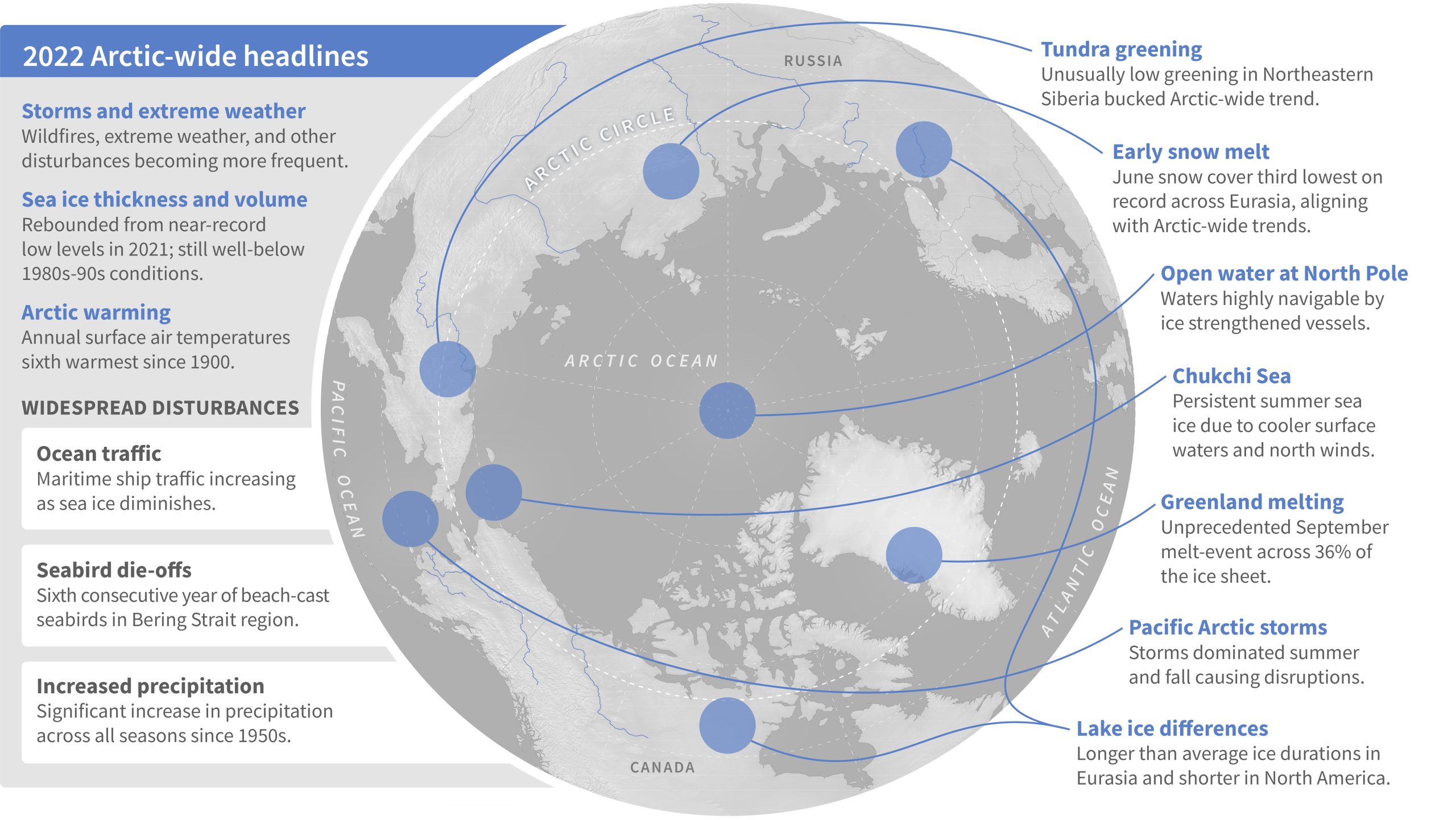
- Air temperature – The average surface air temperature over the Arctic for the past year (October 2021-September 2022) was the 6th warmest since 1900. The last seven years are collectively the warmest seven years on record.
- Sea ice extent – 2022 Arctic sea ice extent was similar to 2021 and well below the long-term average.
- Sea surface temperatures – Sea surface temperatures continued to show warming trends for 1982-2022 in most ice-free regions of the Arctic Ocean.
- Ocean Primary Productivity – Most regions of the Arctic continued to show increased ocean plankton blooms over the 2003-22 period with the greatest increases in the Eurasian Arctic and Barents Sea.
- Maritime ship traffic – Satellite records from 2009 to 2018 show increasing maritime ship traffic in the Arctic as sea ice declines. The most significant increases in maritime traffic occurring from the Pacific Ocean through the Bering Strait and Beaufort Sea.
- Greenland ice sheet – The Greenland Ice Sheet experienced its 25th consecutive year of ice loss. In September 2022, unprecedented late-season warming created surface melt conditions over 36 percent of the ice sheet, including at the 10,500 ft ice sheet summit.
- Terrestrial snow cover – Snow cover was unusually low over both North America (2nd lowest in the 56-year record) and Eurasian Arctic (3rd lowest in the record).
- Precipitation – A significant increase in Arctic precipitation since the 1950s is now detectable across all seasons. Wetter-than-normal conditions were observed from October 2021 through September 2022, in what was the 3rd wettest year of the past 72 years.
- Tundra greening – The rate at which trees and shrubs are taking over the tundra has declined from the record high values of the past two years. Wildfires, extreme weather events, and other disturbances have become more frequent, influencing the variability of tundra greenness.

Our stories are worth telling. Our stories are worth sharing. Our stories are worth your support. Contribute $5 or $10 today to help ICT carry out its critical mission. Sign up for ICT’s free newsletter.
