
ICT is working to shape the future of journalism and stay connected with readers like you. A crucial part of that effort is understanding our audience. Share your perspective in a brief survey for a chance to win prizes
Greetings, relatives.
A lot of news out there. Thanks for stopping by ICT’s digital platform.
Each day we do our best to gather the latest news for you. Remember to scroll to the bottom to see what’s popping out to us on social media and what we’re reading.
Also, if you like our daily digest, sign up for The Weekly, our newsletter emailed to you on Thursdays. If you like what we do and want us to keep going, support and donate here.
Okay, here’s what you need to know today:
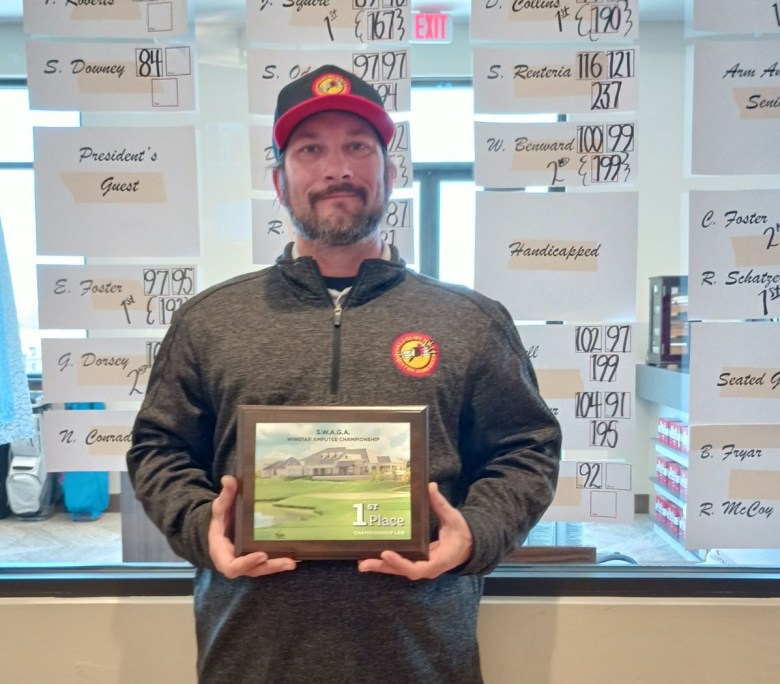
Jimmy Squire has been playing golf and working to help disabled athletes for more than 20 years, and the world is finally beginning to catch up.
Squire, a citizen of the Absentee Shawnee of Oklahoma, lost his leg to a lawn-mowing accident at age 3 and discovered golf at age 15. Now 46, he’s working to bring other disabled Native people and veterans onto the golf course.
He represented the Shawnee in this year’s Native American Open golf tournament at the Santa Ana Pueblo in New Mexico in October, won back-to-back tournaments for disabled golfers in November run by the Veterans Golf Association, and won the 2023 Southwest Amputee Golf Association flight at the Winstar resort in Oklahoma.
“I’m not one to sit at home,” Squire told ICT. “I put my leg on in the morning and take it off at midnight when I go to bed. And if I can open some doors, so others don’t sit at home and stare at the wall, I’ve met my goal.” READ MORE — Mark Wagner, Special to ICT
SUPPORT INDIGENOUS JOURNALISM. CONTRIBUTE TODAY
TULSA, Okla. – The Osage Nation flags are at half-staff this week as the tribe mourns the loss of former Chief John Red Eagle.
Red Eagle passed away Jan. 12 with his family at his side. His funeral and commemoration were held Tuesday morning at the Wakon Iron Chapel in Pawhuska.
The Osage Nation posted on Facebook: “We honor the life and legacy of former Chief John D. Red Eagle. May Chief Red Eagle’s teachings and good ways continue to guide us all. Rest in peace, Chief Red Eagle.”
Red Eagle was originally from the Barnsdall, Oklahoma area and served as chief from 2010-2014. He was the third generation of the Red Eagle family to serve as chief. His father was Chief Edward Red Eagle Sr., and his grandfather was Chief Paul Red Eagle. READ MORE — Felix Clary, ICT + Tulsa World
When a student shut down during math, Brooke Zupan, a first-grade teacher, took a moment to talk to him. He was tired and missed his mom. After making sure he was okay, she took him to a separate room to take a nap. When he woke up, he was back to his usual self.
The teacher follows the school’s motto: Every student, every day. “We have to meet the daily needs of our students and every day they’re different,” Zupan said.
St. John Elementary and Middle School, located in St. John, N.D. near the Turtle Mountain Reservation, shared a Category One Elementary and Second Education Act Distinguished School Award after exhibiting exceptional student performance and academic growth.
Two schools from every state receive the ESEA Distinguished School Award each year. This year, the St. John schools received one of the designations, and Mary Stark Elementary School in Mandan received the other. Last year, St. John High School was awarded this recognition. READ MORE — Buffalo’s Fire
Road traffic has long posed a challenge to caribou on the North Slope. For decades, there has been a standard for oil field traffic heavy enough to disturb the animals: 15 vehicles per hour. Environmental studies and permits invoke that as the threshold at which caribou stop walking freely near and across roads.
Now a newly published study analyzing caribou movements at two oil fields shows that the traffic volumes that inhibit animals’ movements appear to be much lower: five vehicles an hour.
The study adds to a growing body of evidence that caribou are much more bothered by infrastructure and industrial activity than was assumed in the past, when existing North Slope oil fields were planned and permitted.
“Caribou are really sensitive. They’re really sensitive to human activity. And we’ve seen from past studies that they’re also sensitive to human infrastructure, and they really respond to it,” said Heather Johnson, a U.S. Geological Survey biologist who coauthored the study. “The key takeaway from the paper is they’re more sensitive to road activity than we had previously recognized.” READ MORE — Alaska Beacon
Sign up here to get ICT’s newsletter
A new lawsuit has been filed concerning tragic events. Cambria Harris has filed a human rights complaint against Manitoba’s progressive party for ads they made denying the search of a landfill where her mother’s remains potentially lie. Morgan Harris’ remains are thought to be in the Prairie Green Landfill, along with the remains of Mercedes Myren, who are both citizens of the Long Plain First Nation.
A new arctic report card shows that rising sea levels have changed a type of permafrost surrounding the arctic ocean. Terrestrial permafrost, which is defined as earth material that remains below 0 degrees Celsius has changed to subsea permafrost. This resulted in the usual average annual air temperatures increasing from -20 degrees up to -2 degrees Celsius.
Seven tribal representatives have joined the executive committee and board of the American Indian Alaska Native Tourism Association. Established in 1998, AINTA focuses on advancing cultural heritage tourism in native nations and communities throughout the United States.
In a unique collaboration, Starbucks is showcasing Southeast Alaska Native culture on its newest merchandise. Tlingit and Aleut illustrator, Alison Bremner has crafted culturally inspired designs on Starbucks cups that bring a touch of Alaska Native art to coffee enthusiasts worldwide. READ MORE — ICT
WATCH
At one time, Margorie Hudson was in RCMP advertisements in Manitoba to recruit Indigenous people into the Mounties. She was the first First Nations woman to serve in the RCMP in the province.
“I loved wearing my uniform, I was proud to wear my uniform, but it was tough,” she said. “It was fighting a battle for 31 years and I stood up to it.”
Hudson, from Berens River First Nation – a community 360 km north of Winnipeg – joined the force in 1979 after a friend encouraged her.
She spent the next three decades fighting crime in various communities – and racism from her co-workers. READ MORE — APTN National News
- $100M will be left for Native Hawaiian causes: Abigail Kawānanakoa cared deeply about advancing Hawaiian culture
- Tribal elder profile: Patsy Whitefoot: Elder, educator and activist Patsy Whitefoot has a passion for arming the next generation with tools for change
- Indigenous people press on to Indigenize museums: Indigenous consultants are working to Indigenize museums and galleries for accurate identification, representation and repatriation
- US in deep freeze while much of the world is extra toasty? Yet again, it’s climate change
- Nevada high court says it won’t reconsider ‘Dances With Wolves’ actor Nathan Chasing Horse’s case
- Justice Department report finds ‘cascading failures’ and ‘no urgency’ during Uvalde shooting
We want your tips, but we also want your feedback. What should we be covering that we’re not? What are we getting wrong? Please let us know. dalton@ictnews.org.

Our stories are worth telling. Our stories are worth sharing. Our stories are worth your support. Contribute $5 or $10 today to help ICT carry out its critical mission. Sign up for ICT’s free newsletter.

