
Greetings, relatives. (can be in traditional language, make intro your own)
A lot of news out there. Thanks for stopping by ICT’s digital platform.
Each day we do our best to gather the latest news for you. Remember to scroll to the bottom to see what’s popping out to us on social media and what we’re reading.
Also, if you like our daily digest, sign up for The Weekly, our newsletter emailed to you on Thursdays. If you like what we do and want us to keep going, support and donate here.
Okay, here’s what you need to know today:
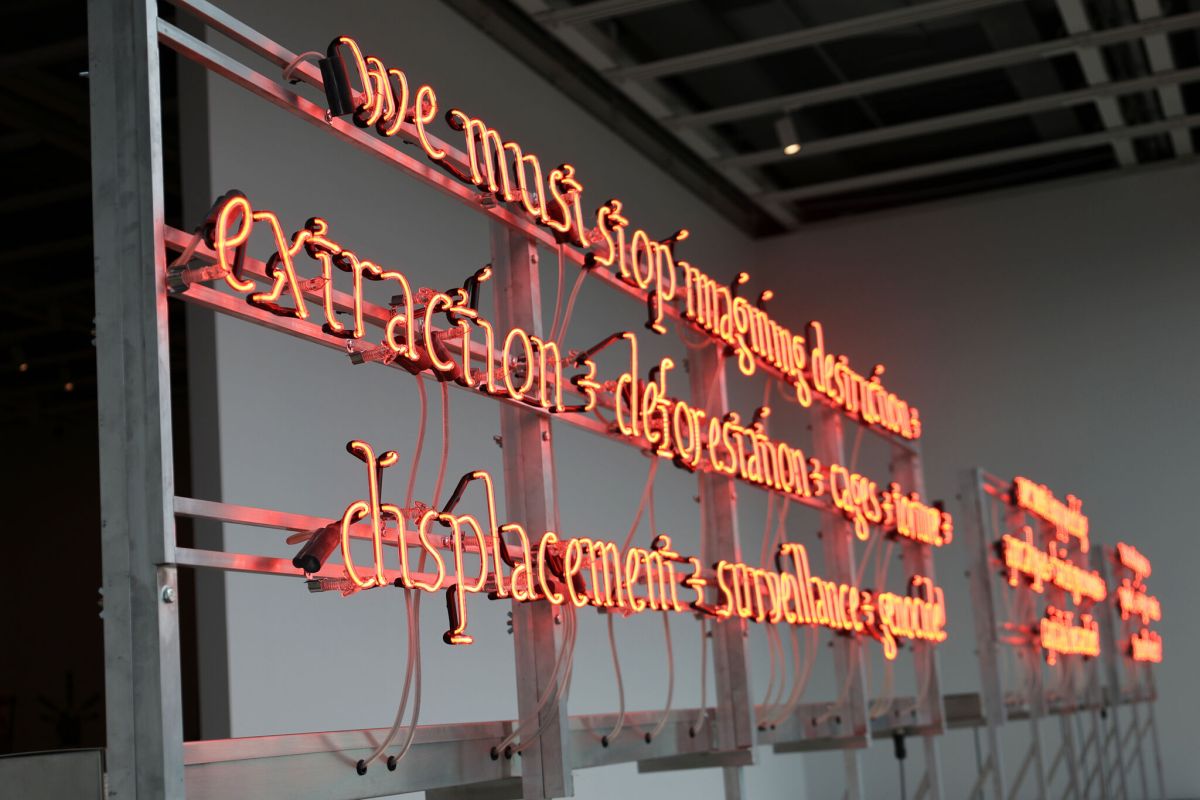
ART: Clay, tipis and neon feature in new artists’ work
The 81st edition of the Whitney Biennial – the longest-running survey of contemporary art in the United States, hosted at the Whitney Museum of American Art in New York City – features 71 artists making sense of today’s most pressing issues.
The exhibition’s subtitle, “Even Better Than the Real Thing,” gives rise to questions of identity and authenticity. The curators say that “in making this exhibition, we committed to amplifying the voices of artists who are confronting these legacies, and to providing a space where difficult ideas can be engaged and considered.”
ART: From Disney to museums
A stunner of a new exhibit at Western Spirit: Scottsdale’s Museum of the West, Inner Light: The Art of Tom Gilleon, shows a painter who started as an illustrator with NASA’s Apollo space programs and with Disney Imagineering before becoming a full-time artist of the West.
Gilleon, Cherokee and Scottish, paints with luminous colors and authentic portrayals of Native Americans and iconic Western structures and landscapes. The exhibition has paintings, a mesmerizing digital art triptych, and original artworks on special loan from Walt Disney Imagineering.
Gilleon has been compared to modern greats Edward Hopper and Mark Rothko, with a glowing sense of light and place. He excels at images of tipis, Montana landscape at different times of the year, and portraits of tribal citizens.
MUSIC: Tribal tunes more than skin deep
Native Bones Tribal Band plays contemporary Indigenous music at powwows, museums, night clubs, fire circles and festivals. Headed up by Akitchitay, the band has six nominations from the Native American Music Awards and a win as Musician of the Year from the Taino Awards in 2023. READ MORE.
SUPPORT INDIGENOUS JOURNALISM. CONTRIBUTE TODAY.
Outside American Indian Hall at Montana State University, dark soil covered in patches of snow and straw sat idle, waiting to grow new life.
It was a gray day at the tail end of winter. Clouds overhead made it easy to forget that in a few months, the garden will boast a colorful crop of sunflowers, squash, corn and beans.
These four sisters once were the basis of Indigenous food systems. Today, the ancestral garden is just a tiny corner of the Native land now home to the buildings, roads and fields of MSU.
Extending far beyond Bozeman, more than 260,000 acres make up Montana’s largest public university. Much of the acreage was allocated by the 1862 Morrill Act, which used land taken from Indigenous peoples to form a network of “land grant” universities across the country.
MSU Bozeman is built on ancestral lands used by the Crow, Northern Cheyenne, Salish Kootenai, Blackfeet, Lakota and Sioux Tribes, among others.
“For centuries, colonization, invasion and dishonesty have resulted in the displacement of these people from their spiritual and cultural homelands and the lands reserved to their sovereign rule by treaty,” the Montana University System land acknowledgement reads.
Today, MSU grapples with that history — and a responsibility to support the Native people whose land was systemically seized to form the institution.
On campus, the support involves cultural offerings, Native-specific education and tuition waivers. Off campus, tribal extension programs fuel cultural rejuvenation but sometimes struggle with funding. READ MORE. — Bozeman Daily Chronicle
Abraham “Snake” Ah Hee rides waves when the surf’s up and dives for octopus and shells when the water is calm. The lifelong Lahaina, Hawaii, resident spends so much time in the ocean that his wife jokes he needs to wet his gills.
But these days Ah Hee is worried the water fronting his Maui hometown may not be safe after the deadliest U.S. wildfire in a century scorched more than 2,000 buildings in August and left behind piles of toxic debris. He is concerned runoff could carry contaminants into the ocean where they could get into the coral, seaweed and food chain.
“Now with all these things happening, you don’t know if the fish is good to eat,” Ah Hee said.
Scientists say there has never been another instance of a large urban fire burning next to a coral reef anywhere in the world and they are using the Maui wildfire as a chance to study how chemicals and metals from burned plastics, lead paint and lithium-ion batteries might affect delicate reef ecosystems.
The research, which is already underway in the waters off Maui, could ultimately help inform residents, tourists and coastal tropical communities worldwide as climate change increases the likelihood of extreme weather events of the kind that fueled the wildfire.
A bill before the state House would provide long-term funding for water quality monitoring in hopes of providing answers for residents whose lives are closely tied to the ocean.
For now, state officials are urging the public to limit their exposure to the ocean and seafood until scientists understand what might be making its way through the food chain.
“I know a lot of people keep asking, ‘Is the water safe? Can we go out? Is it safe to fish and eat the fish?’” said Russell Sparks, Maui aquatic biologist at the state Department of Land and Natural Resources. “We just want to reinforce the message that we know it’s frustrating, but if people can be patient. We’ve never encountered anything like this.” READ MORE. — The Associated Press
Sign up here to get ICT’s newsletter
- More than $1 billion goes to Native American housing: ‘It is an acute problem’
- The real-life fight for Osage headrights: ‘Killers of the Flower Moon’ inspires non-Osage owners to try returning oil headrights to Osage Nation
- Alaska museum celebrates the past to connect with the future: A major renovation is underway to attract tourists to the museum’s Kodiak Island community
- How the Puyallup Tribe Increased Police Accountability in Washington
- New organization seeks to uplift Native American students in medicine
We want your tips, but we also want your feedback. What should we be covering that we’re not? What are we getting wrong? Please let us know. dalton@ictnews.org.

ICT is a nonprofit news organization. Will you support our work? All of our content is free. There are no subscriptions or costs. And we have hired more Native journalists in the past year than any news organization ─ and with your help we will continue to grow and create career paths for our people. Support ICT for as little as $10. Sign up for ICT’s free newsletter.

