Daniel Herrera Carbajal
ICT
The remnants of Typhoon Halong have ravaged the Yukon-Kuskokim Delta in western Alaska.
More than 1,000 people are seeking shelter in schools in the largely Yup-ik villages of Kwigillingok and Kipnuk, according to the Yukon-Kuskomwim Health Corporation.
The storm left one person dead and two missing in western Alaska following hurricane-force winds, storm surges and floodwaters that swept some homes away.
The Alaska State troopers said at least 51 people and two dogs were rescued in Kipnuk and Kwigillingok after the storm system walloped the communities. Both areas saw significant storm surge, according to the National Weather Service.
“The flooding from Typhoon Halong has been devastating to communities in our region,” Mary Horgan, vice president of communications for the Yukon-Kuskomwim Health Corporation, told ICT.
Alaska Gov. Mike Dunleavy declared a state disaster on Oct. 12, which activated state resources to provide aid.
The Association of Village Council Presidents, a nonprofit tribal consortium composed of the 56 tribes in the Yukon-Kuskokim delta, wrote a letter to President Donald Trump urging him to declare a national emergency.
“Western Alaska is in crisis. The remnants of Typhoon Halong have devastated our region, including but not limited to flooding entire communities, washing away homes, knocking out power, and leaving families stranded,” said the association. “This is the second major typhoon in three years, and our people cannot endure another disaster without major federal support.”
“Western Alaska needs your intervention immediately,” said Vivian Korthuis, CEO of the Association of Village Council Presidents. “We are ready to work with you to support our communities. We urge you to declare a national emergency. Send federal aid. Help us protect lives and rebuild our communities and our future.”
The association shared a post on Facebook on Tuesday informing people how to help.
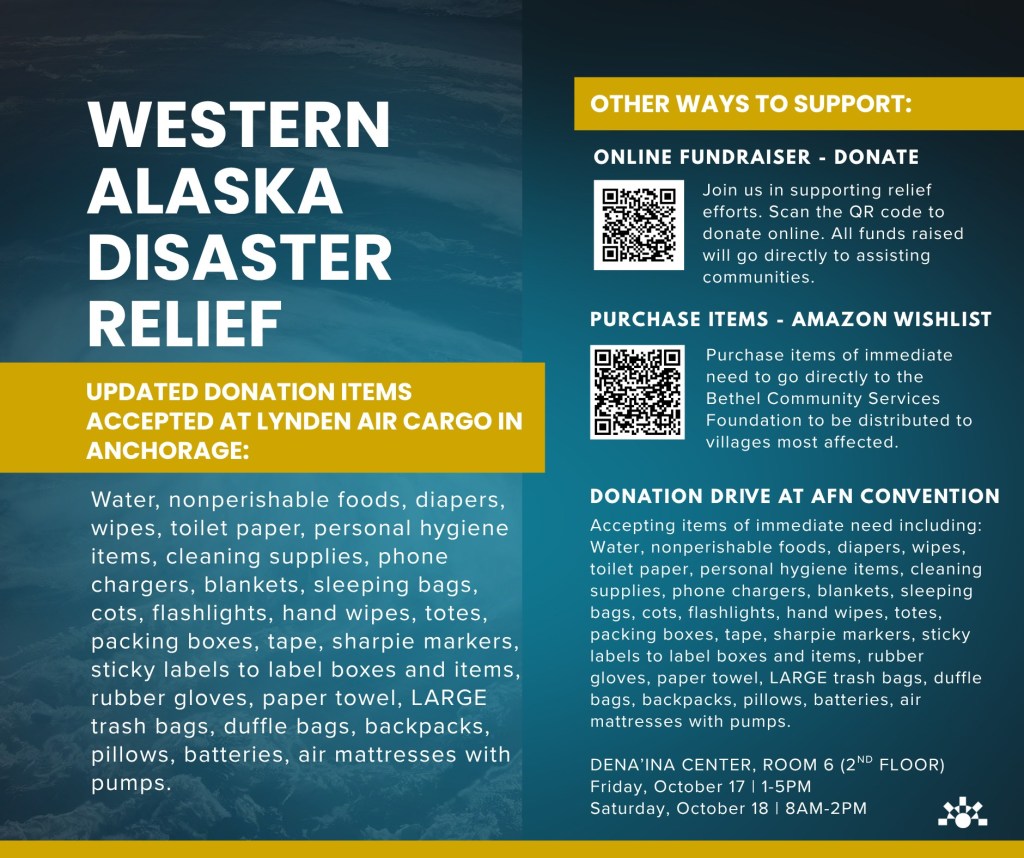
At the request of village leaders, the Yukon-Kuskomwim Health Corporation has sent medical providers and prescription medications to Kwigillingok, Kipnuk, Tuntutuliak and Chefornak, all largely Indigenous villages, according to a press release from the corporation.
The teams are providing care to those in need and assessing the need for additional medical support. Plans are underway to evacuate about 40 people, mostly elders with complex medical conditions and pregnant women, to the regional hospital in Bethel for additional care.
During a news conference organized by Gov. Dunleavy, Alaska’s two U.S. senators, Lisa Murkowski and Dan Sullivan, said they would continue to focus on climate resilience and infrastructure funds for Alaska. Sullivan said it was the congressional delegation’s job to ensure the Trump administration and their colleagues understood the importance of such funds.
Earlier this year, the Federal Emergency Management Agency said it would end a program aimed at mitigating disaster risks. The decision is being challenged in court.
Murkowski said erosion mitigation projects take time to complete. “But our reality is, we are seeing these storms coming … certainly on a more frequent basis, and the intensity that we’re seeing seems to be accumulating as well, and so the time to act on it is now because it’s going to take us some time to get these in place,” she said of such projects.
The Associated Press contributed to this article.