Amelia Schafer
ICT
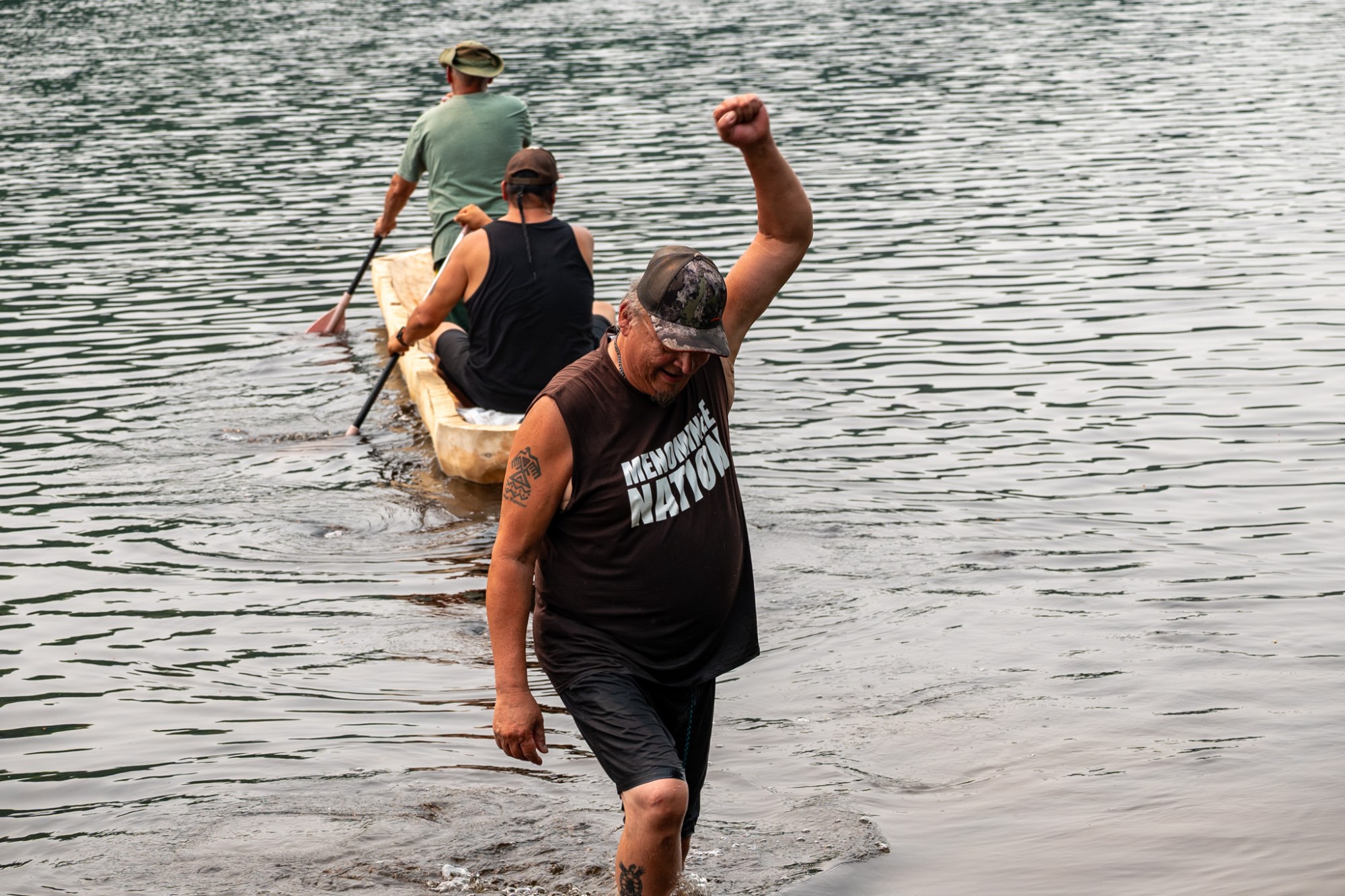
MENOMINEE, Michigan – Stepping out of a traditional dugout canoe, called Maeqtek-ōs in the Menominee language, canoe creator Wayne Swett raised his fist high in the air and proudly proclaimed: “We made history.”
Until Wednesday, no one could remember the last time Menominee people paddled a dugout canoe down the Menominee River. That very question drove a group of Menominee water protectors, led by Dawn M. Wilber and Swett, to launch a dugout.
Since June 15, Wilber, Swett and several community members have camped on the banks of the river, burning, scrapping, debarking and sanding a 17-foot-long pine log into a traditional canoe. They did their work in the Chappee Webster Learning Center, a historic 1824 trading post located in their ancestral homelands in a place that is central to Menominee culture.
“[This] has been a long time coming,” said Oralann Caldwell, a Menominee and Anishinaabe elder who traveled over 60 miles from Keshena, Wisconsin, to attend. “It’s about time that door is reopened.”
To the north are Menominee burial mounds, a traditional dance ring and the largest Indigenous agricultural site in the eastern United States. To the south is the Menominee peoples’ birthplace, the mouth of the Menominee River where it meets Lake Michigan.
“I am beyond excited,” Swett said. “The ancestors are happy. The river’s happy. The fish are happy. The creator’s happy. Everybody’s happy. I’m beyond happy because my work is done.”
The canoe’s construction took two weeks longer than scheduled, delayed by intense heatwaves gripping much of the Midwest. Overall, it took exactly one month to complete the massive boat.
“It was definitely a test because we had to deal with the heat, 100-degree heat,” Swett said. “We had to deal with storms. There’s times where we had to call a rain day and then a heat day. … It’s a weight off my shoulders.”
The canoe belongs to the community, Wilber said.
“I’m thinking about our ancestors, I’m thinking about what they did, how much time that they would put into stuff like this, and how they would sacrifice themselves because a canoe is communal,” Wilber said. “When it’s made, it doesn’t take ownership. It’s for everybody, everybody to use in the community. So it wasn’t just like yours or mine. That’s the purpose of it.”
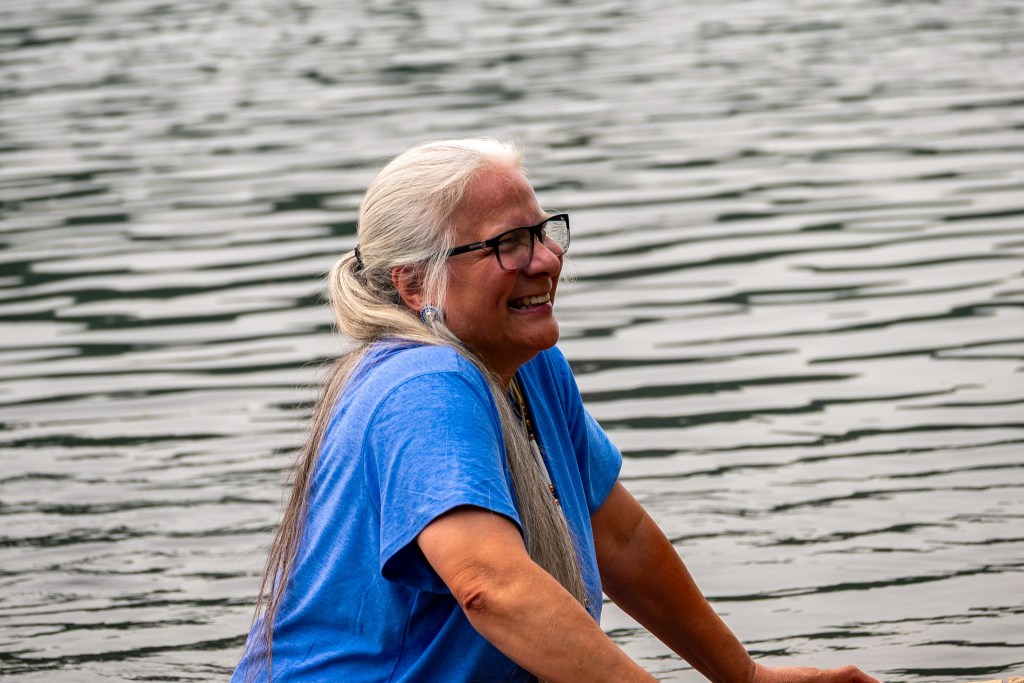
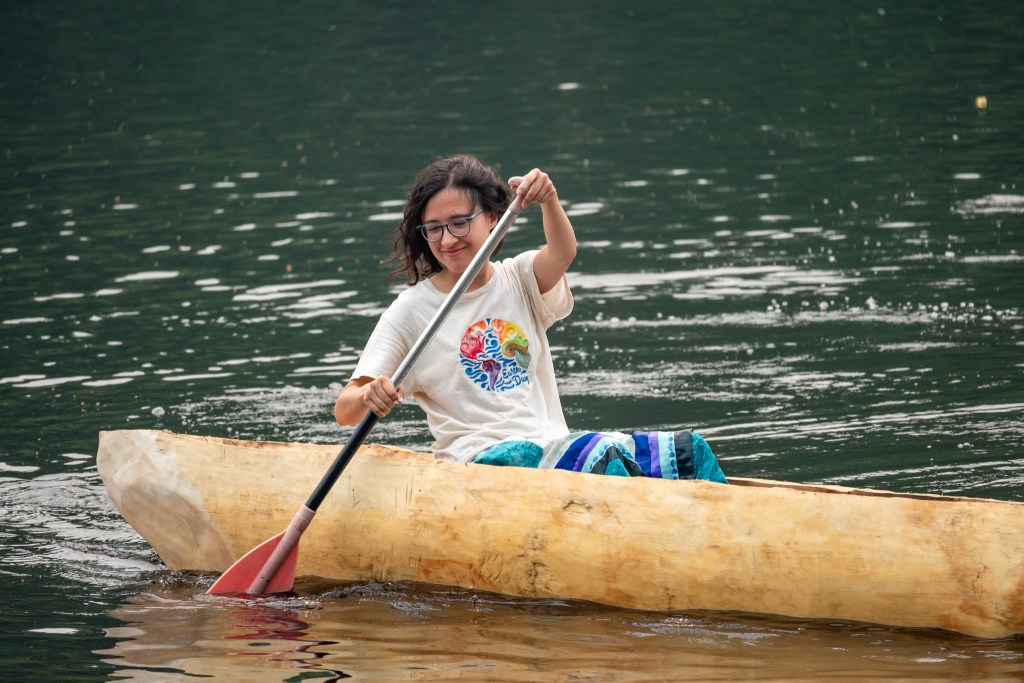
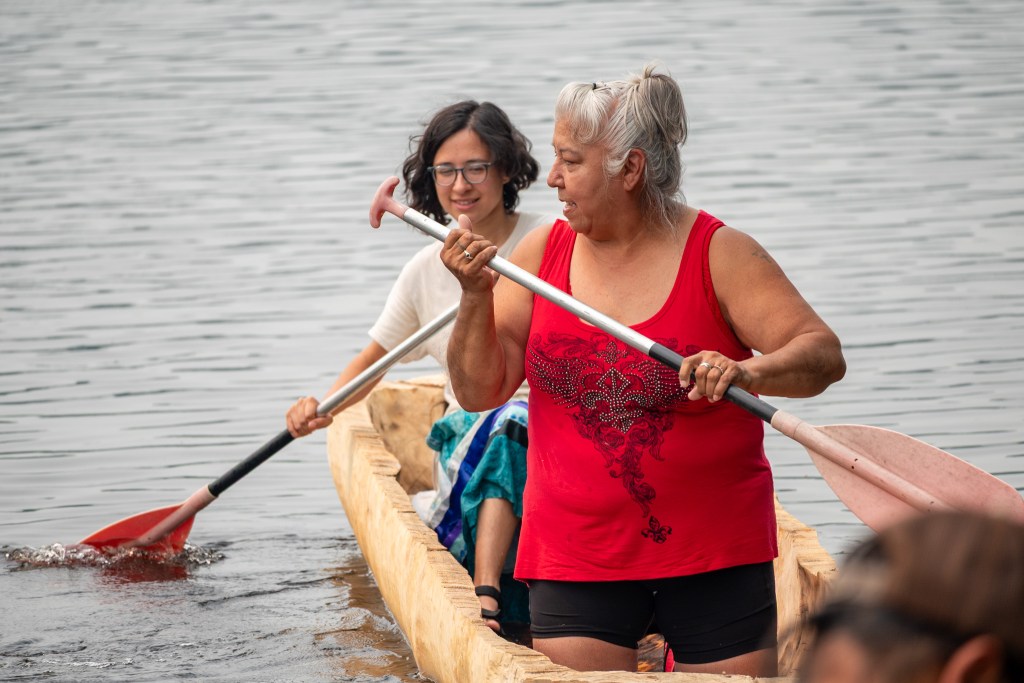
Prior to launching, a group of roughly a dozen community members gathered for a water ceremony to send the canoe off properly. Following the ceremony, canoe creators Swett and Wilber climbed into the canoe to be the first to paddle it. To their surprise, there were absolutely no leaks in the canoe. It floated perfectly.
“I didn’t realize how emotionally beautiful it was. That’s what got me is the emotion,” said Wilber, who is Menominee. “Not just looking at her but feeling her and being able to give her her first drink today before we put her in the water.”
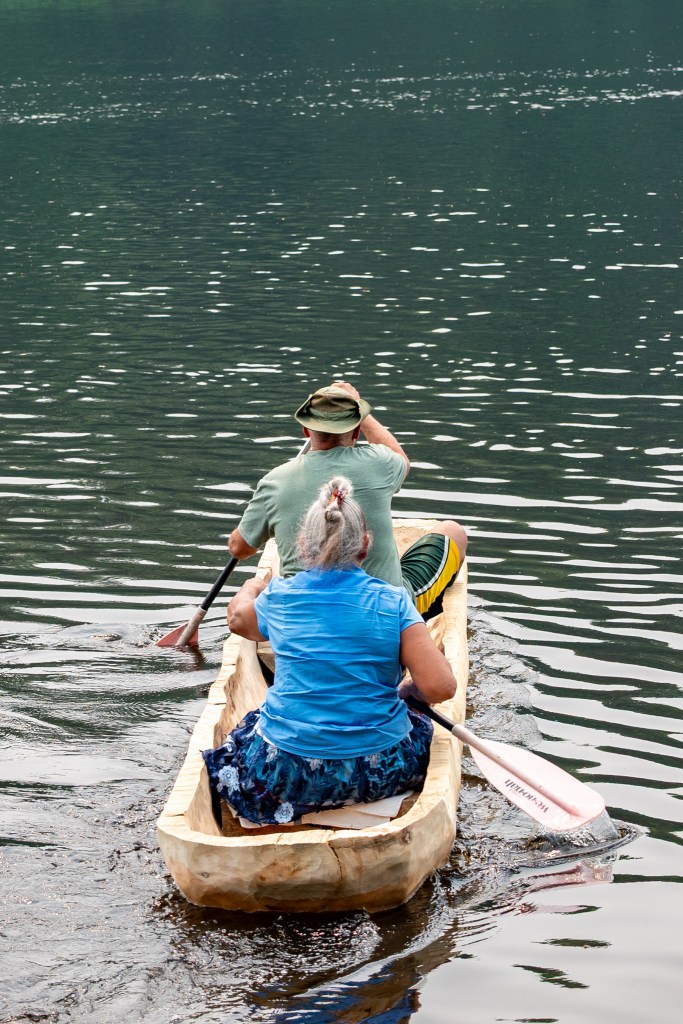
Wilber and Swett paddled the canoe around the river before allowing community members to take it for a spin.
Prior to colonization, countless Menominee families navigated the river in dugout canoes each day – as did countless other Indigenous families in the North American eastern woodlands.
Initially, Swett and Wilber said, they planned to take the canoe out on the eighth annual canoe journey organized by their group, Protectors of the Menominee River. However, because of weather-related delays, Swett stayed and continued to work on the canoe during the four-day journey.
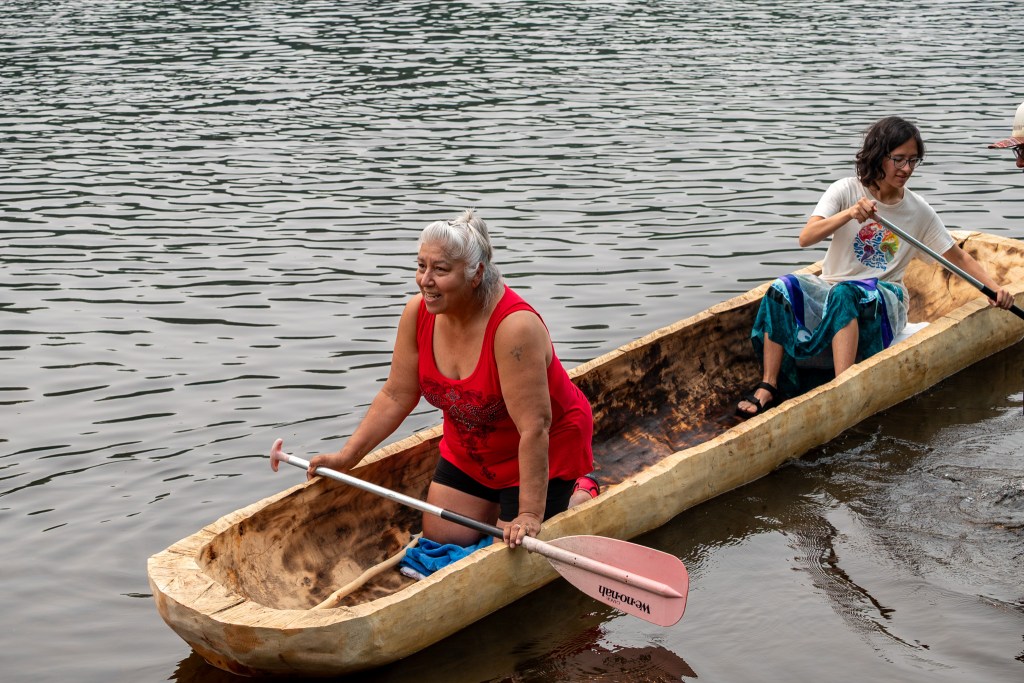
After a solid month of carving, burning and shaping the pine log into a full-fledged canoe, the end result was far more beautiful than anyone had anticipated. The sanded and finished inside revealed silhouettes of different woodland animals, a sign of all the animals who interacted with the tree during its century of existence, said Caldwell.
“It’s like an imprint, a reflection to us,” Caldwell said. “The spirits of all those animals were out there. It’s a love, an honor, a respect. It’s a love for our culture, for our mother [earth].”
Caldwell said inside she spotted silhouettes of a wolf, a bear, a snake and a red-tailed hawk. Other community members pointed out different animal shapes as well, she said.
“The animals: birds, four leggeds, were all with us,” Caldwell said.
She said she and Wilber were struck by the sheer number of community members who supported them during their journey and helped work on the canoe.
“All of the love, all of the gratitude, all of the giving, all of the sharing, everybody, and just everything that everybody has done for us,” Wilber said.
Later this year, the Protectors of the Menominee River plan to use the canoe to harvest wild rice, Wilber said.
“We are the original caretakers of the land, and we’re still doing it,” Caldwell said.