

Sandra Hale Schulman
ICT
The latest: Pioneering Native guitarist, Native art at the Country Music Hall of Fame and hi-tech wool
MUSIC: Celebrating Jesse Ed Davis
Pioneering Kiowa rock guitarist Jesse Ed Davis — who played with legends John Lennon, George Harrison, Jackson Browne, Bob Dylan and, perhaps most notably, with Santee Sioux musician John Trudell — will be honored with a tribute at the Venice Heritage Museum in California, where he lived until the end of his life.
Davis was featured on Trudell’s groundbreaking “AKA Graffiti Man” album originally released on cassette in 1986, two years before Davis died from substance abuse in 1988 at just 43 years old. The album was re-recorded and released as a widely acclaimed studio album on Rykodisc in 1992.

The tribute on July 25 will feature a reading by Douglas Miller from his recent book, “Washita Love Child: The Rise of Indigenous Rock Star Jesse Ed Davis,” published by W.W. Norton in 2025, and will include an archival photo presentation.
Miller says Davis has been remembered mainly for how he died, less so for how he lived. He curated an exhibit of Davis’s archives at the Bob Dylan Center in Tulsa last year.
“I just wanted to fill in the rest of the story,” Miller told ICT. “I thought he was someone who had been robbed of the real beauty of his life and the way that he was remembered and misremembered.”
A panel discussion and Q&A with musicians who played alongside Jesse will feature Jim Keltner, named by Rolling Stone as one of the top 50 drummers of all time; Elliot Easton of The Cars; Bob Glaub, who played with Jackson Browne, Warren Zevon and Stevie Nicks; Steve Jenkins, director of the Bob Dylan Center; and other surprise guests.
As for music, there will be a live acoustic set by Scott McCaughey (R.E.M., The Minus 5, The Baseball Project), performing a special selection of Jesse Ed Davis covers. The outdoor event is set for Saturday, July 25, from 6-9 p.m., at the museum at 1234 Pacific Avenue in Venice.
ART: Native art at Country Music Hall of Fame
The Haley Gallery at the Country Music Hall of Fame and Museum in Nashville, Tennessee, is opening a new solo exhibition by acclaimed Navajo artist Jeremy Salazar, presented in partnership with IndigeNash and the Forge Nashville.
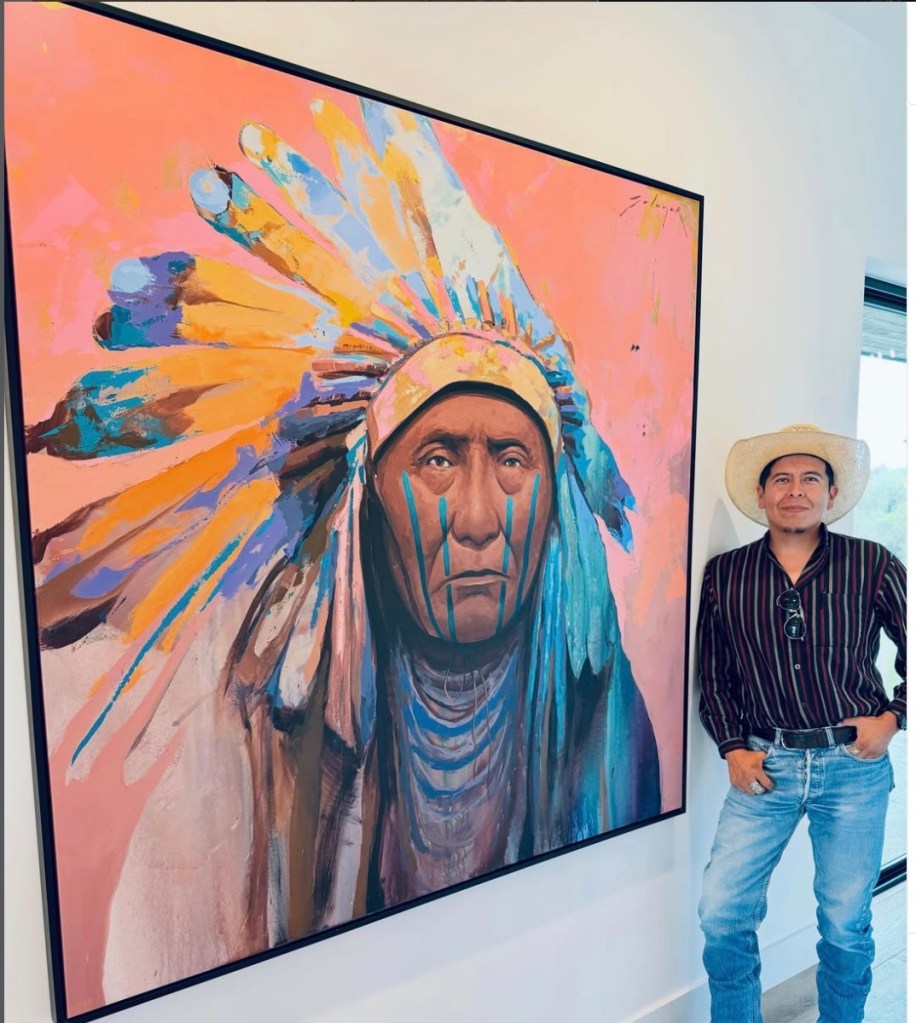
The exhibition, “We’re Still Here,” spotlights Salazar’s evolving artwork with his painted and photographic works. Through his Three Feather Studios, Salazar has gained national recognition for works that feature Indigenous perspectives and lived experiences.
The exhibit opened Thursday, July 16, with a reception, and runs through Sept. 11, 2026.
A self-taught artist who grew up on the Navajo Nation in New Mexico, Salazar is known for the bold and vibrant colors in his works. He is now based in Albuquerque, New Mexico.
“What I try to emphasize in my work are the eyes and facial expressions of my characters, making these more realistic and full of depth while the rest of the composition fades away into abstract colors,” he said in a statement. “The color schemes set the mood while the face gives life to the painting.”
He never received any formal art training.
“I grew up without running water and electricity — old dirt roads, sagebrush, out in the middle of nowhere,” he said. “Although a meager upbringing, it was in retrospect, an open canvas for me as a young kid. It is a passion for me to help represent the authentic Native arts as an authentic Native artist. We as Native peoples know our own stories best, the ones who lived it, the storytellers.”
The exhibit is in the sprawling Hall of Fame building, which also houses CMF Press, CMF Records, CMA Theater, the Frist Library and Archive, the Taylor Swift Education Center, Hatch Show Print poster shop and Historic RCA Studio B.
WEAVING: Digital tales from the loom
A master weaver who merged traditional techniques with digital technology is featured at a new exhibition at the Center for Curatorial Studies at Bard College’s Hessel Museum of Art in Annandale-On-Hudson, New York.
The exhibition, “Replica of a Chip: The Weaving Technology of Marilou Schultz,” opened June 27 and runs through Nov. 29.
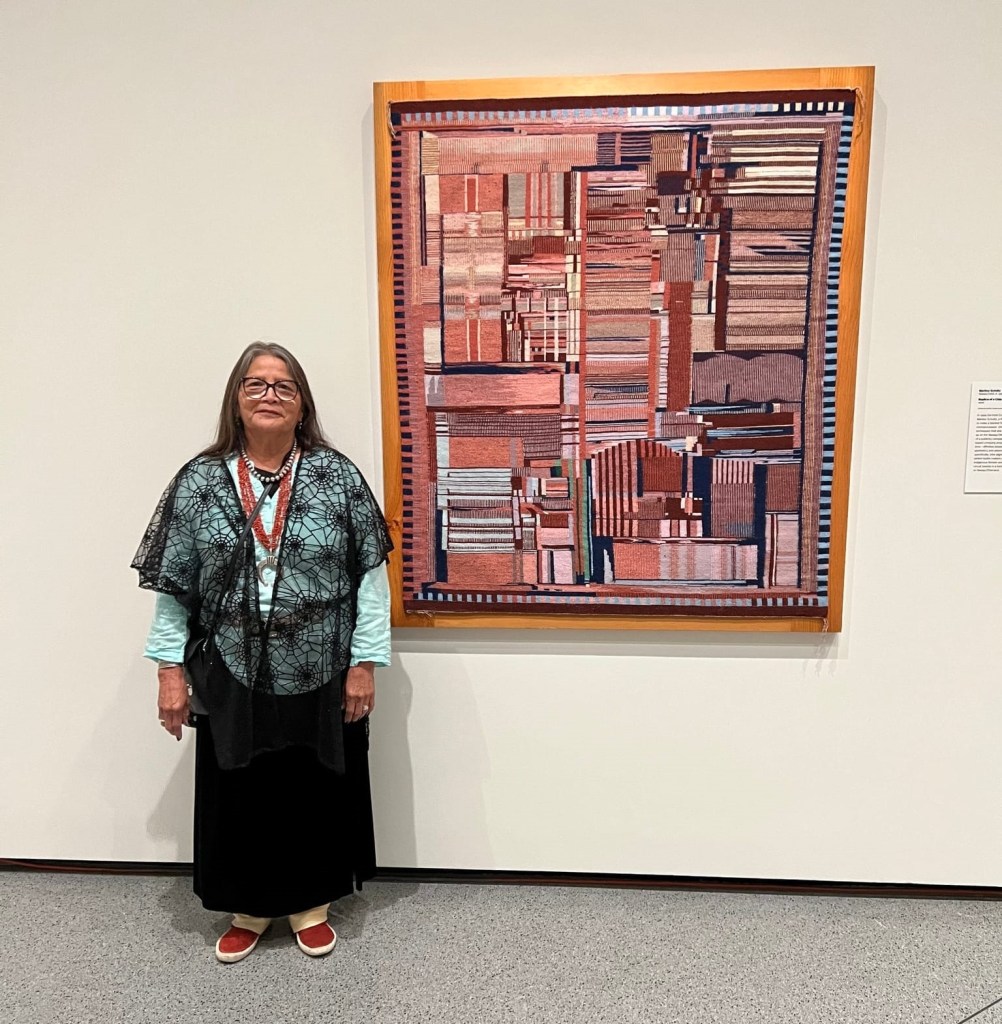
Schultz, Navajo, creates groundbreaking weavings with technical mastery and has been a mentor to multiple generations over a six-decade career.
While working as a math teacher in Arizona, Schultz was introduced to the Navajo weaving tradition at age seven and began to experiment with new techniques. In 1994, the semiconductor manufacturing company Intel Corporation commissioned Schultz to create a woven replica of its Pentium chip. It created a new body of work for the artist — her computer chip replicas — that examines a history of exploitation of Navajo women’s labor by tech companies.
Curated by Candice Hopkins, “Replica of a Chip” explores the overlooked history through archival materials on the Fairchild Industries’ semiconductor plant that operated on Navajo Nation and employed primarily Navajo women.
The exhibit also shows woven works by her mother, Martha Gorman Schultz, and niece Melissa Cody, who has exhibited nationally at museums and galleries.
“After I agreed to weave the image of the Pentium chip in 1994,” Schultz told ICT, “I was given an image a couple of days after the agreement. I didn’t realize how complex the chip looked from the image and thought, ‘What did I get myself into?’ The colors of the chip was not the problem because I could dye yarns and get the natural colors that were in the image.”
She continued, “From the image I also noticed I could use the raised outline technique where I could alternate two colors and get columns of colors that I saw in areas of the chip image. The problem was that I knew how to use this technique using diagonal designs but not where they interlock to make vertical lines … I set up a small sampler and started to experiment with the colors and finally figured it out later, and in the meantime, got all my wool prepped and dyed. I wove what stood out to me visually.”
What does she think of the new generation, such as Cody, who are continuing this type of work?
“Melissa is an exceptional weaver of a younger generation, who comes from more than four generations of weavers, and her work is exquisite,” she said. “I am glad that the young generation are keeping the weaving alive today just as our ancestors did. We are all influenced by our upbringing, family, surroundings, and personal experiences, and with this comes change.
“Our ancestors wove what they saw, as I have seen trains, power posts, feathers, lettering in earlier rugs and we, too, are doing that today. Melissa incorporates her own personal experiences with tech games that she grew up with into her weavings as art. It is great to see her work at a complex level and I am sure the younger generation will do more with weaving as well.”

