
Nika Bartoo-Smith
Underscore Native News + ICT
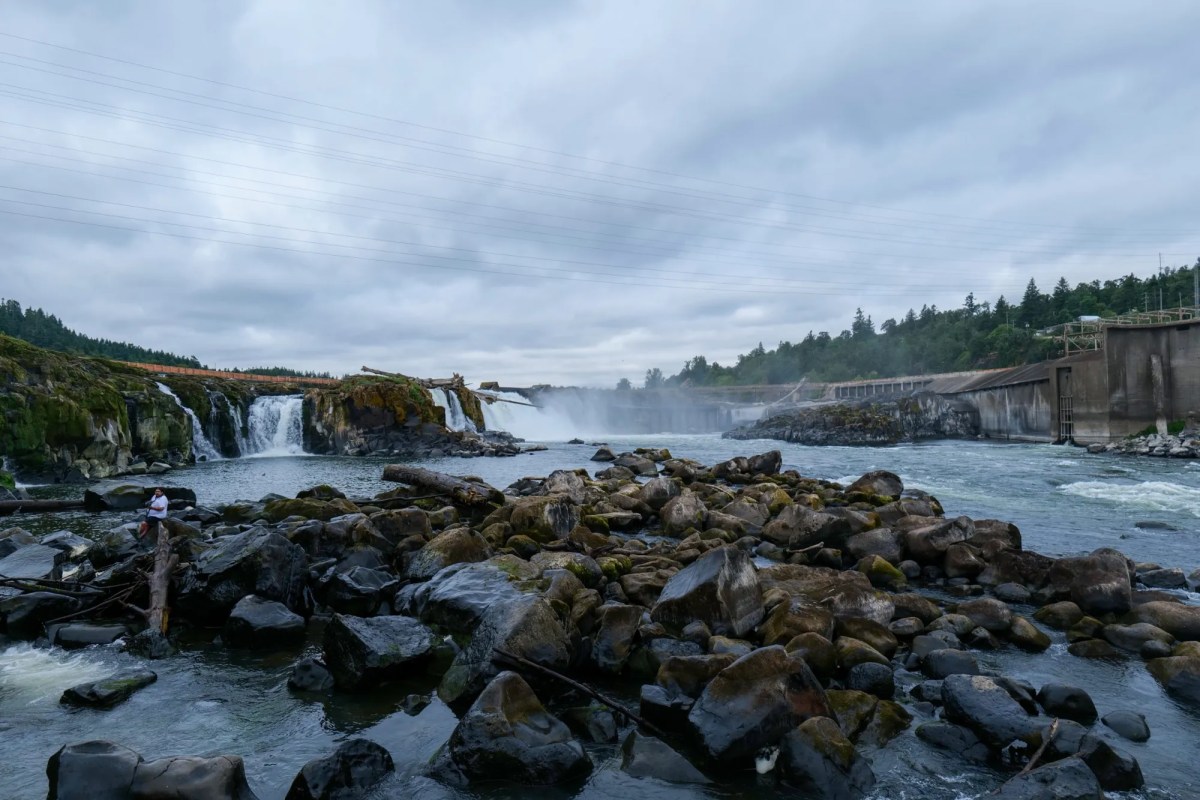
This June, at the end of the 2025 session, the Oregon Legislature approved $45 million for a public access project led by the Willamette Falls Trust. The envisioned project would secure access to the falls for the general public with spaces for community gathering, education and direct access to the river.
“I think what is really clear is that this funding from the state reveals the state’s commitment to preserving this iconic treasure for everyone, for future generations,” said Kate Brown, president of the Willamette Falls Trust and former governor of Oregon.
This $45 million in funding came as part of the “Christmas tree” bill, included in House Bill 5006. The money, in the form of state bonds, will go toward helping the Willamette Falls Trust to purchase property at the falls which includes over 40 acres on a portion of Moore’s Island in West Linn.
“Once we get past the acquisition phase, we will be working with the Pacific Northwest area tribes and communities, including West Linn and Oregon City, and the entire Pacific Northwest to have conversations about what should be on the site,” Brown said.
Right now, Willamette Falls Trust is unsure exactly what the site will look like, but public access and telling a story of place are at the forefront of the Inter-Tribal Public Access Project.
Willamette Falls, the second largest waterfall by volume in the United States, has been a place where Native people from across the region have gathered first foods, such as lamprey and salmon, and connected with others since time immemorial.
But with the onslaught of industry, including damming, Willamette Falls has been largely inaccessible to the general public for over 150 years.
Brown says she expects acquisition to take about two years followed by about four years of demolition and cleanup of buildings, like the paper mill, that currently occupy portions of the site. She said her ambitious goal would be to have a shovel in the ground, starting the project build, six years from now.
“We share a vision that seeks to restore, rehabilitate, and heal the landscape from over 150 years of industrialization. Our shared vision provides for a space where all our histories and truths can be told,” said Davis “Yellowash” Washines, Willamette Falls Trust Board Immediate Past Chair, Yakama Nation Delegate and Government Relations Liaison in the Yakama Nation Department of Natural Resources, in a press release.
The board of directors at the Willamette Falls Trust includes representatives from four Native nations who have extensive cultural, legal and historic ties to Willamette Falls: the Confederated Tribes and Bands of the Yakama Nation, the Confederated Tribes of Siletz Indian, the Confederated Tribes of the Umatilla Indian Reservation, and the Confederated Tribes of Warm Springs Reservation of Oregon.
The board at Willamette Falls Trust used to include a fifth Native nation: the Confederated Tribes of Grand Ronde. In 2019, Grand Ronde purchased the old Blue Heron Paper Mill across the river from where the Willamette Falls Trust is working on its Inter-Tribal Public Access Project and began plans for tumwata village. Then in 2021, Grand Ronde withdrew from the Willamette Falls Trust, leaving the public access legacy project as well in 2022.
Grand Ronde is also in the midst of a pending lawsuit with Portland General Electric over a ceremonial fishing platform they obtained a license for from the state in 2018. PGE operates the hydroelectric dam at Willamette Falls. Other Native nations with ties to the falls, including those who are members of the Willamette Falls Trust, came forward in support of PGE.
U.S. District Judge Michael H. Simon is expected to issue a written decision in the coming months.
Representatives from Grand Ronde expressed opposition to the funding from the legislature for the Inter-Tribal Public Access Project led by the Willamette Falls Trust.
“The Oregon Legislature failed to provide for Oregonians in areas like transportation and education,” Sara Thompson, deputy press secretary at the Confederated Tribes of Grand Ronde, told UNN/ICT. “People are losing their jobs and the fact that they found 45 million dollars for a project that has shown no real progress over the years is a slap in the face to all taxpayers.”
In a June letter to Gov. Tina Kotek, Grand Ronde Chairwoman Cheryle Kennedy outlined her concerns regarding the Willamette Falls Trust’s funding request.
“Proponents are presenting this project as returning lands to Oregon’s tribal nations; however, the Willamette Falls Trust excludes the Confederated Tribe of the Grand Ronde, which is the tribe of record in the area, and includes an out-of-state tribe [the Yakama],” Kennedy’s letter says.
The letter also outlines her concern around lack of consultation with the Confederated Tribes of Grand Ronde.
Leadership at the Willamette Falls Trust say that they are always open to working with Grand Ronde.
“We welcome all tribes with historical connections to the falls, and we have had a seat on our board since 2021 specifically designated for the Confederated Tribes of Grand Ronde,” said Brown. “And we also have a seat on the tribal leadership committee for Grand Ronde. We are essentially holding a seat open for them, and we welcome their participation and their suggestions and their ideas.”
As the project continues to move forward, the $45 million in funding will put the Willamette Falls Trust much closer to buying the land near the falls for the public access project.
Brown is hopeful that this funding will open up additional public and private philanthropy dollars to go toward supporting the project. Some private individual donors wanted to see public money invested in the project before committing, according to Brown, who remains optimistic that Willamette Falls Trust will be able to connect to other public resources available to help with the project.
For many close to the project, this state investment is seen as a significant step toward project completion, though the total cost of the project is yet to be determined.
“State investment (and ownership) ensure the west side property will be available for public benefit in perpetuity,” said Siletz Chairman Delores Pigsley in an April letter to the legislature in support of the funding request. “It expands the ability to share the rich history which began with our ancestors, was reshaped by early settlers and the ensuing industrialization, and now, ultimately opened for the world to enjoy the beauty and grandeur that is Willamette Falls.”
Editor’s Note: For full transparency, UNN reporter Nika Bartoo-Smith’s father, Zeke Smith, is a member of the Willamette Falls Trust board of directors.
