

Help ICT make strides in 2024. Our goal is to raise $150,000 by the end of the year with generous contributions from funding partners and collaborators like you. We’re thankful for your support, and we’re thriving because of it. DONATE TODAY!
Amelia Schafer
ICT + Rapid City Journal
RAPID CITY, S.D. – Janice Dillon, Sicangu Lakota, watched as her seven-year-old grandson Haydn Quick Bear spoke in Lakota. By this time next year, Quick Bear will be the first fluent speaker in his family since his great-grandmother.
Quick Bear has been competing in the Lakota Nation Invitational Language Bowl competition since last year. This year, his grandmother is his coach. The second-grader has placed in the competition both years alongside two other teams from his school, Wakanyeja Ki Tokeyachi in Mission, S.D.
“With my children, we didn’t place that emphasis on language, it wasn’t that important to us. Now we’ve realized how important the language is. We don’t have any fluent speakers left in my family,” Dillon said. “He’s (Haydn) learning so fast, we’re so proud of him.”
Last year, the Wakanyeja Ki Tokeyachi teams took the top three spots at the kindergarten through second-grade competition. This year, they successfully defended their title, winning first, second and third place. Quick Bear’s team, Tasiyagnunpa Tatanka, took second place.
“It is good, wašté,” Quick Bear said when asked how it felt to get second place.
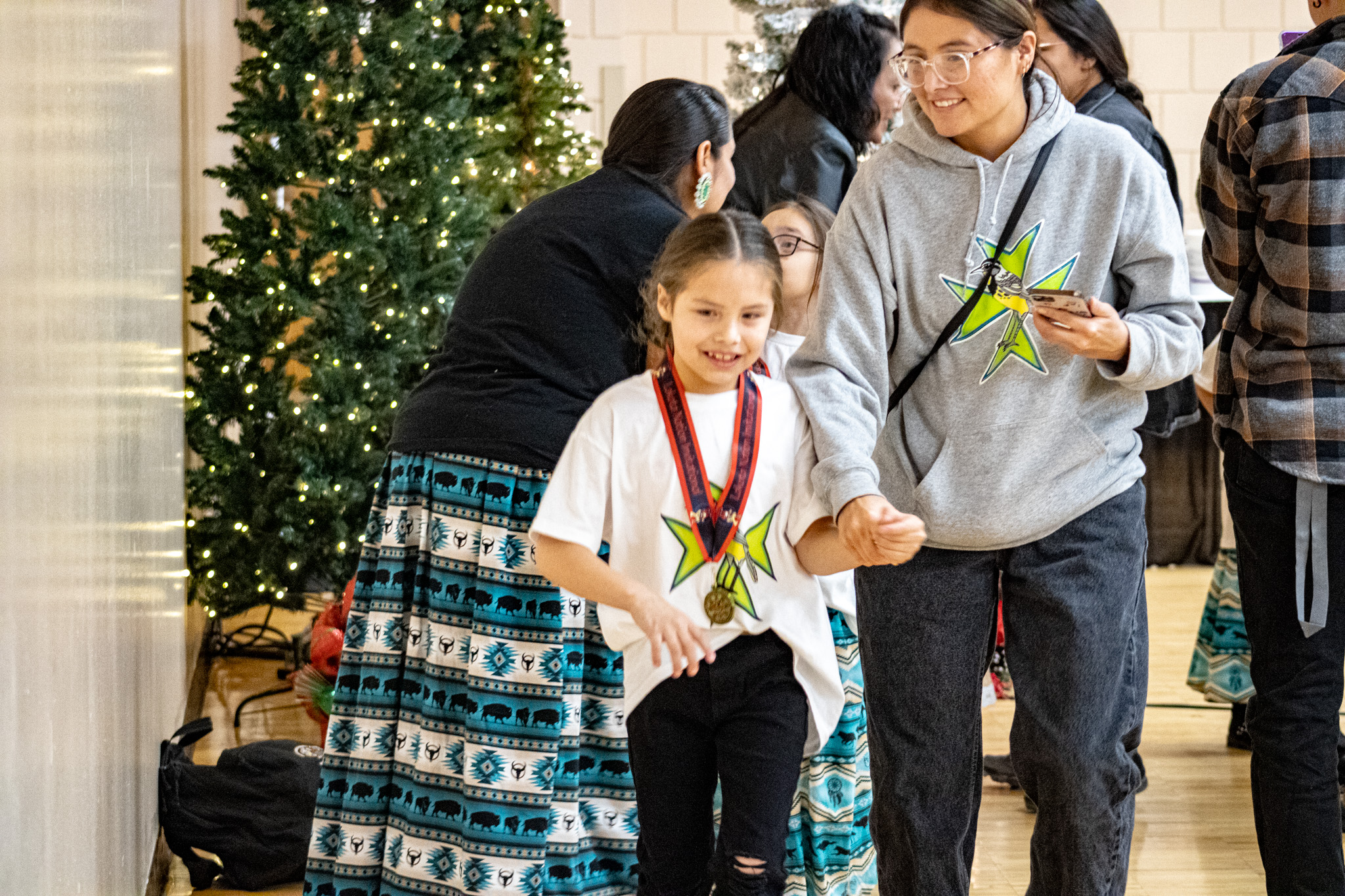
While many know the Lakota Nation Invitational for its basketball tournament, the five-day competition is also a way for youth to engage in their culture. Every year LNI offers traditional hand games, Lakota language competitions, archery and a youth powwow.
For over 20 years, the Lakota Language Bowl has been an important part of LNI. Here, kids are encouraged through friendly competition to speak their Indigenous language and express themselves in Lakota or Dakota.
The three-day competition starts on the second day of the tournament and ends on the last day. The first day is for kindergarten through elementary students, the second day is for middle schoolers and the third is for high school students.
On Wednesday, Dec. 13, Quick Bear and the rest of the Tasiyagnunpa Tatanka team participated in the morning during the kindergarten through second-grade competition.
“Our ultimate goal is to make this something they want to do on their own,” said language bowl director Corey Yellow Boy, Oglala Lakota.
This year, 20 teams competed in the K-12 competition from South Dakota and Minnesota.
“This gets them speaking the language more,” said Ilijah Coleman, Oglala Lakota, and a language teacher from the Wolf Creek School. “(Being a teacher), it feels really empowering knowing they’re learning from me. It lets them know who they are.”
Teams participated in a skit, traditional song, speed vocabulary and picture descriptions. Teams buzz in and answer. If they answer incorrectly, the next team has the chance to respond. Teams are judged on their accuracy and pronunciation.
“I was a Lakota language teacher for years prior to being a para(professional), I think it’s good to have the children know about their language and culture. No matter what, the language is always going to be the same,” said Dori Pille, Oglala Lakota and a language bowl volunteer.
Quick Bear’s team performed a skit about the meadowlark (Tasiyagnunpa). The meadowlark is who gave the Lakota people their language. In the skit, a child dressed as a meadowlark and the other children thanked her for bringing them the language. Another team from Wakanyeja Ki Tokeyachi performed a skit about a traditional buffalo hunt.
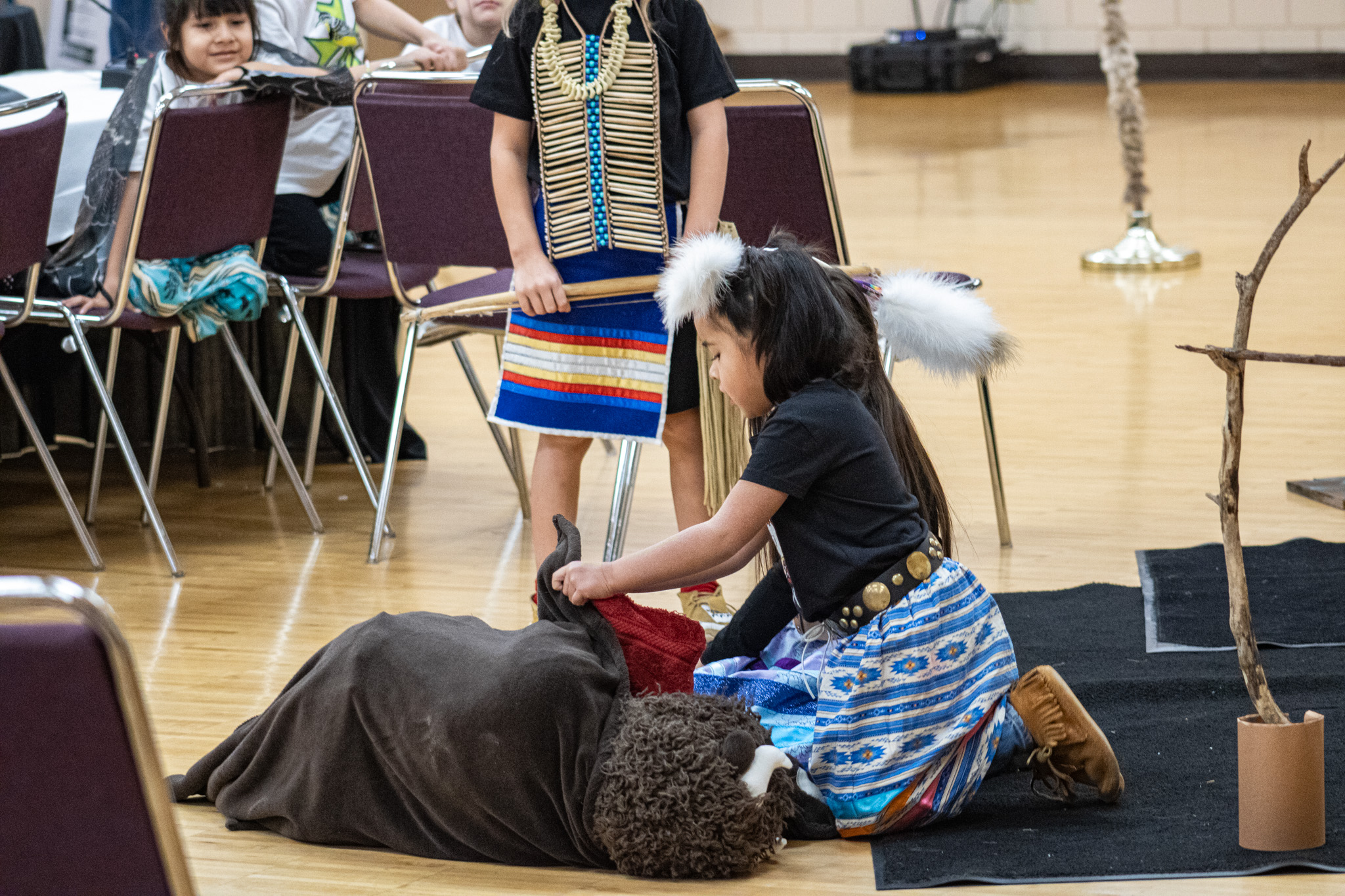
“To see the little kids up there singing, dancing, doing their skits, it makes me proud,” Pille said.
The crowd, filled with relatives, smiled and laughed as they watched the young children sing and act out their skits. Children dressed in traditional Lakota clothing. The first-place team girls wore traditional Lakota t-dresses adorned with teal ribbons. An older team wore vibrant ribbon dresses with tiny cradleboards, their baby dolls nestled tight in the moss bags.
“Keeping the language alive is going to take so much from everybody here,” Yellow Boy said. “There’s no magic formula to increase understanding or anything. It takes hard work and dedication, repetition, it has to start at home. Our language shouldn’t just be something you hear at school or ceremony.”
Quick Bear’s team is coached by their parents and grandparents. The team met three times a week for two or three hours since early November to practice for the language bowl competition.
For their picture description, the kids had to describe a photo of a family. Each child took turns describing in Lakota what they saw in the photo. Dillon watched from the coaching session as her grandson carefully described every aspect of the photo.
“When it comes time for this competition, everyone knows it’s time to go, sometimes these kids are at school for 11 hours a day with school, after-school programming and language bowl practice,” Dillon said. “We’ve had a lot of long days preparing, and this shows how involved the parents are.”
Quick Bear is surrounded by the Lakota language. His school teaches in Lakota. Classes there are small, with about six children per class.
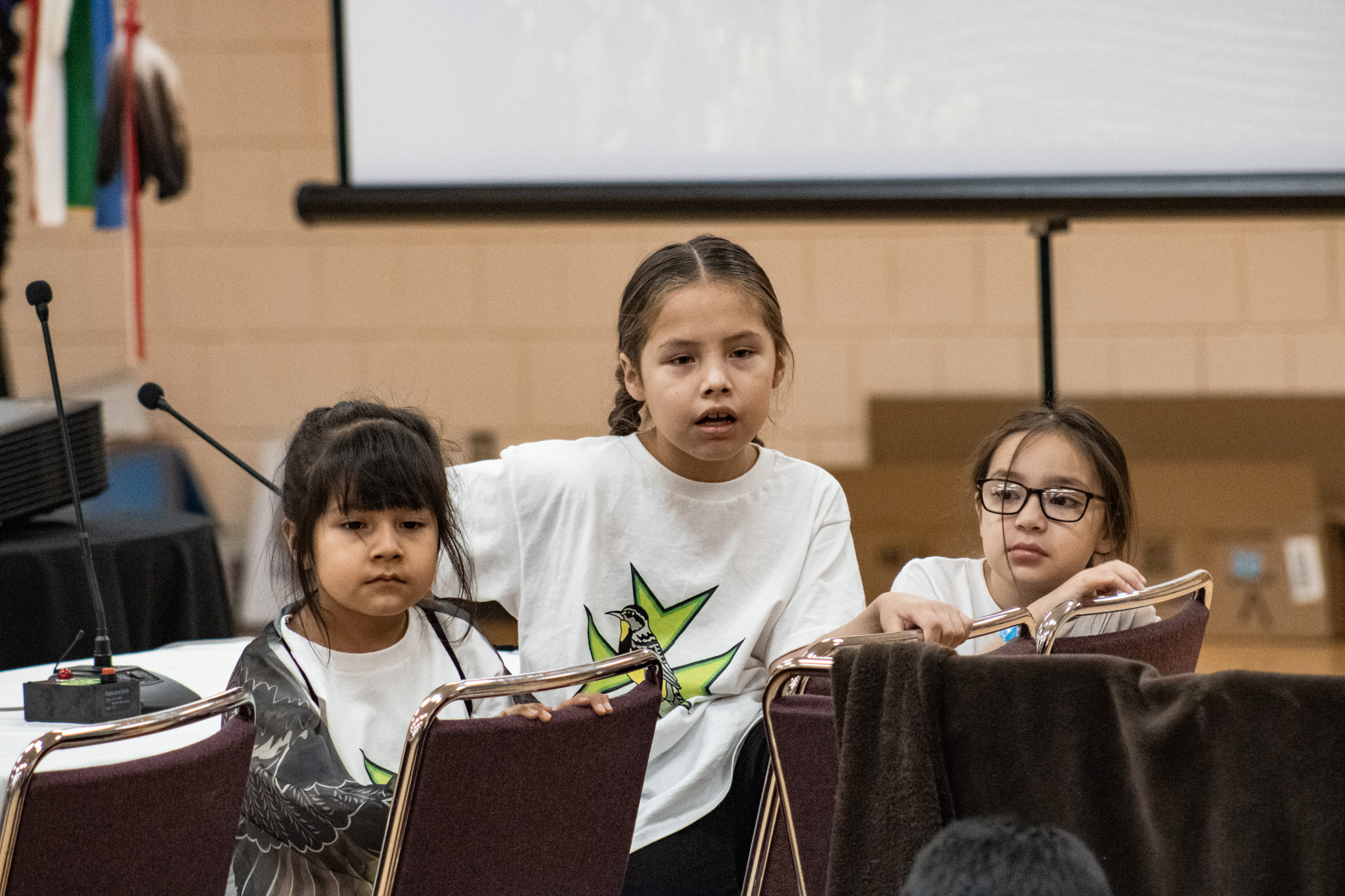
When Quick Bear’s mom accepted a job in Eagle Butte, the family chose to have him stay with his grandparents so he could continue his education at Wakanyeja Ki Tokeyachi.
“That’s how much we believe in the school,” Dillon said. “He’s learning leaps and bounds there.”
Next year when Quick Bear participates as a third-grader, he’s set to be fluent in Lakota. His grandma will be with him every step of the way.
“I’m so proud of him,” Dillon said.
For next year, language bowl organizers are planning on making the competition more based on fluency rather than memorization.
“We want to revamp and push harder for a total physical response, the ability to hold conversations and to make changes for more fluency-based responses,” Yellow Boy said. “COVID really affected our participation and we’re trying to get caught up and rebound. We’re hoping a change in categories will motivate other schools to come.”

This story is co-published by the Rapid City Journal and ICT, a news partnership that covers Indigenous communities in the South Dakota area.
Our stories are worth telling. Our stories are worth sharing. Our stories are worth your support. Contribute $5 or $10 today to help ICT carry out its critical mission. Sign up for ICT’s free newsletter.

