
This story was originally published by Grist.
Miacel Spotted Elk
Grist
In 2020, when Brian Mason began his first term as Chairman for the Shoshone-Paiute Tribes of the Duck Valley Reservation, gold miners came calling. Just a few years before, Integra Resources, a Canadian mining company, had acquired an abandoned gold and silver mine on the tribe’s homelands in southwestern Idaho, but before work began, they had an unusual request: Could the tribe and the company establish a partnership that would benefit both?
“There are a lot of things that were different as we started to work with Integra,” Mason said. Early efforts included invitations to tribal members to the mine while impact studies were conducted as well as initial site surveys.
Historically, mining has been ecologically costly and even deadly to Indigenous peoples around the world. The industry is also notorious for ignoring meaningful consultation with Indigenous communities and outright ignoring human rights. Even in the United States, mining companies have often operated with carte blanche in Indian Country.
Last month, for instance, the Nez Perce Tribe, located north of Duck Valley in Idaho, sued the Forest Service for approving an open-pit gold mine that the tribe says will pose cultural and ecological risks to their homelands. In Arizona, a proposed copper mine on Oak Flat, a sacred site, has been in and out of court since 2014, and ongoing resistance has led President Donald Trump to call tribal members who are against the mine “anti-American”.
For Duck Valley, the question was: How do you draw up an agreement that benefits the tribe with an industry that has thrived on theft and dispossession? The answer was surprisingly simple: Include the nation as development partners in a framework that recognizes tribal sovereignty and self-determination.
Mining operations, and most especially projects connected to transition minerals, become more expensive when companies mine in Indigenous territories without working with Indigenous peoples. In 2023, a federal judge ruled that Enel Green Power, a wind turbine developer, trespassed on Osage Nation lands when it built a wind farm, creating a legal precedent that has shifted the way developers navigate projects and made meaningful tribal consultation a cost-cutting measure for businesses.
“We don’t do this as an ideological sort of effort,” said Mark Stockton, Integra’s vice president of sustainability, with regards to the Duck Valley deal. “It creates resilience in our business. It creates predictability and durability.”
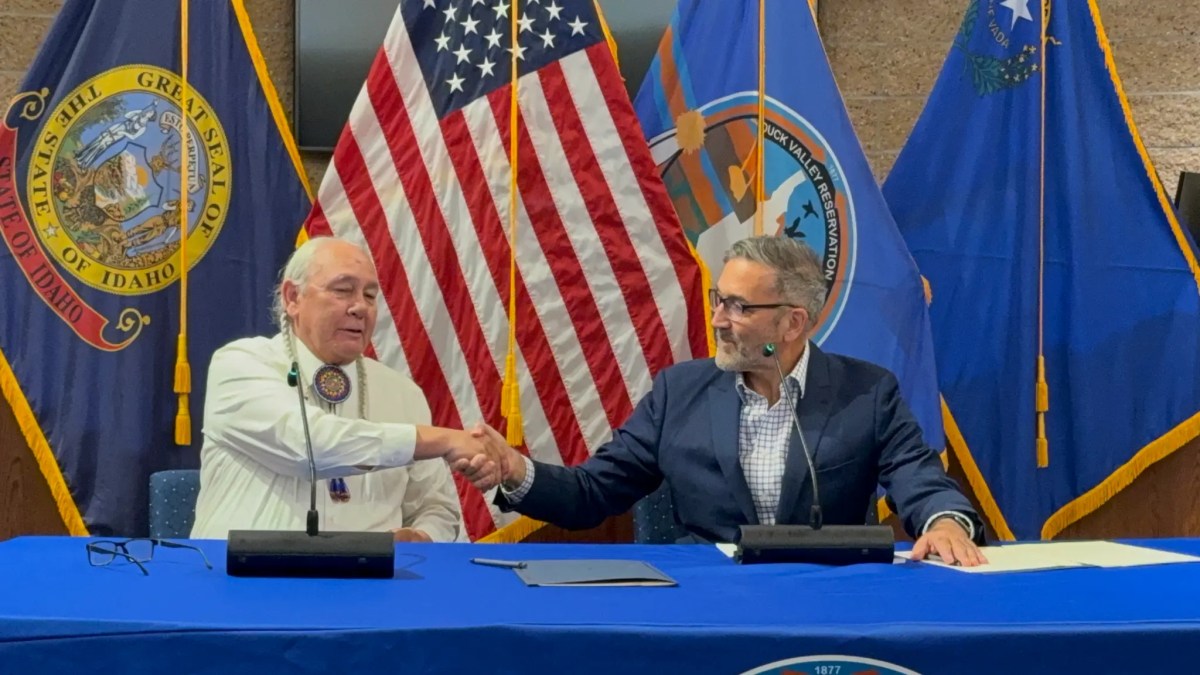
Last month, the Shoshone-Paiute and Integra signed a legally binding agreement to develop and oversee the gold and silver mining project, sharing profits and establishing, within the decade-long timeline of the mine’s active operations, initiatives that will support the tribe’s economic development and language revitalization efforts. But what makes the agreement stand apart from others is its commitment to the United Nations Declaration on the Rights of Indigenous Peoples, or UNDRIP, an international standard for the rights of Indigenous peoples. While other projects, such as the Anahola Solar Project in Hawaiʻi, coordinated a partnership with Indigenous Hawaiians under an UNDRIP-style framework, Integra says its agreement with Duck Valley is a first in the Lower 48.
Maranda Compton, the Founder of Lepwe, an organization that consults tribes and developers in sectors such as mining, focuses on agreements and publishing guidelines that benefit tribes in other sectors through UNDRIP. “My joke is always that consultation is basically the federal government coming to a tribe and saying, ‘How much do you hate this project on a scale from one to you’re going to sue us?’”
Compton co-authored a white paper earlier this year with the Tallgrass Institute, an organization focused on Indigenous economic stewardship, detailing the way industries are shifting to respect UNDRIP and pursue coordination with tribal nations, a move that includes developers engaging in revenue sharing and continuous oversight over projects with tribes.
Chairman Mason says the demand for metals and minerals has a big impact on his tribe, especially in the neighboring state of Nevada, where Shoshone-Paiute lands are also located. “If Nevada were its own country, it’d be the fourth-largest gold producer in the world,” he said. But the state’s also been embroiled in multiple disputes with tribal nations — notably, the Thacker Pass mine project, the largest known deposit of lithium, a mineral used for electric vehicles and a sacred site for tribes, including the Reno-Sparks Indian Colony and Summit Lake Paiute. Beyond a lack of meaningful tribal consultation to mine Thacker Pass, generating an international rights violation report by Human Rights Watch, Mason noted there are no profit-sharing agreements in place and none have been proposed. On top of that, federal mining law allows companies to claim land cheaply while avoiding payments on royalties for use of that land.
“The tribes have never been subject to any of that revenue,” said Mason. “We’ve argued with the U.S. government on that, we’ve argued with the state about it, trying to get some revenue to the tribes in some form of a mineral tax.”
But many tribes in the region, including the Shoshone-Paiute, are known as “nonrevenue” tribes: a tribal nation with an economy solely supported by grants and federal funding. For the Shoshone-Paiute, that has meant 85 to 90 percent of all revenue comes from federal sources. But because funding is contingent on available funding, nonrevenue tribal economies are often unstable.
Tribal nations receive federal assistance as a result of signing treaties with the United States. In exchange for large swaths of land, the federal government agreed to provide support to said tribes. However, in a report released by the Government Accountability Office last year, auditors found that it was unclear how much of the $32.6 billion in tribal funding and assistance actually went to tribes. That funding is also expected to decrease. In a 2026 budget request to Congress, the Trump administration has proposed cutting funding to the Bureau of Indian Affairs by $617 million.
According to Arnold Thomas, the tribe’s Vice Chairman, the tribe’s economy, alongside other tribes in Nevada, has always struggled. By bringing in revenue from mining and gaming, Arnold believes this will move the tribe to “becoming self-sufficient and exercising their sovereignty.”
While details of the agreement are confidential, the tribe says that they wouldn’t participate if the revenue wouldn’t have been enough to fund their projects. Now on the horizon: a tribal health care system and language revitalization efforts to stem the loss of fluent speakers. “The funding will assist us,” said Thomas, “enhancing our teaching modalities, infrastructure, and medical needs.”
“I hope folks view this as not the gold standard, but the new standard,” said Compton.
