
Kalle Benallie
ICT
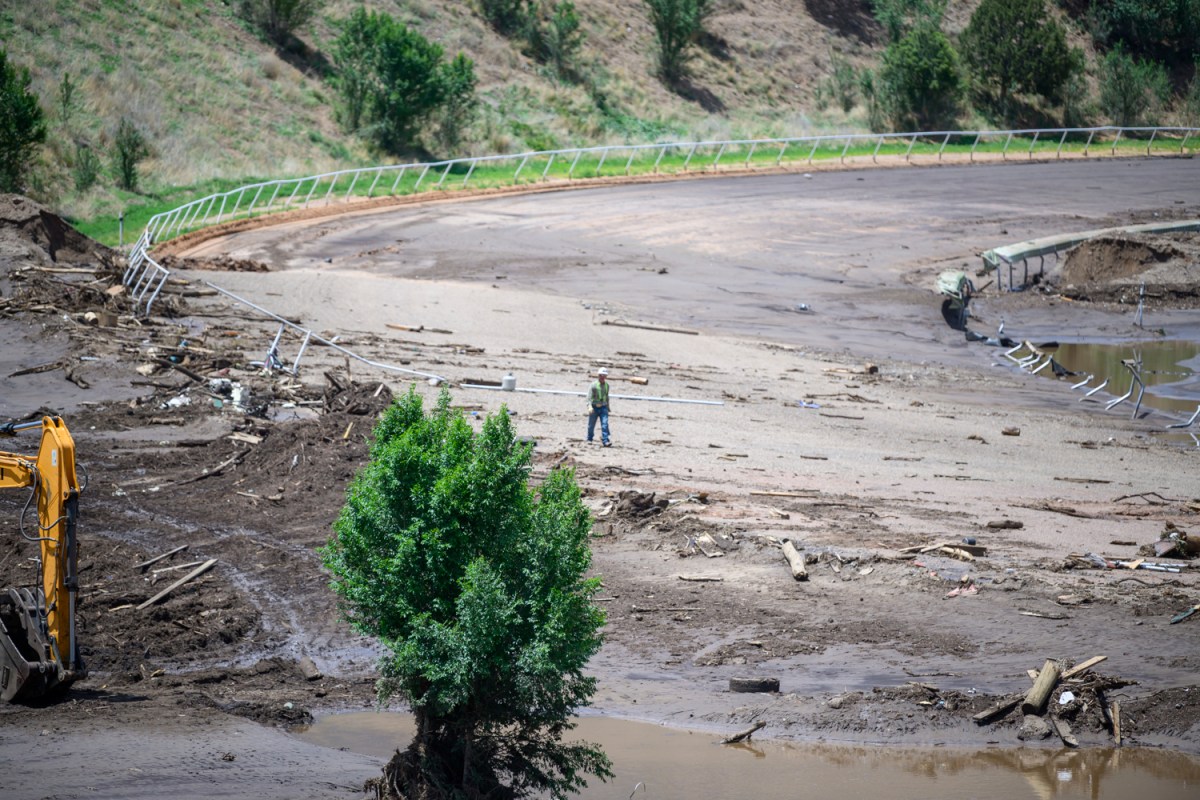
Zacahariah Ben, a sixth generation farmer from Shiprock, New Mexico said he grew up watching the San Juan River flow by and sustain life. Now it has caused devastation to his farmland.
He has two farmlands, one in Aztec, New Mexico which is along the Animas River and the other in Cudeii, a chapter of the Navajo Nation located in San Juan County, New Mexico, that was flooded. It’s about 30 acres and is west of Shiprock.
He and his wife have been farming there for the past five years for their products of Bidii Baby Foods.
They had a 100-foot greenhouse, that was also used as a shared space with local Shiprock farmers, that contained 10 trunkloads of corn. They were damaged from the shared space and Ben estimated with their accountant that they have an $85,000 loss.
“That we won’t be able to get back and that’s including product and the infrastructure that was established there on that plot,” Ben said
Navajo Nation President Buu Nygren posted on Facebook on Tuesday that the flooding has saturated soil and damaged infrastructure, increasing the risk of hazardous conditions.
“Residents are encouraged to avoid flooded roads, washes, and damaged bridges; follow evacuation instructions and official road closures; and remain alert for changing river conditions. Do not enter flood-damaged structures until authorities determine they are safe,” Nygren said.
The Navajo Nation is still under an emergency declaration and chapters are encouraged to continue documenting storm damage, communicating urgent needs and coordinating with the Navajo Department of Emergency Management.
Ben said they were going to use the plot of land for their Farmer-in-REZidence program, where under 30 year old farmers have the ability to gain access to farmland, some water, and irrigation access. The program was created to increase production of aggregation of traditional foods.
Ben said it’s all underwater. It’s additionally devastating because three wastewater treatment plants were breached in Shiprock, Kirtland and Bloomfield.
The Navajo Tribal Utility Authority is advising residents to avoid contact with the San Juan River downstream of Montezuma Creek , which is located in southeastern Utah, until further notice.
“Nobody is allowed to go back and do some recovery efforts due to all of that raw sewage — just to keep you a perspective, that’s gonna be affecting us long term, because a lot of that is now sitting in our soil,” Ben said. “That’s gonna go under immediate remediation next season. No food production will be happening and because of that, we don’t see a return of investment. Except continuing to heal the land that has now been affected by the floods of San Juan County this time around.”
He said it will take decades to recover.
Ben said the individual farmers can’t get their own policy because farming on the Navajo Nation operates as one unit. They are able to attain grazing land-use permits, agricultural land-use permits and receive funding through drought but they cannot have their own farming track number through the Farm Service Agency of the U.S. Department of Agriculture office.
If individual farmers could have their own policy they could apply for equipment grants and emergency funding
Ben recommends for the Navajo Nation to have long-term sustainability or remediation plans like working with FEMA to map out floodplains to avoid critical infrastructure to food systems and irrigation, have an updated irrigation system, a contingency plan for reservoirs, critical funding for producers and working with EPA to understand the chemicals or toxicity is in the contaminated soils.
“I feel like that’s where Navajo Nation is not having a good track record for collaborating with federal and state entities, and I feel like this would be one of the moments that would be critical in order to bring relief to our food systems that have been adversely affected…” Ben said.
Kelbie Kennedy, Choctaw, is a former tribal advocate for FEMA from 2022 to 2025. She said that she has worked with the Navajo Nation on flooding and that they do have an “excellent tribal relations team.”
She said the process is sovereign-driven as Navajo Nation President Buu Nygren would have to be in contact with FEMA’s regional administrators, then FEMA headquarters which would then go to President Trump to request an emergency declaration or a major disaster declaration.
“I will say that FEMA can coordinate with the tribe beforehand, and we often did at my time at FEMA, where we coordinated with tribal nations, even when they didn’t have a disaster declaration, but you are kind of limited on everything you can do when you do not have a disaster declaration in place,” she said.
There are 10 regions that FEMA is organized in; the Navajo Nation typically worked with region 9. She said she hasn’t seen any coordination with FEMA and the Navajo Nation but it may not have been made public.
“When the tribe reaches out to FEMA, usually the region and headquarters, but especially the region, in addition to the tribal relations staff, will also have other members of their team from response to recovery, maybe communications, also working with tribal affairs to start asking the tribal nation what they need, what kind of support can they get,” Kennedy said.
She added that if a tribal nation doesn’t get a disaster declaration FEMA may still help with connecting them with other resources like a nonprofit, a private sector, with the state, local governments, or fellow tribal nations.
“My sincere hope is that not only does FEMA step up where the Navajo Nation wants to see them step up, but that the support that those individuals need, both on an individual level and on a more substantial national level materializes because disasters don’t know political lives,” she said.
Kennedy was the last tribal advocate in FEMA. David Flute is the closest as he is the senior tribal advisor on Indian Affairs for the U.S. Department of Homeland Security, which FEMA operates under.
Ben said they are searching for rapid response funding for themselves and through their nonprofit called the “Ben Initiative.” They have a relief fund for farmers too and are distributing “Bidii Buckets” filled with their farm produce and baby/toddler food items to the communities affected.
“Corn pollen purchased will also be distributed to local families to support spiritual well-being. Donations to the Farmer-in-REZidence program will be shared with FiR graduates whose farms were directly impacted by the floods,” their website states.
“We’re able to pull in fiscal sponsorship and for a Farmer-in-REZidence program, but also physically sponsoring in moments like this as a great example, being able to pull in rapid response funds, and redistributing that to those that have been affected directly by these floods,” he said.
Ben said right now they don’t know exactly how many farmers have been affected and it’ll take about a week or more to understand.
“Since it’s considered a hazmat situation, a lot of people are staying at their neighbors, their family members, or in shelters, so we don’t know who and how much has been affected as of yet,” he said.
He said to help the communities that have been affected is to support your local agriculture or go to farmer’s markets that support them directly.
“Especially those that have been affected by the flood. I know they’ll be continuing to get products outside, knowing that they’re going to have to recover some of their losses. Support the,” Ben said.
He said they are currently prepping for the next storm that is arriving on Friday through Sunday.
“It’s supposed to equate to the same amount of moisture that we received because of the floods, and now that the soil here is already saturated, we’re predicting rising river levels once again,” Ben said.
