
Amelia Schafer
ICT
ST. PAUL, Minnesota — An Anishinaabe Kwe — an Ojibwe woman — made history Tuesday, becoming the first Native woman elected to the U.S. Senate.
A surge of votes late Tuesday from Minneapolis — a center for the state’s urban Indigenous community — pushed Lt. Gov Peggy Flanagan to a solid 54 percent of the vote over Republican opponent Michele Tafoya’s 43 percent in the race to replace Democratic U.S. Sen. Tina Smith.
Flanagan, White Earth Nation, was one of three Indigenous women in the general election with the potential to make history on Election Day as the first Indigenous women to serve in the upper chamber of Congress.
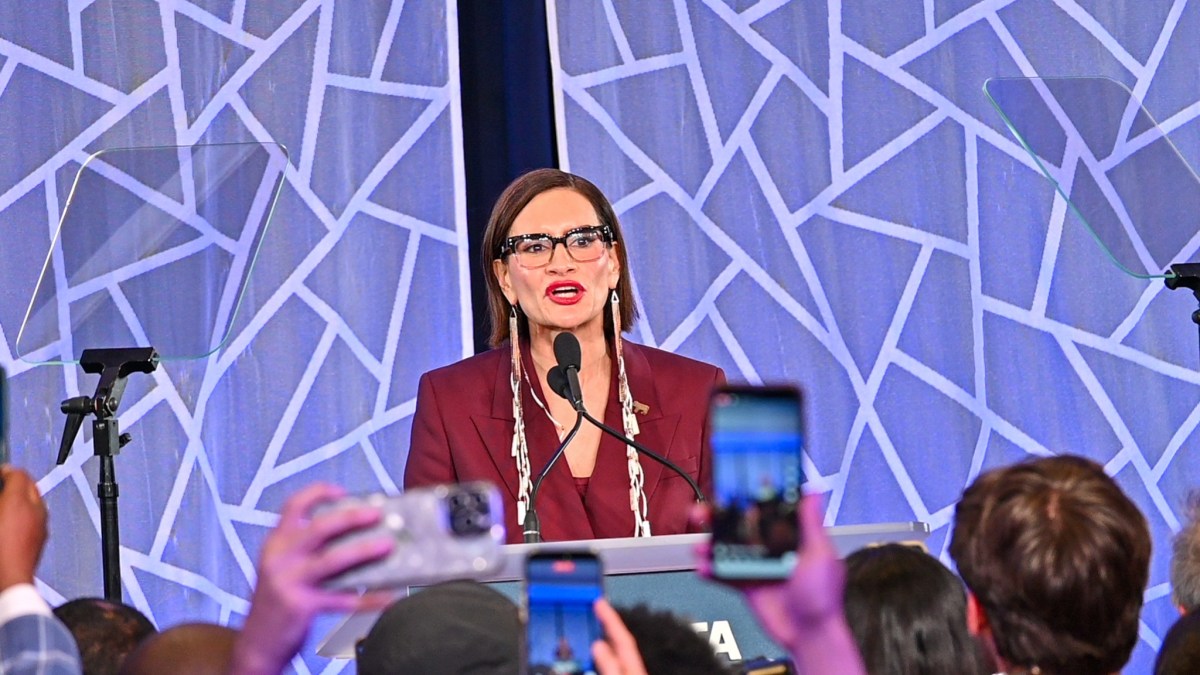
She spoke to the crowd gathered at her watch party late Tuesday following a performance from a White Earth Nation drum group brought in by White Earth Nation Chairman Michael Fairbanks to perform a victory song celebrating her historic win.
“You’ve helped me become the first Native American woman in history to be elected to the United States Senate,” she told the cheering crowd. “To the young people out there who look like me, to the daughters and to the sons too often forgotten or erased, I see you. Do not be disheartened that it took 250 years for one of us to get here. Be inspired by the fact that with grit and determination and the resilience of our people, whichever one of you is next, you’re going to get here a lot faster. Because if Auntie Peggy can do it, you can do it, too.
“People will underestimate you,” she said. “Do not let them. You know who you are, you know where you come from and you know what you can do. There is no stopping you from achieving your dreams, and there is no stopping Minnesota.”
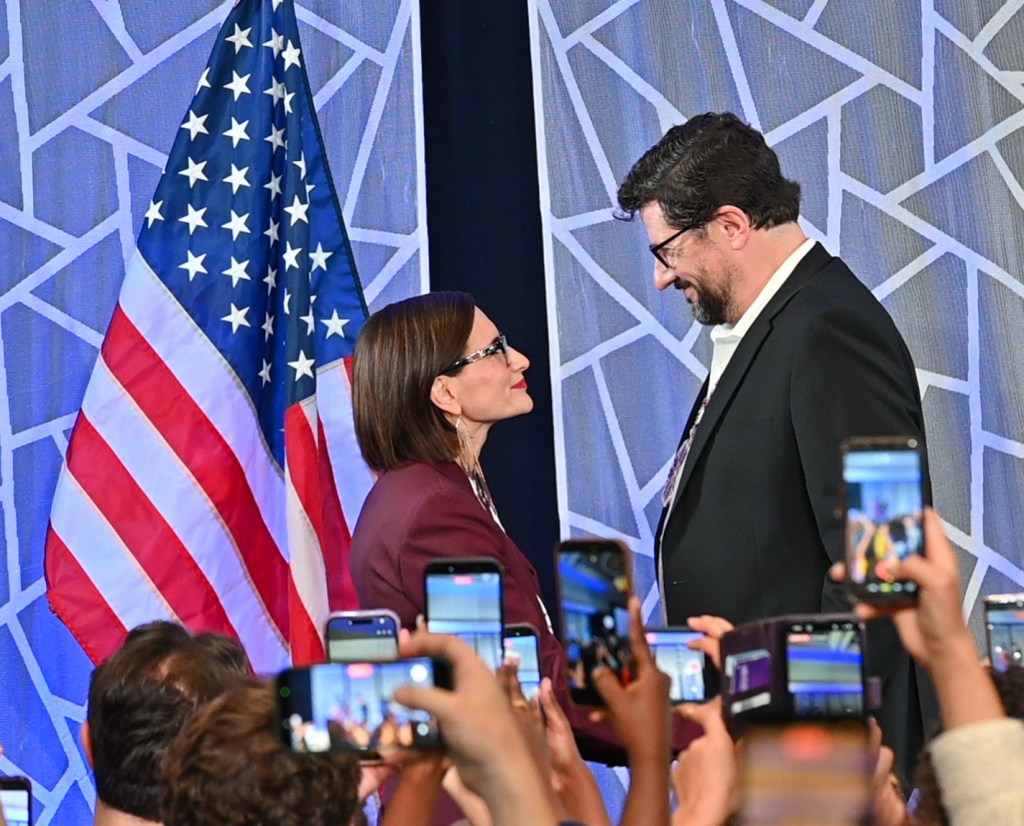
Flanagan also spoke about her father, the late Marvin ManyPenny, an Indigenous activist, and the role he and her mother played in getting her to where she is today.
“He used to say, ‘My girl, I want to burn this system to the ground and you want to change it from the inside out,” she said. “Well, Minnesota, that’s what we did tonight.”
Flanagan could be joined in making history in the U.S. Senate by Mary Peltola, Yup’ik, a Democrat running for the Senate in Alaska, where she was neck-and-neck with Republican incumbent Sen. Dan Sullivan shortly after the polls closed. Results may not be final for more than a week, however, because of Alaska’s remote communities and a complicated ranked choice voting system that kicks in if no candidate gets more than 50 percent of the vote.
Democrat N’kiyla “Jasmine” Thomas, Chickasaw, also made a run for the U.S. Senate but lost Tuesday to her Republican opponent in Oklahoma.
The races came amid a heated midterm election in which Democrats were seeking to flip control of the U.S. Senate in their favor. Democrats needed to flip four seats from red to blue in order to reach a 51-seat majority — and they did. Flanagan is a member of the Democratic-Farmer-Labor Party, the Minnesota affiliate of the Democratic Party.
Early polling leading up to the general election had shown Flanagan with a slight edge, appearing to lead Tafoya, a former sports broadcaster, by about 3 percentage points, according to the Cook Political Report, an independent nonpartisan election analysis organization. She also received key endorsements from former President Barack Obama, former U.S. Secretary of State Hillary Clinton, and Democratic U.S. Sen. Bernie Sanders of Vermont.
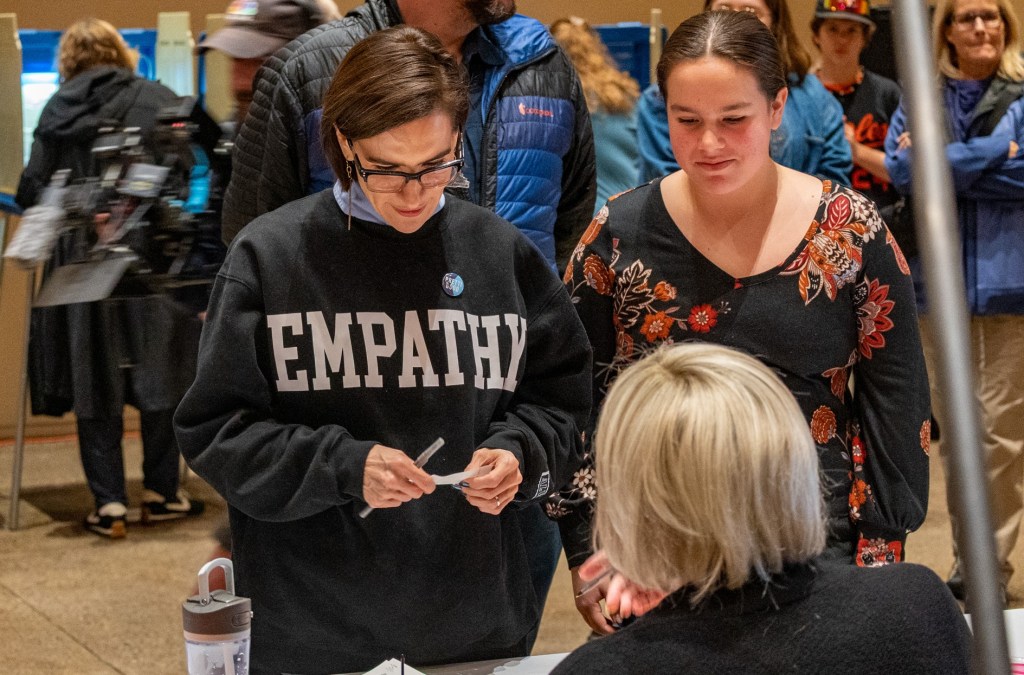
Flanagan, whose Ojibwe name is Gizhiiwewidamookwe (speaks in a loud and clear voice woman), is from the wolf clan of the White Earth Nation and of Irish descent. She spoke to reporters after casting her vote at 11:30 a.m. in St. Louis Park, Minnesota, a suburb of Minneapolis. Flanagan’s 13-year-old daughter, Siobhan, and husband Tom Weber joined her at the Wat Promwachirayan, Thai Sunday Market.
“Native women have been leaders since time immemorial and now we’re able to run, and my hope is win, all across the country,” Flanagan said during a press conference Tuesday morning. For a really long time, we’ve seen that the Native vote can make a difference in electoral outcomes. Thirty years later, we are now running for office and in many cases are frontrunners, and that gives me a tremendous amount of hope for our future.”
Over 1 million people, a record number of Minnesotans, voted early this year, according to the Minnesota Secretary of State’s Office. But while polls closed at 8 p.m. Central Time in Minnesota, voters in the Red Lake Nation reported hour-long waits to cast their ballots as of 8:30 p.m. according to Holly Cook Macarro, a Red Lake Nation citizen.
Waiting for returns
Supporters remained optimistic waiting for returns to trickle in.
“We know it’s gonna happen, the first Native American female senator, she’s gonna come from Minnesota,” said Louise Matson, White Earth Nation and a Flanagan supporter who attended the watch party Tuesday night. “I think we’re going to be thrilled by what we see when we get her into the senate and what’s going to happen. It’s going to change things.”
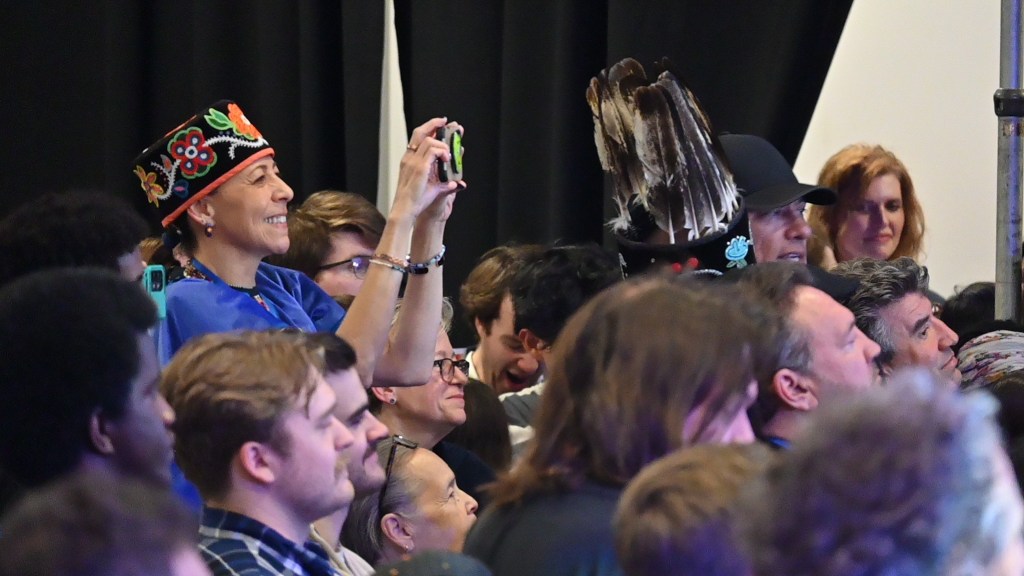
Danielle Grant, Little Shell Ojibwe and a Flanagan supporter, also attended the watch party Tuesday night.
“I can’t wait for the rest of the country to get to know Peggy,” Grant said, “Because she is absolutely the real deal and she is incredible.”
Flanagan previously served in the Minnesota State Legislature from 2015-2019, leaving to serve as lieutenant governor under Gov. Tim Walz. She was temporarily seated to become the nation’s first American Indian woman governor in 2024 after Walz was selected to be the vice presidential candidate with Democratic presidential nominee Kamala Harris.
“She’s just done a phenomenal job as lieutenant governor,” said Jodi Archambault, Hunkpapa and Oglala Lakota and former deputy assistant secretary of the interior for Indian affairs. “So she’s going into the race with familiarity within the population.”
Archambault also served as special assistant to the president for Indian affairs on the White House Domestic Policy Council from 2012-2015 in the Obama-Biden administration.
Falling short in Oklahoma
Thomas fell short in her bid to defeat Republican opponent Kevin Hern in a fight to fill the seat vacated by Markwayne Mullin, Cherokee Nation, who stepped down to take over the U.S. Department of Homeland Security in the Trump administration..
Hern was declared the winner shortly after the polls closed as he led with about 60 percent of the
Those options narrowed late Tuesday, however, after Thomas’s Republican opponent, Kevin Hern, was declared the winner by The Associated Press. Hern was leading late Tuesday with about 57 percent of the vote to Thomas’s had about 60 percent of the vote to Thomas’s 39 percent, and he was declared the winner by The Associated Press.
Thomas, 31, a licensed practical nurse from Ardmore, Oklahoma, made headlines this summer when she became the first Democratic Socialist to win the nomination of Oklahoma’s Democratic Party.
It would have been her first time to serve in public office, and Oklahoma has not elected a Democratic candidate to the Senate since 1990.
Hern received an endorsement from President Donald Trump on March 13 after the president had chosen Mullin to replace former Homeland Security Secretary Kristi Noem.
Alaska race
Peltola has been working to unseat the incumbent senator in a field of four candidates who advanced from the nonpartisan primary to the general election.
Peltola was trailing by about 1 percentage point with 54 percent of voting locations counted, according to The Associated Press late Tuesday.
Peltola, 53, previously served in the U.S. House representing Alaska’s only at-large congressional district from 2022 to 2025. She also served in the Alaska Legislature as the representative for House District 39 and later for District 28 before losing her bid for re-election.
Alaska utilizes ranked choice voting and accepts absentee ballots up to 15 days after the election to accommodate rural voters whose ballots are brought in by boat or plane, according to FairVote, a nonpartisan voter advocacy group. Once the initial ballots are counted, the second-choice options are tabulated to calculate a projected winner if no candidate exceeds 50 percent.
Peltola would become the first-ever Alaska Native as well as the first Alaska Native woman to serve in the Senate.
Alaska could face a heated legal battle, however, which could further delay the state’s Senate results. A lawsuit filed by the Department of Justice in late October had sought to block certification of the winner if incumbent Republican Sen. Dan S. Sullivan loses the race. But a judge Sunday threw out the lawsuit.
The suit had argued that the presence of a candidate with a similar name, Dan. J. Sullivan Jr., could have confused voters who wanted to re-elect the incumbent senator. Dan J. Sullivan filed for office as a Republican candidate, but the Alaska Republican Party rejected his candidacy in the general election. His name appeared on the ballot without a party affiliation.
“They’re [the Department of Justice] just going to fight the results,” Archambault said. “And to me what that’s saying is that she’s ahead and she has a great chance of winning.”
Alaska had been regarded as a toss-up, with recent polls like Data For Progress showing Peltola with a slight lead over Sullivan and Democrat-leaning pollster Public Policy Polling showing a one-point lead for Peltola.
Less than a week before the election, Peltola announced a pause on all campaign appearances for several days following a car crash on Saturday, Oct. 24. Peltola said she and her family were leaving a campaign event when another driver struck their vehicle, leaving the candidate with minor injuries.
There are currently no sitting Indigenous senators. Mullin held the seat until stepping down March 23 following his appointment as secretary of the Department of Homeland Security.
Oklahoma Republican Gov. Kevin Stitt, Cherokee Nation, appointed energy executive Alan Armstrong to temporarily fill the open seat. Under Oklahoma law, however, an appointee is legally barred from running as a candidate in an upcoming election for the seat to which he or she was appointed.
On the heels of her historic win in Minnesota, Flanagan spoke about the role of her clan and how she plans to carry its values into the senate.
“The name you voted for on the ballot says Peggy Flanagan, but my Ojibwe name is Speaks in a Loud and Clear Voice Woman,” she said. “The role of our clan is to ensure we never leave anyone behind and that’s been the purpose of our campaign. We refuse to let this country leave anyone behind.”
