
Sandra Hale Schulman
Special to ICT
As a Native filmmaker nominated for an Academy Award for “Sugarcane,” his documentary about his father and Native boarding schools, Julian Brave NoiseCat has more to add to the story. Much more.
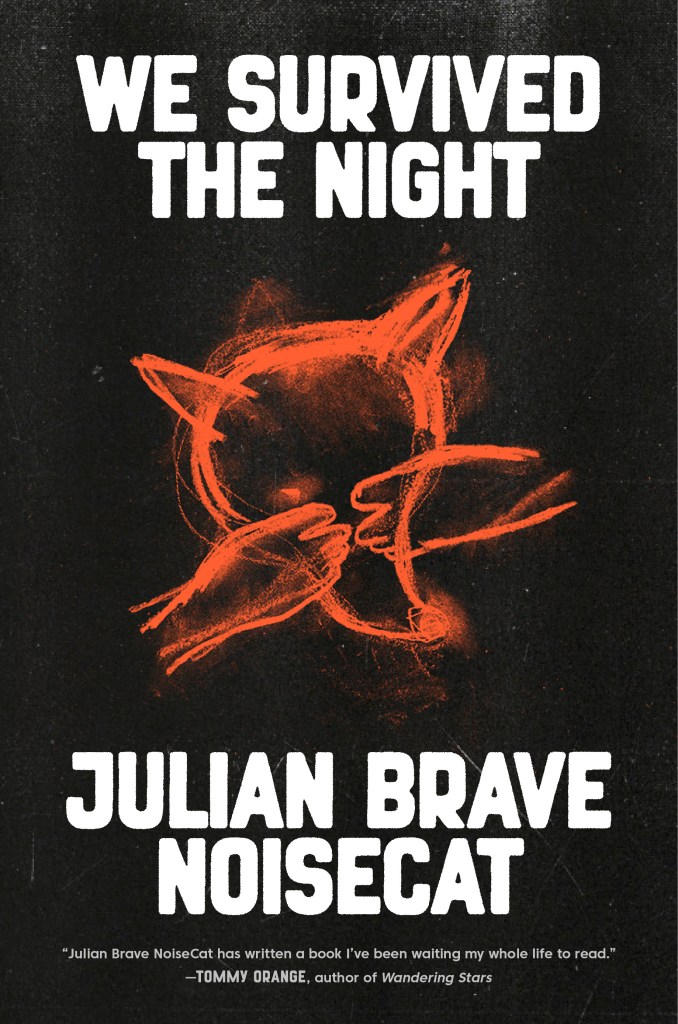
In his new book, “We Survived The Night,” which came out on October 14, the day after Indigenous Peoples’ Day, he digs deep into his family history, focusing on his estranged father, Ed Archie NoiseCat, who was abandoned at birth and found in a carton by an incinerator at a boarding school.
Trauma and restlessness and broken families follow Archie the rest of his life as he abandons Julian. To make sense of this pattern and behavior, Julian looks to coyote stories in a narrative nonfiction book that combines investigative journalism, folklore and a deeply personal father-son journey in a searing story of a community fighting for survival in a fractured nation.
“Technically the book started a little bit before the film,” Julian told ICT.” Some of the reporting in the book comes a number of years before the film, and obviously the life events. The book contract was signed in early 2021 and then we started ‘Sugarcane’ in the summer of 2021, so it was just a few months apart. I was hesitant initially to work on the film because I just signed a book contract and I had never written a book before. I had never made a film either. I didn’t know if I could do both at the same time.
“The initial conception of the book was different, but I had always dreamed of becoming a writer. I read Sherman Alexie obsessively when I was a kid. Circumstances brought me the documentary when my co-director Emily Kassie called about the boarding school film she wanted to do.”
Julian goes majorly in depth into coyote creation stories to connect to his personal family story.
“It developed that way organically,” Julian says, ”working on the film about how they wiped our cultures nearly off the face of the earth. It made me think very purposefully about what it is that I do as a storyteller and what traditions I wanted to carry forward. That made me interested in looking at our oral histories, but I never heard somebody tell a coyote story in my entire life.
The coyote stories had been laid low. They were considered nonfiction by our ancestors of how we understood our world. I wanted to take them seriously as nonfiction. As I read them, I increasingly was like, ‘Holy sh*t, this crazy coyote figure makes the world and destroys it at the same time, constantly governed by his id.’
“He’s feasting and chasing women and trying to enlarge his own legend. I see so much of the coyote in my dad, the men in my family and if I’m being crudely honest, a healthy measure of it in myself. I got obsessed with that concept, the idea that what if you did narrative nonfiction as a coyote story in a form that was traditional to our people.”
Julian alternates coyote stories with his family story, contrasting the actions and misdeeds. Some are crude and almost predictable as Coyote messes up time and time again. He also tells first-person stories of his travels across the country, including Standing Rock protests, the election of Deb Haaland, and many more.
“The stories had a lot of relevance to how I see my father, myself, my grandfather, our people and beyond that, the Indian world more broadly which still has a lot of the magic and the ideas and the undercurrents of the coyote story running through it. I see the whole book as a coyote story, it’s organized around Coyote to the sun, Coyote steals a salmon, and Coyote comes back, the big three of the epic misadventures of the trickster.”
There are no photos in the book or even on the cover, only illustration art from the late esteemed artist Jaune Quick to See Smith, Confederated Salish and Kootenai. Why did Julian make that choice?
“Jaune’s people and my people are cousins, more or less. She comes from another Salish nation, hers is from Montana, mine is from British Columbia. When I was thinking about the cover art, I knew immediately that it needed to be a representation of the trickster coyote, and she had some of the best painted representations of the trickster of any artist.”
On the cover, Coyote is covering his eyes. Why that choice?
“Coyote sees the world clearly,” he says. “I think it’s kind of playful, it’s about truth, but it’s also see no evil. He’s the most immoral. We tell stories about his immorality or about his backwards ways as examples to our kids of how exactly they shouldn’t be. But the irony is at the same time the coyote has made so much good in the world. Before colonization and still to this day in a lot of households up in BC, half the calories come from salmon. This guy was essential to the creation of our world.”
Julian got Smith’s permission and a month later she passed away and didn’t get to see the cover. Julian tells another story about when he was in New York City in May on the day when art galleries in Chelsea have their openings. He went to see a friend’s show and then was walking down the street when he looked in a window and saw a show by Smith. He walked in.
“The first thing I’m greeted by is one of her sculptures representing the trickster coyote in a canoe. On the wall behind that is a painting with the trickster coyote. Before Jaune left, she said she was going to visit me from the beyond. We really do believe that our ancestors, particularly in that first year after they’ve passed, can come back and do work here that needs to be done and visit people in a light touch kind of a way. Their presence and power is still here and that’s in the coyote stories; that’s in our traditions. Jaune was of that and one of the greatest painters, not even just Native painters, in my opinion, one of the greatest painters of the last 100 years in this country. She gave me permission to use her work and then winked at me from the beyond.”
Julian spent years living with his father writing the book and then making the film. What is his relationship with his father now? Is there any closure or is it still an evolving relationship?
“I don’t know if there’s ever any closure in these kinds of things, relationships are evolving things,” Julian says. “But we got a lot closer because of the time that we’ve lived together. We get along really well. I consider him one of my best friends now. I came to understand him better and I think he came to understand me better, giving us the grounds to have a healthy father-son relationship.”
Is there another film out of this expansive book?
“Along with the book tour, I’m moving on to next projects,” Julian says. “I’m working on a book proposal right now. I have a pitch for another documentary. My dad’s an artist, I’m an artist in my own different kind of way. I love to write books. I love to make movies. I feel like I live such a blessed life to get to do that and to make a living doing it. It’s also been hard to tell these kinds of stories, it’s taken a lot out of me. I just want to keep making art and telling stories and I want to keep being part of a long tradition of my people sitting around and telling good stories in artful ways and trying to push myself and grow as a storyteller, a writer, a filmmaker, and an artist.”

