
Darren Thompson
Special to ICT
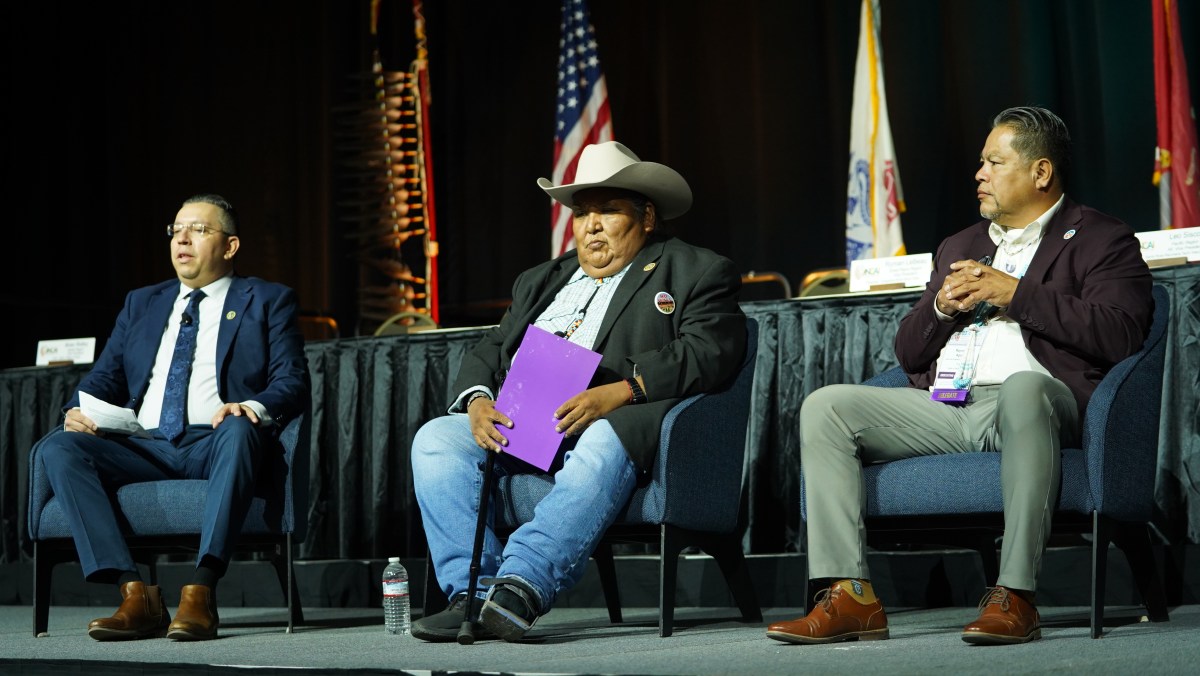
AGUA CALIENTE LANDS — More than 2,000 traveled to the California desert to discuss strengthening tribal sovereignty while navigating the changes in the federal government.
“While we may have made tremendous progress as tribal nations, we are still facing serious challenges,” said Agua Caliente Band of Cahuilla Indians Tribal Chairman Jeff Grubbe on the opening day of the National Congress of American Indians 83rd annual convention from Palm Springs. “Our sovereignty continues to be tested with tax dollar jurisdiction, challenges to our gaming rights, threats to our water resources or attempts to weaken the federal government’s trust and treaty responsibilities.”
Chairman Grubbe continued: “We must remain vigilant, we must remain engaged, and most importantly, we must remain united.”
The annual convention brings hundreds of tribal leaders to voice their concerns regarding land conservation, securing federal funding, supporting a tribal cause, or to hear from federal officials on developments within the federal government.
At each annual convention, tribal and community leaders aim to pass resolutions within various committees and subcommittees so they have a chance to be presented to the entire NCAI delegation. If a resolution is passed in a committee it is then presented to the resolutions committee. If a resolution passes there, it then is presented to the entire delegation where a resolution gains the stamped approval of the oldest, largest, and most representative intertribal organization in the nation. Resolutions are aimed to complement a cause, not serve as a stand-alone declaration.
The full list of resolutions passed at this year’s convention is available online.
Founded in 1944, NCAI supports tribal leaders and tribal issues while headquartered in Washington, D.C., with membership extended to both federally and state recognized tribes. Each year the organization’s president, currently Pechanga Tribal Chairman Mark Macarro, delivers the State of Indian Nations Address in Washington, D.C., during its annual winter executive session.
While there are dozens of initiatives presented and discussed at each annual gathering, here are some of the key issues to pay attention to from this year’s annual convention.
1) Protecting sacred sites, opposing removal of Section 106 of National Historic Preservation Act
One big talking point of the conference was the opposition to a legislation that would remove Section 106 in the National Historic Preservation Act of 1966.
The proposed legislation will weaken or eliminate tribal consultation requirements under Section 106 of the National Historic Preservation Act of 1966, said NCAI and tribal leaders at a press conference on Monday, Oct. 19.
If the bill passes, the legislation can remove the mandatory duty of federal agencies to consult with tribal nations or seek their expertise before approving infrastructure, extractive, or other projects that impact sacred sites, ancestral lands, and cultural resources off Indian reservations.
The bill is now in the Senate Committee on Energy and Natural Resources.
In an effort to oppose new legislation, NCAI announced at this year’s general assembly an initiative to protect sacred sites called “Sacred Then. Sacred Now. Sacred Tomorrow.” The national political organization aims to raise $300,000 to oppose the Bipartisan American Affordability and Jobs Act of 2026, which was introduced to the U.S. Senate on Sept. 30.
The Shakopee Mdewakantan Sioux Community also pledged $50,000 to NCAI supporting the effort to oppose the potential removal of tribal consultation on projects that tribes have historical and cultural ties to.
“For 60 years, the federal government has recognized the essential rights of Indian tribes with regard to cultural and historic preservation,” said Natasha Hacker, vice chair of the Shakopee Mdewakantan Sioux Community, during the convention.
2) Tohono O’odham’s ongoing fight against border wall construction
The words, “No Border Wall,” were visible throughout the conference on buttons, postcards, and information packets. All materials being distributed to attendees, vocalizing the opposition of the border wall construction on the Tohono O’odham Reservation in southern Arizona.
Tohono O’odham Chairman Verlon Jose discussed the tribe’s opposition during a panel at the conference, including a lawsuit filed earlier this year in June on behalf of the tribe against the U.S. Department of Homeland Security’s attempt to build along 62-miles of the tribe’s reservation boundary on the U.S.-Mexico border. The lawsuit says that the construction of the border wall illegally seizes tribal lands and shrinks the reservation, trespasses on sovereign territory, and permanently destroys sacred cultural sites, burial grounds, and religious traditions. The tribe has a law that protects the Saguaro cacti, and grants them personhood, and that their removal for the border wall construction violates their tribal law.
A district court denied the tribe’s request to pause construction and federal attorneys argued that Congress authorized border barrier construction. The administration has also waived dozens of environmental and cultural protection laws to speed up construction, citing other federal laws, including the REAL ID Act of 2005 and the Illegal Immigration Reform and Immigrant Responsibility Act of 1996, that can speed up border wall construction.
“They’re using federal authority, but they do not have the authority to diminish our land,” said Chairman Jose. “They do not have the authority to desecrate our sacred lands. They might have them on paper, but we’re not going to allow them and we need and every one of you stand with Bears Ears, Chaco Canyon, and the Tohono O’odham.”
He emphasized: “If this can happen to us, it can happen to any tribe.”
3) National American Indian Veterans
The National American Indian Veterans organization was highlighted during the opening general assembly, where attendees were able to hear directly from organizational leadership about the history of the organization and its goals.
The 20-year-old organization is the first American Indian veterans association to receive a congressional charter and is a result of the passing of the National American Indian Veterans Charter Act, which was passed as part of the fiscal year 2024 National Defense Authorization Act, granting an official federal congressional charter to the National American Indian Veterans organization. Members of the organization are able to testify in Congress regarding American Indian, Alaska Native, Native Hawaiian, and Native Samoan veterans issues.
“The National American Indian Veterans strives to improve access to healthcare and housing, support mental and spiritual health, and ensure Native veterans have a seat at the tables where decisions are being made,” the organization’s National Commander and Crow Creek Tribal Chairman Peter Lengkeek said at the annual convention. “We’re working to build a national organization that is united, sustainable, and capable of making real change for our veterans and their families. Today, we want to invite every tribal nation represented here to become part of our next chapter.”
American Indians, Alaskan Natives, and Native Hawaiians serve in the U.S. Armed Forces at higher rates than any other demographic, but also face the highest suicide rates when they return home. Native veterans also experience high rates of post-traumatic stress disorder, elevated exposure to homelessness, and significant barriers to accessing care, especially in rural areas where most Native veterans live.
Dean Dauphinais, executive director of the organization and U.S. Marine Corps veterans enrolled at the Turtle Mountain Band of Chippewa, told ICT that this year’s convention was their most successful convention in its history.
“With five NAIV [National American Indian Veterans] leaders present, standing shoulder to shoulder, we demonstrated the strength and credibility of a unified national organization,” Dauphinais told ICT.
He hopes that the visibility, three resolutions advancing in the NCAI veterans committee, meetings with officials, media exposure, partnerships and funding opportunities all lead to membership and policy influence that turns into “meaningful results for Native veterans.”
4) International updates regarding Indigenous intellectual property
NCAI held a workshop that focused on protecting the intellectual property of Indigenous people from an international level, specifically where Indigenous people and their knowledge may be threatened and they discussed how leaders are taking a stand to protect traditional knowledge.
One way is through the United Nation’s World Intellectual Property Organization. NCAI passed the WIPO Treaty on Intellectual Property, Genetic Resources, and Associated Traditional Knowledge, also known as the GRATK Treaty, back in 2024.
NCAI, along with other national and international organizations, contributed to the inclusion of Indigenous peoples’ traditional knowledge in the treaty. Traditional Indigenous knowledge is not always included in other intellectual property law systems, leaving traditional Indigenous knowledge and culture vulnerable.
For example, tribal leaders say that language, traditional plant and animal knowledge, history including creation stories are all at risk of being commercialized. Peyote, a protected cacti to members of federally recognized tribes, has long been challenged for its medicinal qualities both domestically and internationally with current legal efforts to decriminalize mescaline, which is the active ingredient in peyote.
To date, 44 countries have signed the treaty, according to the The Centre on Knowledge Governance, but it hasn’t been signed by the United States and getting it signed requires a signature by the president and consent from the U.S. Senate
To get the GRATK Treaty across the finish line would require consultation with federally recognized tribes in the U.S., as well as examination of federal Indian laws. NCAI passed a resolution in Nov. 2025 urging the U.S. to support and sign the agreement.
5) Press freedom gains support
Press freedom gained full organizational support after a resolution led by the Native Media Freedom Alliance passed. It is the first resolution regarding press freedom and Native media since 2003 and the second resolution supporting press freedom in the organization’s 82-year history.
“The resolution means that NCAI supports any efforts for tribal communities to pursue freedom of the press — that is free from tribal government influence — and that tribal citizens have the freedom to access activities of their leadership and governance, including access to tribal public records and data collected for Tribal use,” Suzan Shown Harjo, former NCAI executive director and Muscogee Nation citizen said to ICT.
There are only five tribal nations that have freedom of the information protections supporting both access to information and the support of a free and independent press that is separate from a tribal government. News outlets in Indian Country, particularly tribal publications, are often funded entirely by tribal governments and is one of the reasons press freedom protections in tribal communities are not common.
Another, is that not a lot of people know what freedom of the press means, Tom Arviso, former Navajo Times Editor, told ICT.
“It’s a learning experience for [tribal] officials and sometimes some of them wanted to learn and others simply refused,” he said of previous efforts to gain press freedom protections for the Navajo Nation. “Back then, to them, they just wanted positive news coming out of the government, and nothing critical of them.”
“This resolution acknowledges something I have believed throughout my career — a free press does not weaken a tribal nation, it strengthens it,” Shannon Shaw Duty, the editor of the Osage Nation News, told ICT. “Healthy tribal democracies depend on informed citizens, transparency, accountability and the freedom to question those in power without fear of retaliation. Our people deserve access to information about the governments that represent them, and Native journalists deserve the independence to report that information without interference.”
The Indigenous Journalists Association applauded NCAI for adopting the resolution.
“Free press is essential to tribal sovereignty and democracy at all levels; Indigenous communities have the right to know what their governments are doing and Native journalists should have the right to report on those activities,” said Rebecca Landsberry-Baker, executive director of the Indigenous Journalists Association. “Still, in Indian Country, only five of 575 federally recognized tribes have legislative press protections for tribal media outlets.”
Those that currently have laws and ordinances specifically protecting journalists and an independent and free press are the Cherokee Nation of Oklahoma, the Osage Nation, the Confederated Tribes of the Grand Ronde Community of Oregon, the Muscogee Creek and the Navajo Nation, according to the association. There are other tribes that have provisions in their constitutions, giving enrolled members of the tribe rights to review business records of the tribe, but not an independent press separate from the tribe itself.
“Each tribal nation must approach press freedom according to the needs of their communities – this exercise of self-determination is key to adopting legislative or constitutional protections,” Landsberry-Baker said.
Harjo said that while the resolution covers the freedom of information, it fails to say that, “Native Nations’ proprietary information is to be respected and protected.”
“Since the beginning of the federal FOIA [Freedom of Information Act], many people and businesses have sought private information with malicious intent about individual tribal citizens and about Native tribal citizens as a whole, including child custody and child welfare matters, as well as other health, income and status information,” she said.
“Native Nations have the right to protect all the private information they hold against developers, speculators, other parties in adversary proceedings, scientists and researchers who and that are known to be exploitive and injurious to Native Peoples and even in many cases journalists,” Harjo said, and suggested NCAI amend the resolution to say what it covers.
Darren Thompson is a multi-media journalist enrolled at the Lac du Flambeau Band of Lake Superior Chippewa in Northern Wisconsin, where he grew up. He covers breaking news, missing and murdered Indigenous people, environmental and social justice, tribal sovereignty, art, music, and film. He can be reached through his website, www.darrenthompson.net.
