

Mark Trahant
ICT
DENVER – If history is documented by footnotes, then the legal citations naming John Echohawk and the Native American Rights Fund will be found in virtually every Indian law case since the 1970s.
Pick a legal question: Treaty rights? Voting rights? Sovereignty?
Check. Check. Check. The record of action is deep.
Echohawk, a Pawnee citizen, has led the Native American Rights Fund, or NARF, for 53 years creating a public interest, nonprofit legal firm dedicated to Indigenous rights.
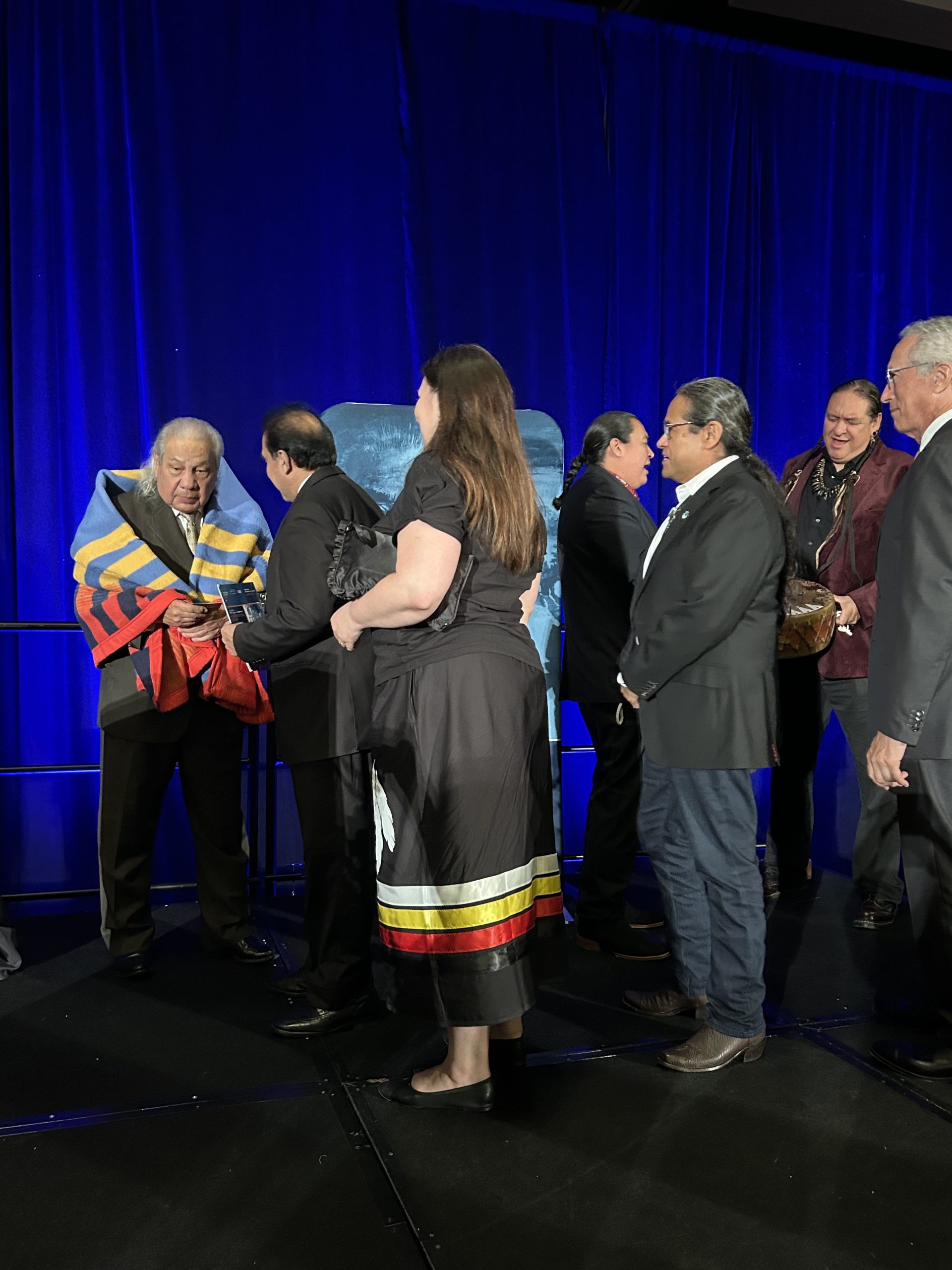
Saturday, the American Bar Association awarded Echohawk the Thurgood Marshall Award at its annual convention. Lawyers, Indian leaders, and family members from across the country joined the celebration of Echohawk’s career. In probably a first for the bar association, Echohawk was wrapped in a robe and then dozens of people lined up to shake his hand.
Echohawk credited his colleagues at NARF and its board of directors. He said NARF’s focus was on protecting sovereignty, natural resources, human rights and our rights to religion and culture. That included “the development of Indian law and educating the public about Indian law policy because really nobody knew anything about that.”
Tenth Circuit Court of Appeals Judge Harris L. Hartz – who grew up as a neighbor of Echohawk in Farmington, New Mexico – said legal advocates are struck by Echohawk’s fairness.
“Everyone who knows John trusts him. I’ll just give one example,” Hartz said. This was early in his career and “he was contacted by, I’ll call it the demonstrators, asking him to come to help resolve the situation. Then he was called by the Department of Justice to go and help resolve the situation. Everybody trusts John. It’s never about him. Perhaps John’s most important quality for leadership is that it’s never about him. He doesn’t show off. He doesn’t brag.”
Mary Smith, president-elect of the American Bar Association, said that it was appropriate that the Thurgood Marshall award go to Echohawk because of their shared dedication to important work. So often when a Supreme Court decision is released, the first question from lawyers is who wrote the opinion. “Because if it was assigned to Justice Thurgood Marshall, you could be pretty sure the case was decided in favor of Indian interests during his time on the court.”
She said Marshall wrote 14 opinions in cases involving federal Indian law.
Echohawk also praised the late justice. “He was a great friend of ours and he understood these civil rights issues for Native Americans and he was really a, a great, a great hero of mine.”
Echohawk cited three examples of the work of NARF. What became known as the Boldt decision, or US v Washington, and the restoration of the Menominee Tribe in Wisconsin and the Maine land claims.
These cases showed that “treaties were not ancient history, they were the supreme law of the land.”
In Maine the state took over tribal lands. Yet the 1790 Non-Intercourse Act said that there could be no transactions unless approved by the United States through treaty.
“So we took that law to court and the court says, yeah, this was the law. And so the state of Maine has to give back all this land they took from the tribes, about two-thirds of the state of Maine. Of course, of course, the state appealed and the, and the court of appeals affirms that yeah, you gotta give that land back. It’s not your land, the illegal theft.”
The case was headed to the Supreme Court when the Jimmy Carter administration got involved.
“Why don’t you folks come to the White House and let’s talk this over because somebody is going to be a big winner and somebody is going to be a big loser and you might want to talk about settling.,” Echohawk recalled. “So we all went and we talked and ended up with a huge settlement for those tribes, they got a lot of their land back, a lot of money, and federal recognition.”
Echohawk said that he resisted signing up as the first Native American executive director of NARF. He was more interested in legal case work than management or fundraising. But the board said no and told him he had to step up.
“So here it is 53 years later,” he said. “I’m still here.”
The American Bar Association has recognized Echohawk’s contributions for a long time. A 2006 essay about him said, “A good lawyer wins cases for clients. A great lawyer wins the law.”

Our stories are worth telling. Our stories are worth sharing. Our stories are worth your support. Contribute $5 or $10 today to help ICT carry out its critical mission. Sign up for ICT’s free newsletter.
