
Kadin Mills
ICT
WASHINGTON – Naelyn Pike was just 13 years old when she testified in front of the U.S. Congress for the first time. She was speaking out against a planned mining project that would destroy her people’s sacred land.
“This has been my entire life,” she told ICT, “to protect the planet, to protect my people’s religious freedom and the environment.”
Twelve years later, Pike, who is enrolled Chiricahua Apache and from the San Carlos Apache Tribe, is once again in the nation’s capital – this time at the U.S. Supreme Court – as Apache Stronghold officially files their case with the nation’s high court.
Apache Stronghold v. United States centers the Apache people’s right to freely practice their religion in their sacred places. Apache Stronghold argues mining will destroy Oak Flat, or Chí’chil Biłdagoteel as it is called in the Apache language. They say this is an infringement on their right to free exercise of religion.
On Sept. 11, members of the Apache Stronghold movement convened in front of the Supreme Court to formally appeal a narrow 2023 decision from the Ninth Circuit Court. The petition asks the justices to reconsider the lower court’s opinion, which held the proposed mining project under Oak Flat does not pose a “substantial burden” to Apache religious exercise. The Ninth Circuit Court of Appeals declined to rehear the case in May 2024.

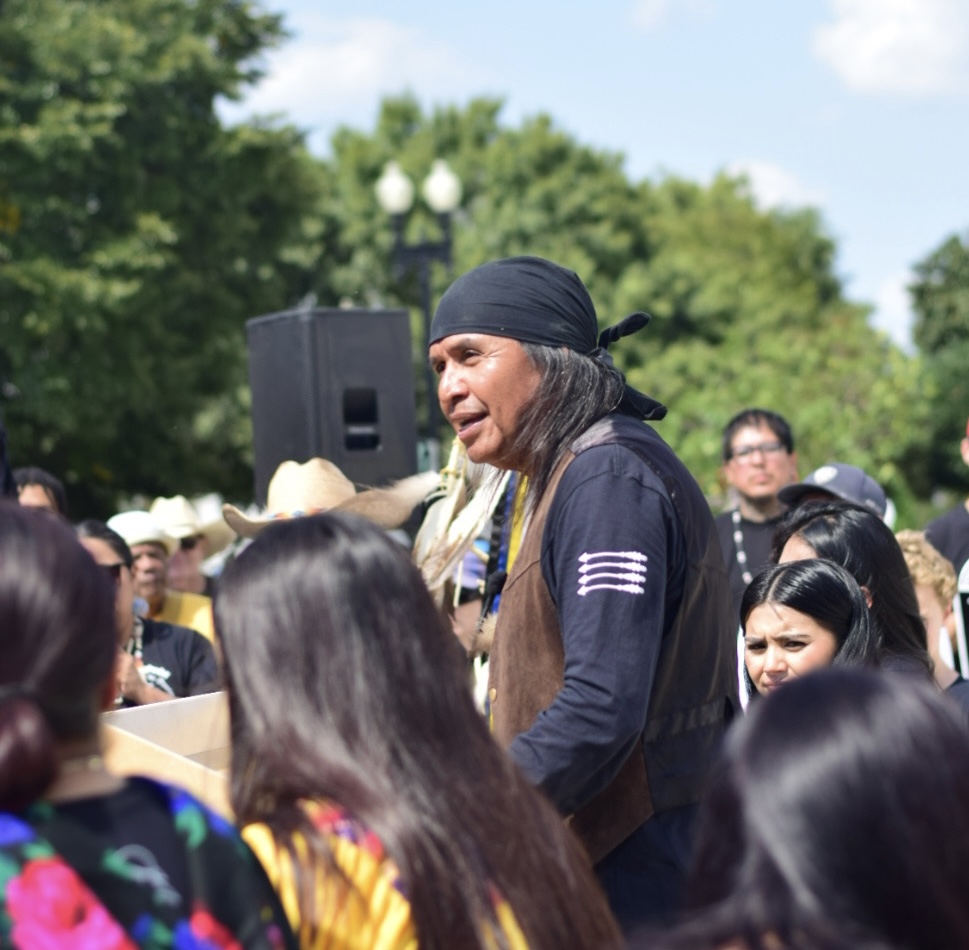
The weekend in Washington marked the end of a two-month-long “prayer journey,” as described by the movement’s leader, Wendsler Nosie Sr., former chairman of the San Carlos Apache. He said people of all faiths need to come together to protect sacred spaces.
Apache Stronghold made 20 stops across the country, meeting with religious and tribal leaders and building solidarity. The Hyattsville Mennonite Church in Maryland hosted members of the Apache Stronghold for a reception on Tuesday Sept. 10. “I love being able to work for justice and gather people to work for justice together,” said the church’s pastor, Cynthia Lapp.
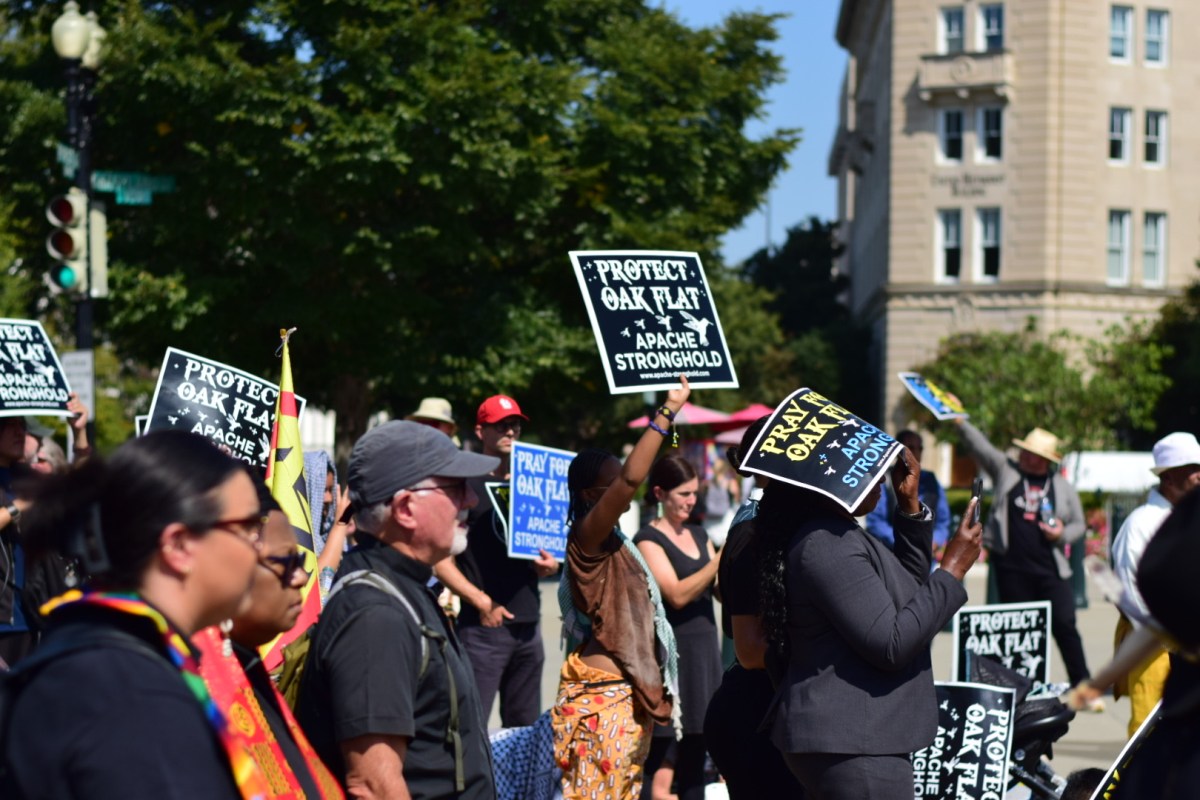
“There is nothing just about taking people’s holy, religious lands,” said Rev. William Barber to the crowd of about 100 people gathered at the Supreme Court Wednesday. Barber is co-chair of the Poor People’s Campaign and founding director of the Center for Public Theology and Public Policy at Yale Divinity School.
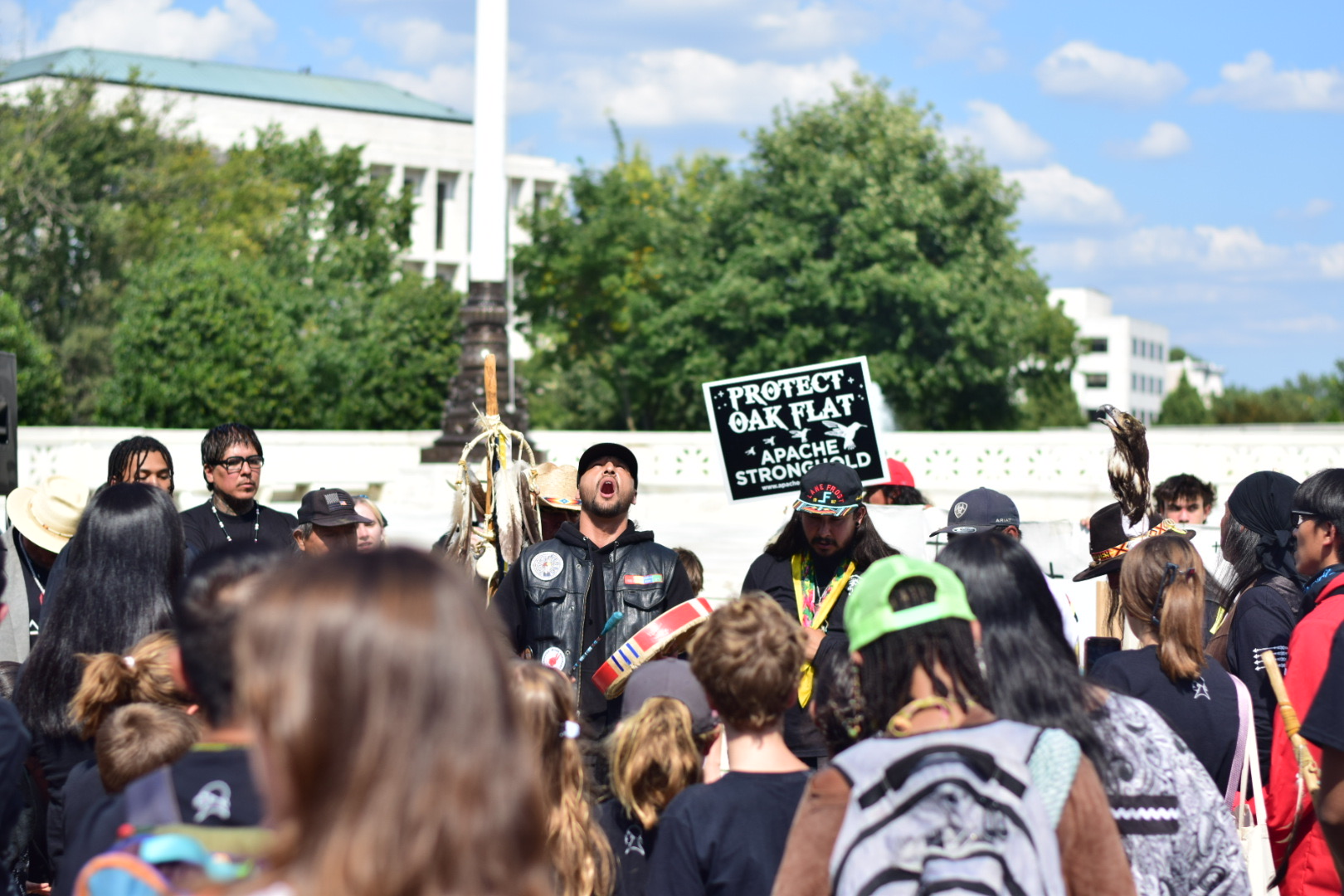

“I guarantee you,” he shouted with a fervor, “nobody would stand for drilling at the National Cathedral.” He compared Oak Flat to Mecca or Mount Sinai.
Attorney for Apache Stronghold Luke Goodrich, vice president and senior counsel at Becket Law, also spoke. “Come December, there’s going to be nine judges looking at those very papers that we just prayed over and filed today,” he said. “What goes on in their hearts is really what’s going to decide how they’re going to act.”
The court is expected to decide whether or not to hear the case by December.
Where the acorn grows, the Apaches go
Named for its abundant Emory oak trees, Oak Flat is sacred to the Apache people, as well as several other tribes. These include the Yavapai-Prescott Indian Tribe, Gila River Indian Community, Salt-River Pima-Maricopa Indian Community, Hopi Tribe, and Pueblo of Zuni Tribe. For the Apache, Emory oak is just one of many important plants growing at Oak Flat.
JoAnn Williams is an elder from the San Carlos Apache tribe. She came to Washington with Apache Stronghold and she remembers picking acorns in the area around Oak Flat as a little girl, but she has never physically been to the holy site.

Williams was raised by her grandparents, who taught her to speak the Apache language. She recalls her grandmother telling her never to speak to strange men. But one night, she went to Oak Flat in a dream and she disobeyed her grandmother’s order.
“In my dream, this guy told me (in Apache), ‘Come on, follow me,’” Williams said.
She followed her intuition and asked, “Where?” The man proceeded to show her the place where the Apache people used to cook and prepare dried medicines.
“Years ago, the Apaches used to live here,” Williams remembers the man told her in her Native language. “So, people say that there’s nothing here, but I’m telling you – I’m showing it to you – because you’re the ones going to tell them,” he told her in the dream.
“And I saw it,” she said.
Located about one hour east of Phoenix in Arizona’s Tonto National Forest, Oak Flat is still a place where Western Apache and other Native people go to attend sweat lodge ceremonies, pray and collect foods and medicines. Songs, dances and other traditions are passed from generation to generation at Chí’chil Biłdagoteel. The Apache deities are also believed to live there, and their religion says it is the place God touched the Earth.

Pike said Oak Flat is a cornerstone of their spirituality, the birthplace of their religion.
In an 1852 Treaty with the Apache, the U.S. government promised to protect Oak Flat in perpetuity. But just 20 years later, many Apache people were forced off their land and onto the San Carlos Indian Reservation. Then in 1955, the land was once again expressly protected from private mining interests by the Eisenhower administration with the expansion of the Tonto National Forest.
Copper was later discovered in the ’90s and mining company Resolution Copper, owned by UK-based Rio Tinto and the Australian BHP Group, has been working to obtain the land ever since.
After several failed attempts by Congress to pass legislation that would transfer roughly 2,400 acres of land – including Oak Flat from the Tonto National Forest – into Resolution Copper’s ownership, Arizona Senators John McCain and Jeff Flake added a bill called the Southeast Arizona Land Exchange and Conservation Act to the annual defense budget for fiscal year 2015.
According to reporting from The Intercept, “The addendum, known as a rider, incurred no congressional debate.” It was signed into law by President Obama on Dec. 14, 2014.
Sen. McCain accepted $7,500 from the Rio Tinto America Political Action Committee during the 2013-14 election cycle, according to data from OpenSecrets. Sen. Flake previously worked as a lobbyist and formerly represented Rössing Uranium Limited, which was majority-owned by Rio Tinto, according to a 2012 report by the Associated Press. Flake did not receive lobbying dollars from Rio Tinto America PAC at the time of the land exchange act. He accepted $4,500 from the PAC between 2005 and 2018.
Protecting Oak Flat – solidarity for religious freedom
Copper is considered a critical material in the transition to greener energy sources and Resolution Copper. Through the land exchange between Resolution Copper and the Tonto National Forest, the mining company would swap nearly 5,500 acres of conservation lands to mine what is believed to be one of the largest undeveloped copper deposits in the world under Oak Flat.
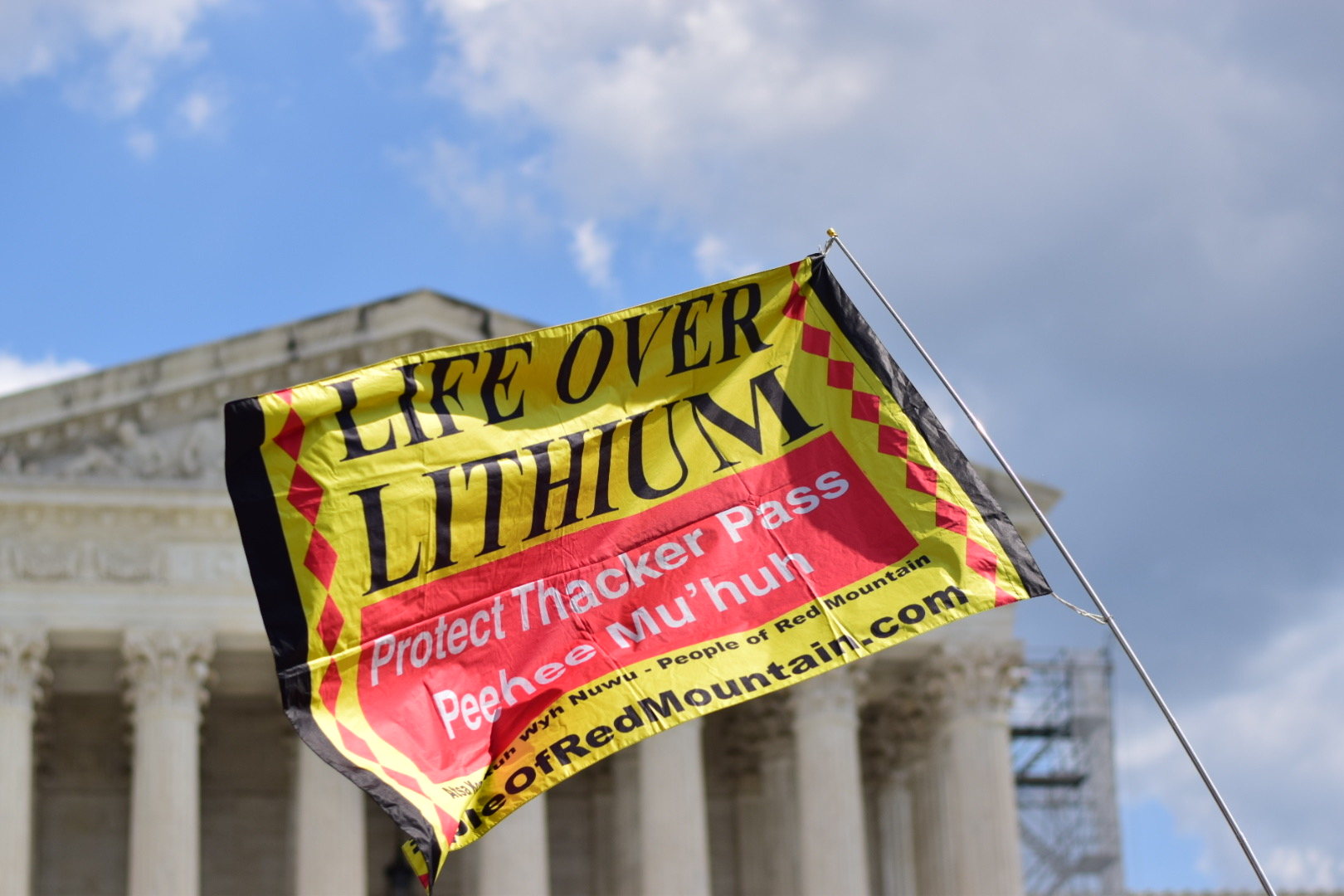
Resolution Copper said the project has the potential to supply up to 25 percent of U.S. copper demand, and has proposed tunneling under the sacred site and using dynamite to blast the ore. The activity would cause the surrounding earth to cave in, forming a crater roughly two miles wide and 1,000 feet deep, which would have a significant impact on the surface flora and fauna.
A technical report from the U.S. Bureau of Land Management also criticized the final environmental impact statement for its lack of consideration of groundwater impacts, stating certain findings “did not meet the analysis standards of (the National Environmental Policy Act).” Others lacked sufficient evaluation or made unsupported conclusions.
The final environmental impact statement was published in January 2021, in the final week of former President Donald Trump’s term. This started the clock on a 60-day deadline to complete the land transfer. After President Joe Biden took office, his administration promptly directed the U.S. Forest Service to rescind the environmental impact statement to continue environmental evaluation and government-to-government relationships with local tribal nations.

In February 2021, Apache Stronghold filed their lawsuit against the federal government in the Arizona District Court, which sided with Resolution Copper. They have continued to fight the issue, taking the case to the Supreme Court.
“It’s very rare for Indigenous rights, and cases like this, to go to the Supreme Court – especially when it comes to our religious freedom,” she said. “So for me, I feel like my ancestors are here with us today, and we’re just carrying on that next fight.”
In an email to ICT, a spokesperson for Resolution Copper said the case is unworthy of Supreme Court review. “This case is about the government’s right to pursue national interests with its own land,” the company said, “an unremarkable and longstanding proposition that the Supreme Court and other courts have consistently reaffirmed.”
Those opposed to the project see the issue differently, saying the decision has lasting ramifications for tribal sovereignty and freedom of religion for all people. Apache Stronghold argues the destruction of Oak Flat is an infringement upon their right to freely practice religion under the Freedom Restoration Act and the Free Exercise Clause. They say the proposed mine also violates the National Environmental Policy Act.

Organizations such as the Religious Freedom Institute and the Mennonite Church USA, as well as numerous other churches and religious groups, have joined the fight to save Oak Flat by submitting amicus briefs in support of Apache Stronghold. Other supporters include Notre Dame Law School’s Religious Liberty Clinic, the Coalition to Dismantle the Doctrine of Discovery, and the Poor People’s Campaign.
Apache Stronghold also has the support of grassroots movements like the Save Chinatown Coalition in Philadelphia and the LA Tenants Union, as well as other Indigenous movements. Organizers from each joined the prayer journey to Washington, led by Nosie.
The San Carlos Apache Tribe, under the leadership of Chairman Terry Rambler, continues to oppose the land transfer between the U.S. and Resolution Copper. In 2021, the White Mountain Apache Tribe also reaffirmed its opposition to the deal. Former Chairwoman Gwendena Lee-Gatewood said, “We truly are a family. In solidarity we stand with our sister tribe – the San Carlos Apaches,” according to a press release.
The next Supreme Court term will begin Oct. 7. The justices will meet in the final week of September to discuss any additional cases to the upcoming docket. If the Court accepts Apache Stronghold v. United States, oral arguments will likely take place in January or February, 2025, and a decision will be made by summer.

ICT is owned by IndiJ Public Media, a nonprofit news organization. Will you support our work? All of our content is free. There are no subscriptions or costs. And we have hired more Native journalists in the past year than any news organization ─ and with your help we will continue to grow and create career paths for our people. Support ICT for as little as $10. Sign up for ICT’s free newsletter.
