
Mark Wagner
Special to ICT
MESCALERO, New Mexico — Skiing was clearly not a popular pastime for Apache tribal members in 1963.
As far as anyone can recall, not a single Apache tribal member even knew how to ski, said Sarah Kazhe, whose father served on the tribal council at the time.
Nevertheless, with the Mescalaro Apache Tribe facing heavy poverty and high unemployment, then-Tribal Chairman Wendell Chino convinced the oil man who built the nearby Sierra Blanca Ski Resort to sell the tribe the ski area at a considerable loss.
It was a move that steered the Mescaleros into the hospitality and tourism business in a way that no tribe had ventured before. Under Chino’s vision and leadership, the tribe had expanded by the mid-1970s with the Inn of the Mountain Gods, including a ski and hunting lodge, a recreational lake and groundbreaking golf course designed by Ted Robinson Sr. that is now known as the “Birthplace of Native American Golf.”
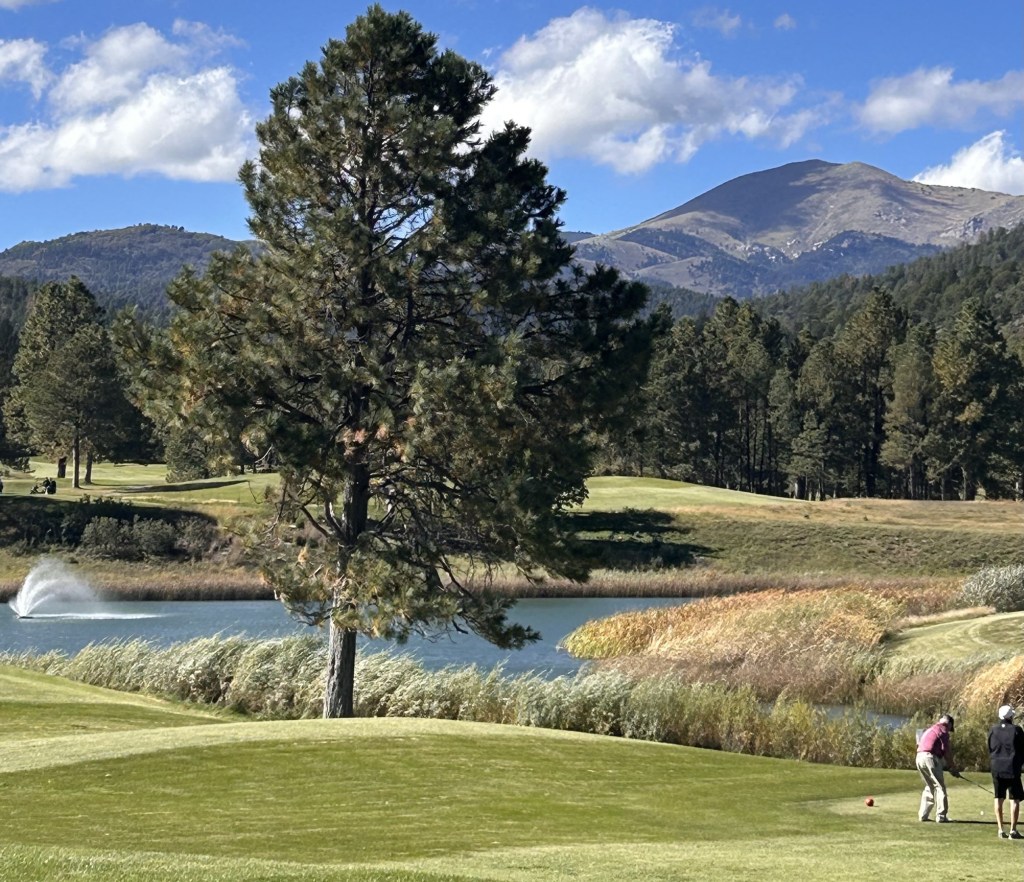
Against all odds, and despite the fact no Apache was known to have grown up skiing or playing golf at the time, the resort marked its 50th anniversary in 2025, with the golf course celebrating the anniversary this year of its completion in 1976.
Today, the Inn of the Mountain Gods Resort and Casino has nearly 300 rooms and suites, 38,000 square feet of gaming space and a convention or meeting capacity for up to 3,000, with the lake and championship golf course. The numbers of golfers and other visitors each year are not publicly available, but Ski Apache alone is reported to handle about 300,000 visitors per year.
‘A champion story’
The visionary Chino served as tribal chairman from 1955 to 1965 and then as president for more than 30 years, from 1965 until his death in 1998.
With the tribe’s purchase of the ski resort in 1963, Chino worked closely over the next decade with Kazhe’s father, Peter Khaze, and others, to develop plans for the ski and hunting lodge, golf course, hotel, convention center and casino. The tribe had a winter income from the ski operation, but officials wanted to bring in summer tourists as well.
The plans developed a hitch, however, after the tribe hired Ted Robinson Sr. to build a golf course to grace the hillsides and ponderosa forest of the Sacramento Mountains. Robinson was the “King of Waterscapes,” with designs known the world over for naturalistic and playable courses built around water features.
Chino and Robinson then came up with a new idea: Why not build a lake along with the golf course?
Mescalero Lake is now a 144-acre, man-made reservoir that physically centers the resort. Horse trails mark the bulwark trails to the east of the resort that dammed the water of Carrizo and Cienegita creeks. The water is stocked with trout for fishing, and kayaking is a recreational feature of the resort.
At night, the breathy and haunting calls of loons give voice to the night. During the day, gunshots from the nearby Apache Hunting Lodge startle the calls of the crows, some of which are as large as eagles.
“Our story has value in it,” Sarah Kazhe told ICT. “We still know how to fish and how to hunt. We know how to survive and persevere and live in an ever-changing world. We can do that and still hold onto our identity. Our story is a champion story.”
In addition to the traditional lifestyles of hunting and fishing, Kazhe notes, “We know how to sit around a campfire and tell stories. Those traditions are passed down. Yes, we need to evolve, but we also have not lost our identity.”
That identity thrives on what today is a territory in south-central New Mexico that covers about 463,000 acres.
‘Red Capitalism’
On any given night at the dinner hour, the Great Hall fills with travelers pulling travel bags and golf bags. Wendell’s, a restaurant named for Chino, bustles with folks prepared to dine on Indigenous-inspired foods. The late sunlight fills the valley with gold aspen and clear blue skies.
While the number of people who remember Chino and his visionary ways has steadily dwindled, Emmaline Botella, a tribal member who has worked at the resort for 35 years, remembers Chino well.
“There was something about him that made you listen,” she said. She herself went from being a waitress to holding many roles. She now works as a senior accountant for the resort, and her family’s history parallels the economic evolution of the tribe and feathers into Mescalero history in historic ways.
Hugh Chee, Botella’s great-grandfather, was a scout for Geronimo and served time with him and others imprisoned at Fort Sill. When they were released in 1913, the Chiricahua were invited to join the Apache in Mescalero. The Lipan Apache had joined the reservation in 1903.
While Geronimo would not make it back to the homeland, Botella’s grandparents did. They settled in Whitetail on the southern side of the territory, near the large tribal cattle ranch that still operates today. Botella grew up working at the resort.
“Some people talk, but it’s hard to listen to them,” she said. “Mr. Chino was someone you wanted to listen to.”
Sarah Kazhe also remembers Chino as having a drive and vision that live on today.
“Following Chino’s passing, my father created the Wendell Chino Golf Classic to honor him,” Kazhe said. “The tournament was later retired and replaced by the Mescalero Invitational Golf Tournament.” That tournament was eventually folded into other events at the golf course.
Chino coined the term “Red Capitalism” to reflect an Indigenous approach to building the economy. Kazhe said she understands the concept, and notes that his vision for full employment is still very much the tribe’s legacy.
She points to a comment Chino was fond of saying.
“The Navajos make rugs, the Pueblos make pottery, and the Mescaleros make money,” he would say.
Growing demand
Golfers are obsessed with origins. Like salmon, they swim upstream to find where things began.
Since 1975, the year Inn of the Mountain Gods opened, Native golf has gone through considerable growth. Today, about 70 tribes own and operate courses, and a number of Native players thrive at the professional and collegiate level.
Acclaimed Native golfer Notah Begay lll won the Wendell Chino Open tournament at a young age. Robert Komahcheet ll, Comanche, won the tournament when he was 23. And while these early Native tournaments and successes may have been seeded at the Inn of the Mountain Gods, Native golf and golfers have evolved beyond the Sacramento Mountains since 1975.
Many other Native players have now reached a high level, including Steve McDonald, Potawatomi; Gene Webster Jr., Ojibwe, Oneida, and Navajo; Beans Factor, Chickasaw; Ricky Fowler, Navajo; and Skyesong Alexis, Sioux. This year, Gabby Barker, Shoshone-Paiute, had her first professional win and, like Aidan Thomas, Laguna Pueblo, is closing in on a tour card, a certification that allows play on a professional tour.
There are also now dozens of Native-owned, destination courses, designed by the best architects, and some, such as Circling Raven in Idaho and Wildhorse in Oregon, have developed relationships with the Ladies Professional Golf Association. All regularly hold successful Native and non-Native tournaments, and host travelers from around the world.
The Inn of the Mountain Gods golf course is discussed in hushed and reverent tones, developed well before gaming began to draw in the revenues necessary to design and run a golf course.
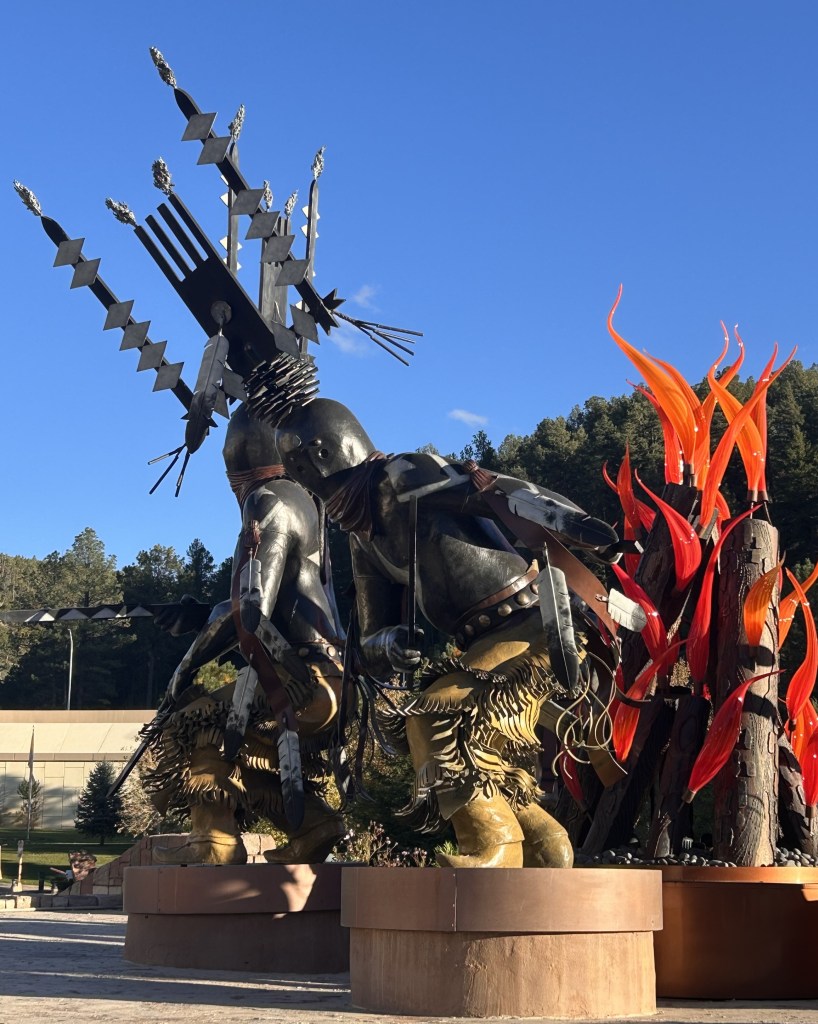
On a recent visit, having passed by the statue of the Spirit Dancers that guard the entrance, and coming through the Great Hall and glancing out at Mescalero Lake, a visitor’s eyes are drawn to the island green that punctuates the landscape.
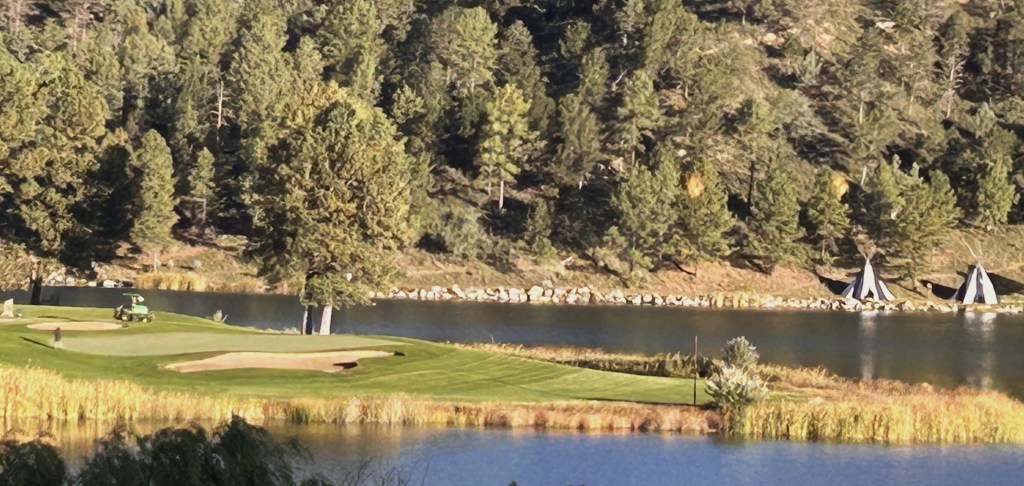
Nestled beneath the gaze of Sierra Blanca and framed by the deep blue waters of the lake, the island balances the gold, blue and green colors in a way that speaks to one of the purest design features of golf course architecture — the feature of the risk and reward.
A bad shot is not just off the fairway, or short or long. It’s gone, into the water.
On a recent day, a gentleman from El Paso — which is a short, two-hour drive from the resort — had come with his wife to gamble and play golf.
He mentioned that during his last visit, three years earlier, he had been with his brother Larry, who has since died. The man said he’d never successfully made it over the water on the island green, but on this day he did — a soft line drive that carried over the broom grass and blue water.
“That was for Larry,” he said, with soft but considerable pride.
A sacred peak
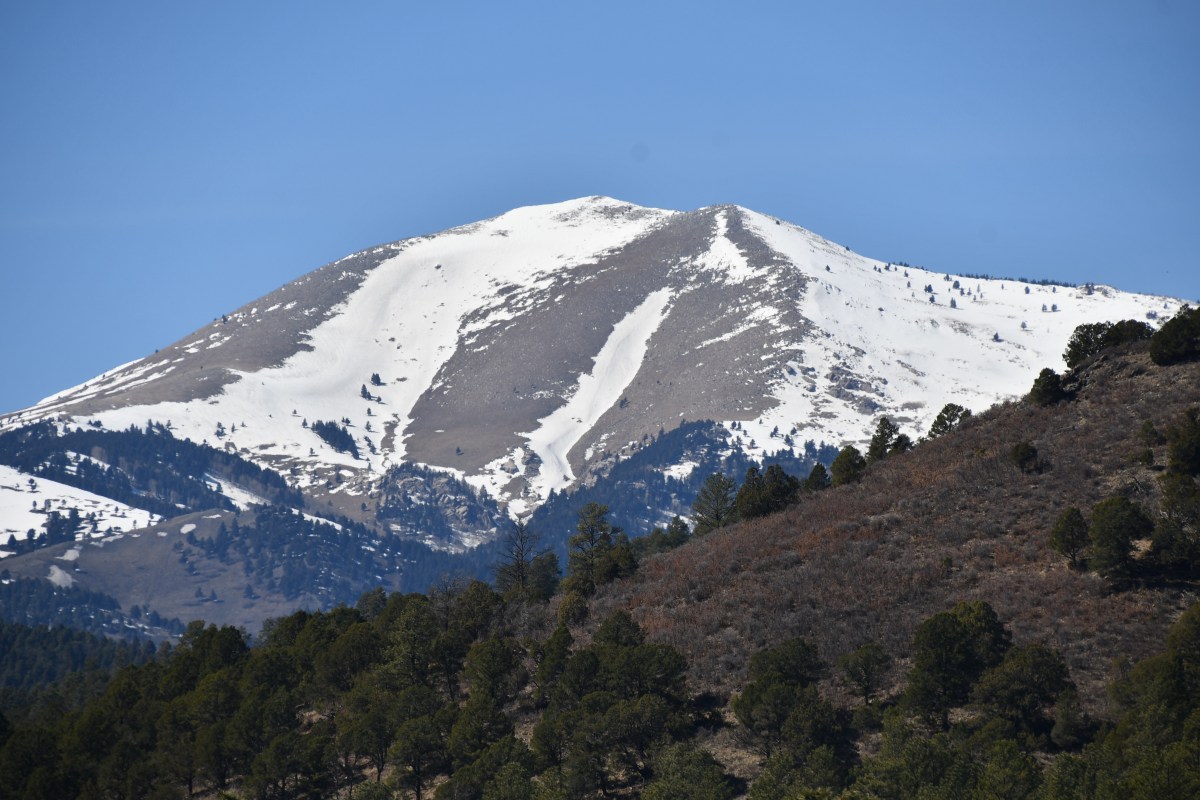
The Apache call Sierra Blanca Dził Gais’ą́ní — the sacred mountain — and the bald, high peak guards the northern wall of the valley surrounding Mescalero Lake.
At certain times of year, with a light snow, the face of an elder appears on the northeast slope. It’s said to be the man who lives in the mountain to protect the Mescaleros, who have been living in the hills since before recorded time.
That same spirit is represented at the entrance to the Inn of the Mountain Gods — a dramatic statue of the five Ga’an dancers — the Crown Dancers, the mountain gods. At the cultural learning center, a visitor learns that of the five Crown Dancers, one is called the Clown, or Messenger. The Clown Dancer is considered the most powerful of the five, the “boss.” He is both fierce but can bring relief and laughter.
Bobby Jones — one of the finest golfers and course designers in history — famously said, “On the golf course, a man may be a dogged victim of inexorable fate, be struck down by an appalling stroke of tragedy, become the hero of an unbelievable melodrama, or the clown in a side-splitting comedy — any of these within a few hours, and all without having to bury a corpse or repair a tangled personality.”
Seems the game of golf at Inn of the Mountain Gods is ruled by gods who distribute a varied menu of fates, including comedy. Bobby Jones did not live long enough to play at Inn of the Mountain Gods, but if he had, the Clown Dancer might well have had a message or two for him.
The island green and its waters await all comers.
