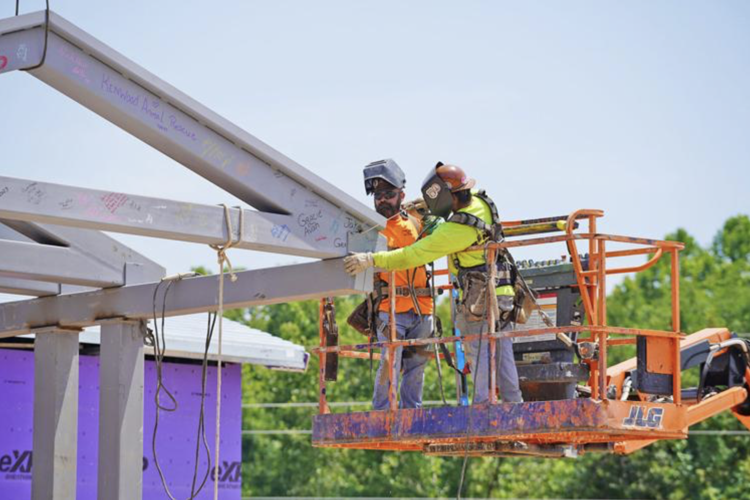
TAHLEQUAH – The Cherokee Nation is currently witnessing a surge in construction activity. With funding exceeding $1.17 billion, numerous projects across a spectrum of initiatives, including health, education, and language preservation, are underway.
Jon Asbill, director of infrastructure and development, pointed to the openings of community centers in Kenwood and Marble City and other work being undertaken.
“There’s a variety of projects that are under construction and will be completed,” Asbill said. “The thing that’s really driving this is some of the timing with ARPA – the American Rescue Plan Act – and for the most part, this round of projects has to be completed by 2026.”
The projects also benefit from other revenue, including the recent $75 million opioid settlement.
“We’re investing in our communities,” Asbill said. “You see the community center projects. You see a lot of wellness center type projects. You get the community focus component; the housing focus component that Mr. (Todd) Enlow is tackling at the (CN) Housing Authority. And then you also have the health piece where we’re building the new hospital (in Tahlequah) and new clinic in Salina. We’ve updated, to some degree, every clinic we have over the last 18 months or so. There’s a ton of work going on out there.”
Principal Chief Chuck Hoskin Jr. said the influx of funding is “unprecedented and historic.”
“Of course, we can, as a government, make choices how we spend that, but I think investing in these capital projects is part of how we make generational impact,” Hoskin said. “That’s what the deputy chief (Bryan Warner) and I want to do with the administration and the Tribal Council members feel the same way.”
Hoskin mentioned passage of the Durbin Feeling Language Preservation Act as a priority that was carried further by the augmented funding, resulting in an expansion of the language program into Greasy, and meeting the demands of public safety entailed with the acknowledgement of tribal sovereignty in the McGirt decision.
Several projects were conceived many years ago.
“Those are things that were, I think, the vision of many people – not just the deputy chief and I – and the dreams of people that have served in these offices,” Hoskin said. “But to get to have the resources to do it now is important. Then we’re meeting some challenges and the timing is just incredible. The opportunities created by McGirt commands a lot of our attention, and this is an opportunity to build up our law enforcement and criminal justice infrastructure – and it includes victim services infrastructure.”
Warner said the projects can even address small issues, and often benefit people who are not members of the CN.
“Our parks, these places, quality of life is important,” Warner said. “ARPA dollars have been able to fund clean sanitary restrooms for places that would have had to wait on its budget for a year where the budget is favorable for somebody to put in a new bathroom at an old park. That’s stuff that people usually don’t think about.”
The application of ARPA and other funding to so many projects requires the dedication and hard work of many people, Warner said.
“I’m proud and humbled to be just a small piece,” he said. “It’s the sum total of all the little things that every Cherokee that works for the tribe does every day that really makes that big wheel turn. I promise you the individuals that are in the trenches are still turning and churning. These big capital investments – they deserve it. It is what is needed, and it’s absolutely paramount for us to launch into the future.”
Project priorities and the money allocated:
Community $67,762,616
Education $194,411,566
Government $124,209,921
Health $551,084,111
Human Services $76,466,014
Career Services $10,000,000
Infrastructure $3,100,000
Language $63,200,000
Law Enforcement $2,700,000
Wellness $83,357,215
Total $1,176,291,443