
Sandra Hale Schulman
Special to ICT
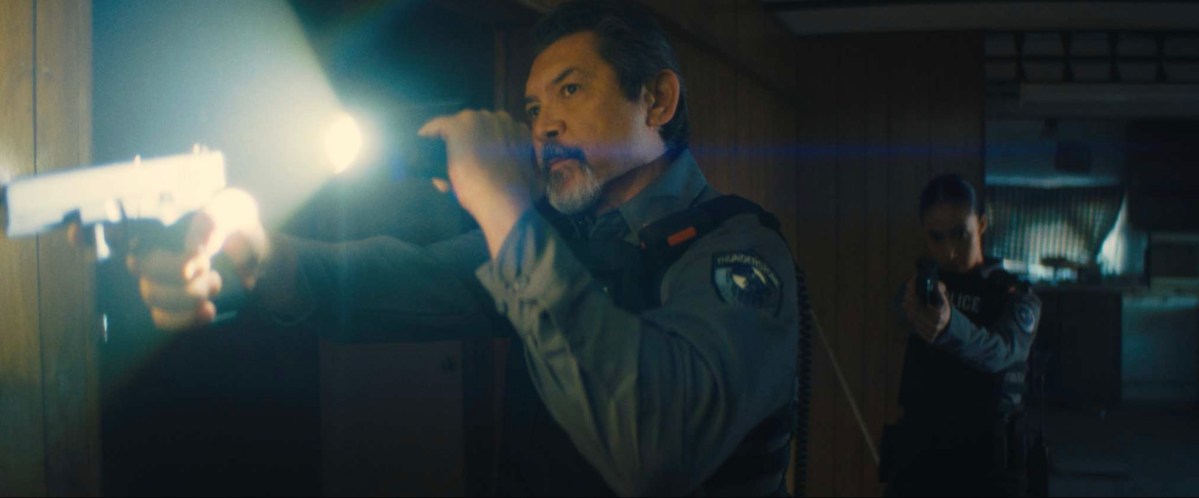
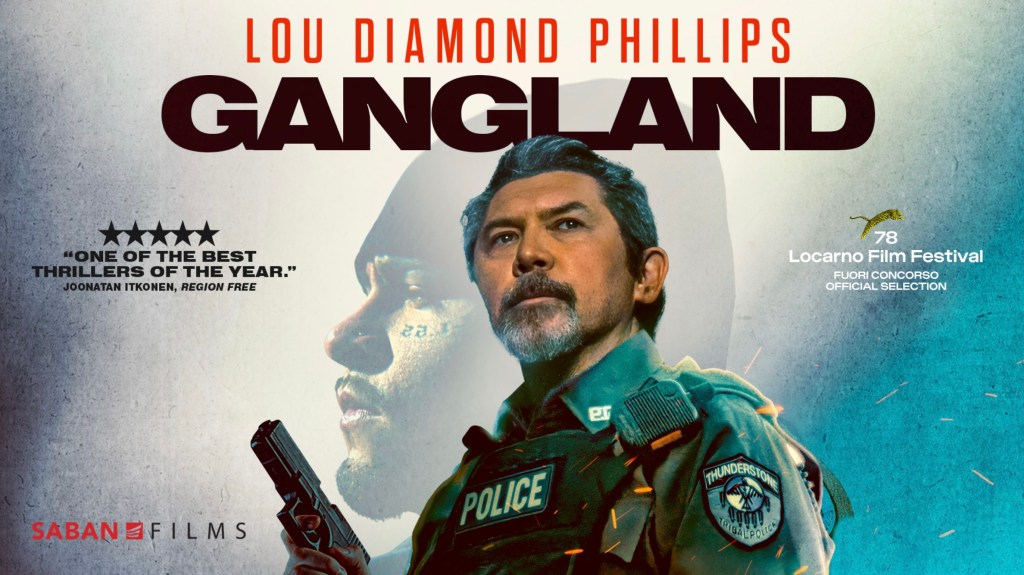
In one of his strongest roles yet, actor Lou Diamond Phillips plays a haunted police officer taking on tribal violence in the crime thriller, “Gangland.”
Phillips, who is Filipino/Scottish/Cherokee, plays tribal Officer Teddy Sharpe as he trains rookie cop Dana Namerode, played by Sandra Scala, during a volatile time on a fictional drug-plagued reservation.
A recently released felon, Richie Blacklance, stirs up trouble when he returns to settle old gang-related scores. His actions ignite a gang war, forcing Sharpe into a collision of the law and his own past. Blacklance is played by actor Elisha Pratt, Pawnee, who also appeared in “Killers of the Flower Moon” and “True Detective.”
“It’s an amazing film,” Phillips, who served as executive producer on the film, told ICT. “And the response to it has been incredibly uniform and consistent. People are very touched, very moved by this. It’s incredibly thought-provoking.”

It was filmed across parts of eastern Oklahoma City and on Cheyenne and Arapaho lands, though the location remains anonymous in the film.
“Gangland” includes a broad cast of Indigenous actors. In addition to Pratt, the film includes Lane Factor, Muscogee (Creek); Michael Tubby, Choctaw; and James Whitecloud, also Muscogee (Creek).
“Elisha is a great guy, he is a real discovery in this role,” Phillips said. ”I sincerely hope that this film is a platform for him to go on and get many, many more opportunities. Because not only is he a fantastic actor, he’s a lovely human being. The same is true for the entire cast …so many fantastic indigenous roles in this.”
“Gangland” is now streaming on Apple TV and Prime Video. Phillips has been touring film festivals with “Gangland,” with screenings at the Santa Fe Indian Market, the Soho International Film Festival on Oct. 12, and at the Red Nation Film Festival in Los Angeles, where he is set to receive a Lifetime Achievement Award Nov. 14 in Beverly Hills.
Cultural advisor
Phillips said the film was shot in just 18 days, with his portion of the film taking up 15 days. It was directed by Vincent Grashow, who is not Native.
“The thing that I think people don’t realize is how difficult it was to get this movie made,” Phillips said, “and how difficult it was to get it out there. …. Our schedule was literally just down to the minute. Vincent Grashow was an amazing director who literally got the last juice out of the headstone.”
“Gangland” brought in cultural advisor Marcus Red Thunder to help on the Cheyenne reservation set to make sure that everything was portrayed as it should be. Red Thunder also served as co-producer and tech supervisor on the film.
“They were kind enough to allow me to be an executive producer on this,” Phillips said, “so I was able to have input creatively on the film. One of the first things that I did after I read this script was, I asked that we run the script by my friend Marcus Red Thunder, a Native Wellness trainer with over 25 years of experience working directly with urban and reservation communities. Marcus had been my technical advisor on ‘Longmire’ for six years. I was impressed with what Marcus brought to the table as far as keeping things authentic and keeping things real and respectful.”
Phillips said Red Thunder knows the challenges of producing a full-length, feature film.
“Marcus has a great understanding of what it takes to make a movie or a television series,” Phillips said. “This is his line — he goes, ‘Well, we’re not making a documentary.’ So there are times for the plot or for the dramatic nature of the piece to not 100 percent adhere to what you would in a documentary.”
“And as a result, it was his suggestion to make the reservation fictional and not place it on any one specific reservation,” Phillips said. “We never mention the tribe. We never mentioned the state that it’s in. Because the themes in this are incredibly universal.”
Screenwriter Zach Montague is an actual tribal officer in Canada, so brought realism to the story, Phillips said.
“I’ve done a lot of films that could be viewed as niche,” Phillips said, “whether it’s ‘La Bamba’ or ‘Stand and Deliver,’ about a very specific community. You realize that the themes and the story are so universal that it touches everyone. Everyone can relate to it — the problems of gangs and the violence on the reservations and the teen drug use and the suicide.”
A central theme
Phillips’ character at times acts antagonistic to the female rookie as he wrangles with the violence.
“People have asked me what attracted me to this role,” Phillips said. “And it’s, I know this guy. Not only that, I know this life. I’ve played so many cops … In our first scene together, he really comes across as an in-your-face asshole. But there’s a method to his madness and you start to understand that eventually.”
Phillips said it soon becomes clear why the cop is being so harsh.
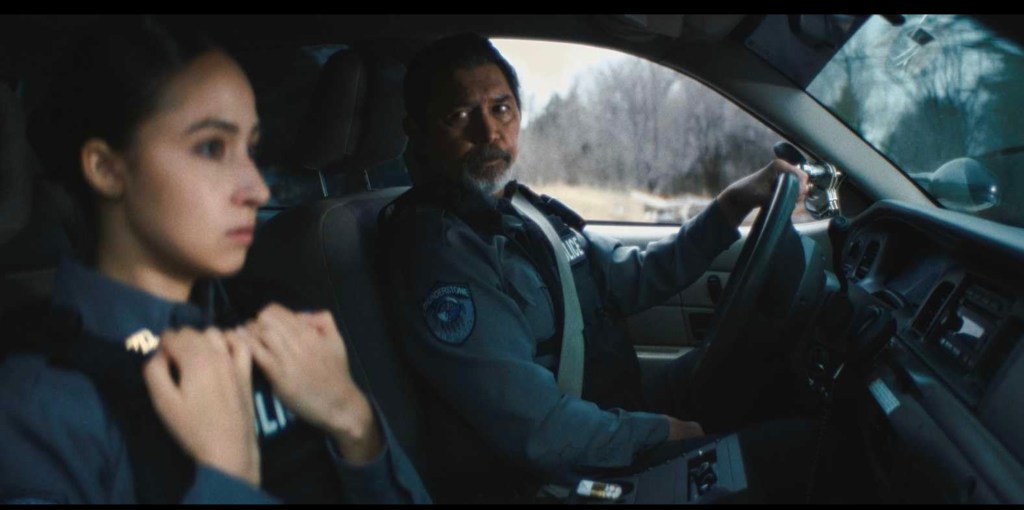
“He comes on strong because he is testing her. He is seeing how much she can take,” he said. “And also whether she has the backbone and the mettle to take on this very, very difficult job. I think we learn as the movie goes on that he is hiring her specifically because he needs somebody with compassion. He needs somebody who understands people’s motivations and their way of life, because she’s a little broken herself.”
A particularly powerful scene happened by chance off-script and before shooting started. The scene features Sharpe as he drives, mesmerized, by a large herd of bison, moving like waves across a misty field.
The filmmakers came upon the 600-head bison herd accidentally while they were scouting the location on Cheyenne and Arapaho land in Oklahoma.
The writers called Phillips and asked if he could come out a few days early to shoot the scene with the buffalo.
“What’s amazing to me is that little scene turns out to be such an important scene to the arc and the heart of the character,” he said. “Because it is about redemption. It is about surviving and just resilience in the face of mere extinction. That is how symbolic that scene has become. To me, it’s a real turning point for Teddy, my character in the movie ,,, a really powerful scene.”
Without giving too much away, the ending is dark and unexpected. Did Phillips feel that was appropriate? Or just reality?
“Vincent Grenshaw is a very honest director,” Phillips said. “He’s gloves off, what does it take to tell the story? The more I got into the script and the more I understood Teddy, you have to understand that there’s more to Teddy than the tough drill sergeant, old bull cop. He carries such a burden. He carries such guilt and a weight about him, yet gets up every morning, puts on his boots and goes and does his job.”
“But for Teddy,” he said, “he’s haunted by things that have happened in his past and he’s been a perennial outsider because he’s not Indigenous. He married into the tribe so he has that deep desire of his, that need of his to not only protect and serve this community but to be accepted by it … I never question where the movie goes. It makes a lot of sense to me. It’s poetic. It’s somewhat Shakespearean.”
‘Young Guns 3’ locked and loading
Beyond promoting “Gangland,” Phillips had a recent reunion with the original cast members of the “Young Guns” 1 and 2 films, including Emilio Estevez, Kiefer Sutherland, Dermot Mulroney and Christian Slater.
He said there may be a “‘Young Guns 3.”
“We had a ‘Young Guns’ reunion for the first time in 38 years with all six of the original cast,” Phillips said. ”We’ve been trying to get a third film off the ground for a couple of years now. I’ve read the script. It is fantastic. So God willing, that’s going to happen next year. A lot of people are going to see us back in the Santa Fe area to film.”
Phillips played the Mexican/Indigenous regulator, a young gun-slinging cowhand, Jose Chavez, who gets taunted in the ‘Young Guns’ films, called “Chief” and made fun of for his spiritual beliefs, exhibiting a lot of racism in those films.
“There is,” Phillips acknowledged. “And once again, just a character to me who’s very aspirational, he ends up being the spiritual center of both films. He really is the only one with a very clear moral compass. I love that. And to be quite honest, Emilio Estevez and writer John Fusco, who had a hand in the script as well, they lean into that in the third one. I love where Chavez goes in the potential third film. It brings it up to our ages now. So chronologically and historically, that puts us in the middle of the Mexican Civil War, and Pancho Villa is a character in the beginning of the third film.”
“It’s exciting because it is still based in historical fact and historical supposition, if you will, that Brushy Bill Roberts was actually Billy the Kid,” he said. “Up until the time he died, he was attempting to prove that he was Billy the Kid and that he deserved to get the pardon that the governor had promised him. That plays a part in the next script.”

