Miles Morrisseau
ICT
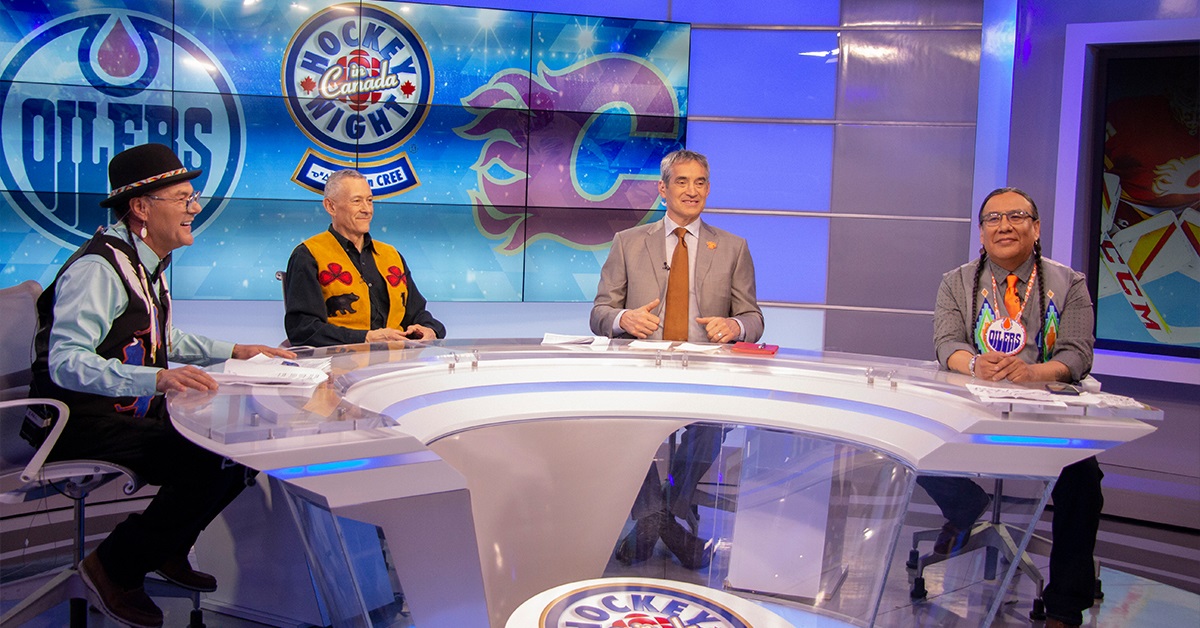
Shouts of “kitāskwēw, pihtikwahēw” are heard on television screens across Canada when the country’s unofficial national pastime is being broadcast in the Cree language.
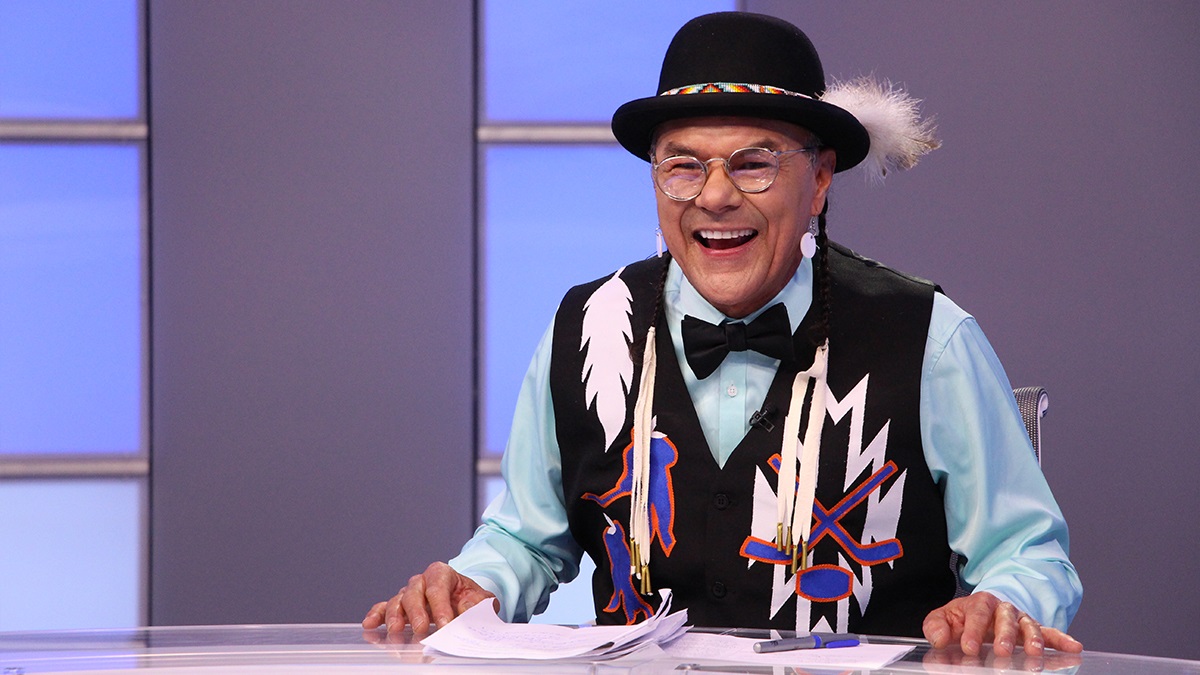
A translation of the very familiar hockey phrase, “He shoots – He scores,” it is one of the many descriptives uttered with great enthusiasm by studio host Earl Wood, Saddle Lake Cree Nation, in the special “Hockey Night in Cree” program on the Aboriginal Peoples Television Network, APTN, in Canada.
The show features all seven Canadian National Hockey League teams in a five-game broadcast series ending on April 1.
SUPPORT INDIGENOUS JOURNALISM. CONTRIBUTE TODAY.
To say that Wood brings dynamic energy would be an understatement. He has passion for the game and for the language.
“The profound aspect of it is, you feel like your part of a storm of coherency,” Wood told ICT. “That revitalization and the interest in the language has gone up exponentially, bringing it to a format recognized in popular sports entertainment such as hockey.”
Mike Omelus, the non-Native executive director of content and strategy for APTN, believes that “Hockey Night in Cree” is part of the reconciliation movement in Canada.
“The federal government in Canada created a national statutory holiday a couple of years ago, the National Day for Truth and Reconciliation,” Omelus told ICT. “And because of that and other initiatives that APTN and others have undertaken, there is a deepened understanding and more of a willingness to try to reconcile relationships and write historical wrongs.
“And hockey’s part of that,” he said. “It’s bringing people together. It’s positive. It’s uplifting. And, you know, I think it’s helping bring us further down the path towards reconciliation.”
Three-year deal
A version of “Hockey Night in Cree” debuted on APTN in 2019 when Canada’s national Indigenous broadcaster partnered with Rogers Sportsnet, which owns the NHL broadcasting rights in Canada.
The programming resulted in a three-year deal between the networks that is set to end this year.
The broadcast is filled with features on Indigenous hockey players past and present and stories on difficult subjects that need to be discussed on the path toward reconciliation in Canada, including the horrific history of the Indian Residential School system in Canada.
Wood is joined on the broadcast by play-by-play announcer Clarence Iron, Plains Cree, who brings an old-school energy that suits the speed and excitement of the fastest game on ice.
Providing game analysis in Cree is Jason Chamakese, Pelican Lake First Nation, who is an award-winning Native flutist in addition to being a language advocate. Game analysis in English is provided by former NHL player John Chabot, Kitingan Zibi Algonquin, who played eight seasons in the NHL and finished off his professional career in Europe playing for 11 seasons.
Wood believes the language lives inside Indigenous peoples, and that they just need to hear it more often in our overstimulated modern society.
“Our young people are inundated, and they’re bombarded by social expectations, technology,” he said. “And the Creator gave us something a long time ago as individuals and our stories go right back to the beginning.
“It’s in our DNA, we all have that collective genetic memory,” he said. “So the language is embedded in all of us, all we have to do is water it and wake it up a little bit and help it grow.”
Wood believes the broadcast is building interest in Indigenous languages in his own communities and in non-Indigenous communities.
“Part of our mission is to try to help and equip the next generation with all that we have from our Indigenous worldview and who we are as Indigenous people,” Wood said. “I’ve seen a lot of interest in the language, regarding even the terminology. I see a bridging between non-Natives and Natives through hockey and by utilizing our language.”
What’s ahead
Omelus is hoping that the partnership with the NHL can continue.
“We haven’t had those discussions with Rogers,” he told ICT. “Obviously, they are the primary rights holder for hockey in Canada with the NHL. But we’re going to be starting those discussions soon.”
He’d like to see an expansion of the program.
“I would love to see us be able to do games in additional Indigenous languages,” he said.
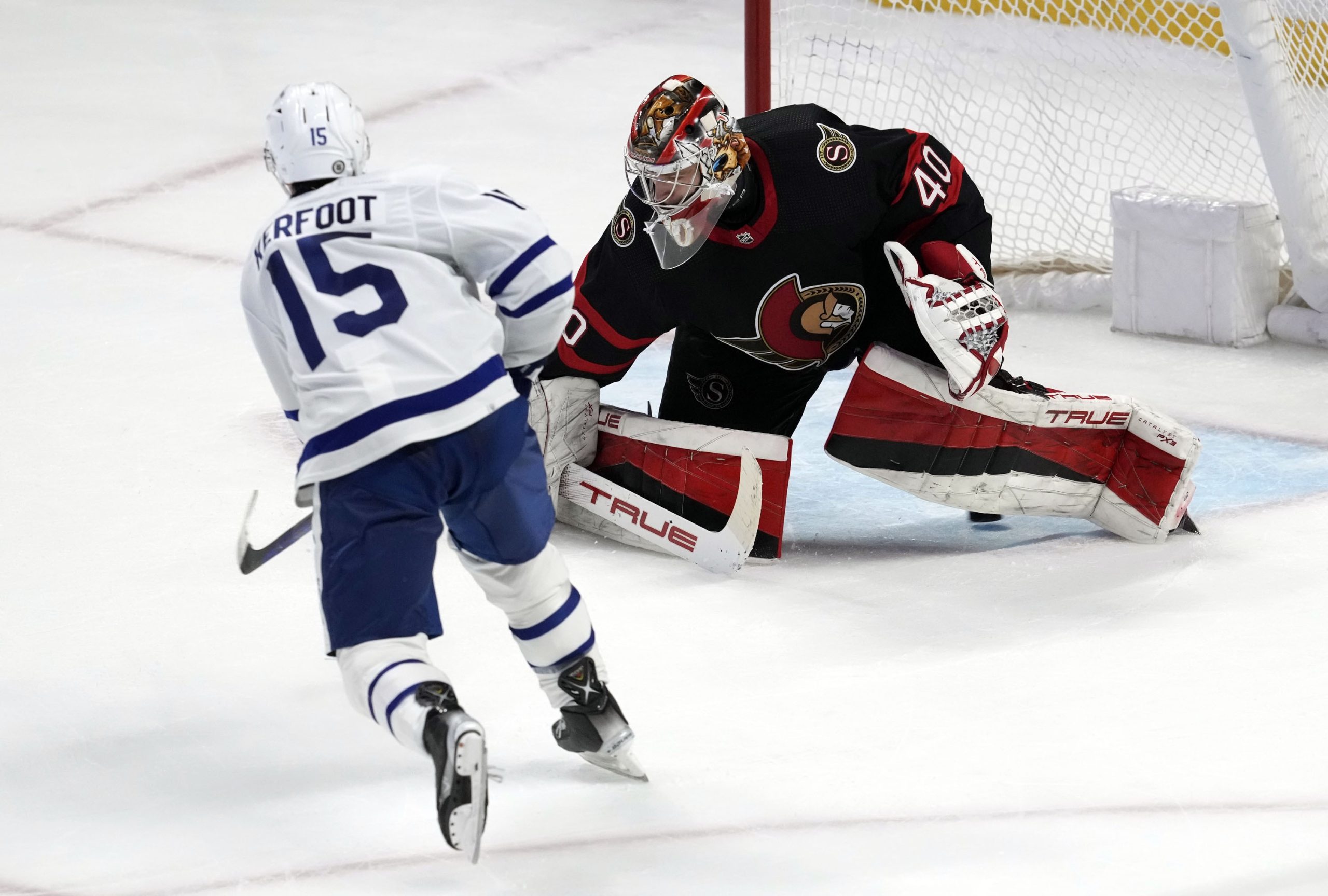
The season’s action will wind up April 1 in the Canadian capital with the latest installment of the Battle of Ontario, as the Toronto Maple Leafs head to Ottawa to take on the Senators. Should be a good one.

Our stories are worth telling. Our stories are worth sharing. Our stories are worth your support. Contribute $5 or $10 today to help ICT carry out its critical mission. Sign up for ICT’s free newsletter.